Craftsman SB410 Electric Start Not Working: 120V Cord, GFI or Starter Path?
An exact-chassis SB410 electric-start diagnosis that separates a dead 120V starter path from an engine that cranks normally but will not fire, without bypassing grounding or replacing fuel parts for an electrical symptom.
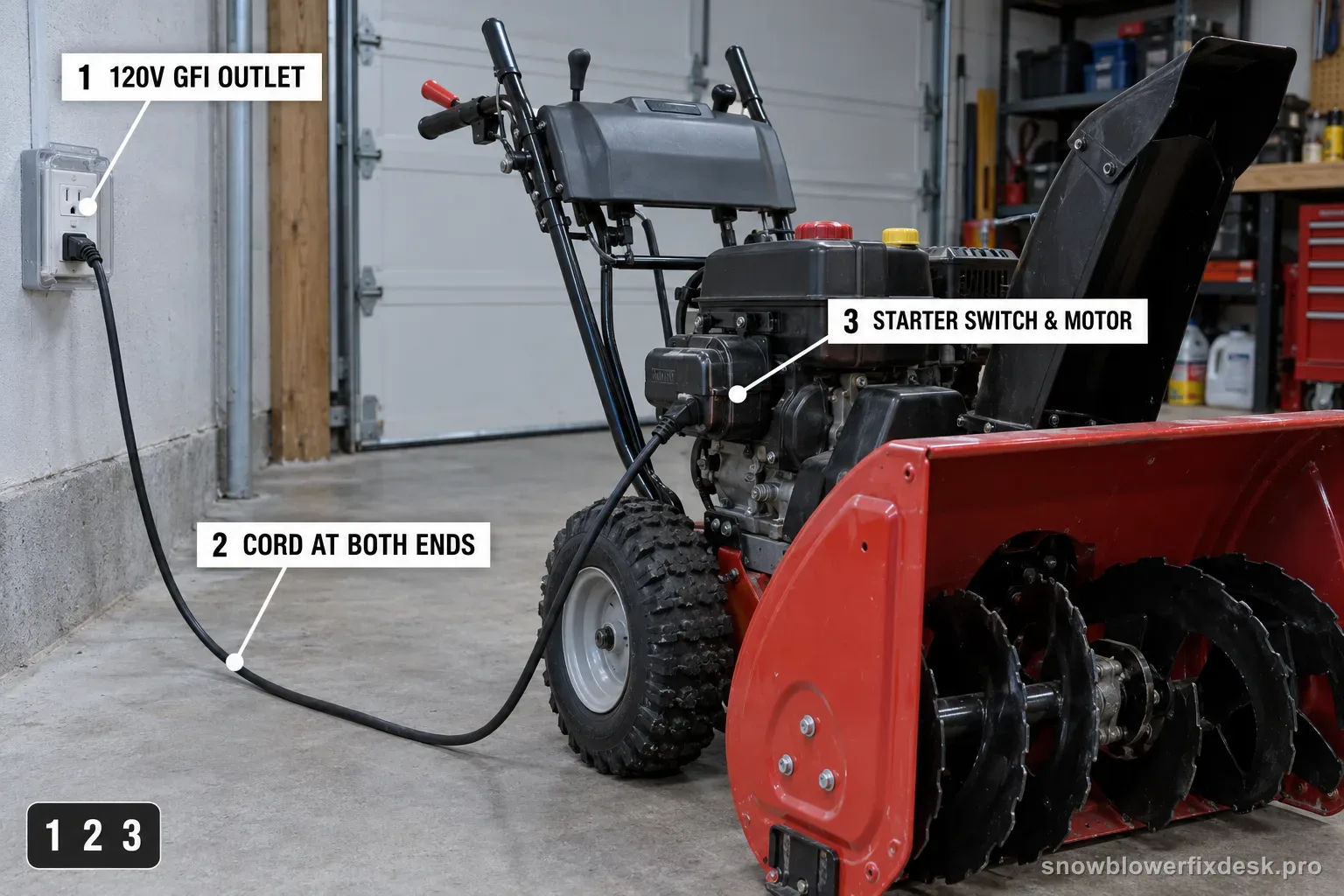
Applies to SB410 24-inch (CMXGBAM1054541 / 31AS6BEE793)
Identifiers: CMXGBAM1054541 · 31AS6BEE793 · SB410
Chassis / service ID: 31AS6BEE793
Engine ID: 208cc OHV — read the engine label before engine-specific parts
Guide scope: Applies to Craftsman SB410 retail model CMXGBAM1054541 mapped by MTD service material to chassis 31AS6BEE793. The matched MTD engine-family manual uses a corded 120V A.C. electric starter with a grounded three-wire/GFI supply. Read the engine label and exact-chassis manual set before ordering starter components.
Treat CMXGBAM1054541 and 31AS6BEE793 as a paired machine identity. The manufacturer manual catalog spans multiple form revisions, so verify the serial/year before applying a manual-specific adjustment or ordering parts.
Dead 120V starter vs. an engine that cranks but will not fire
Use this diagnosis when the corded starter is silent, weak or will not turn the engine. If the starter already cranks the engine at normal speed, unplug the cord and move to the SB410 no-start path instead of replacing starter hardware.
If the SB410 electric starter is silent or will not crank, verify the exact chassis, grounded 120V/GFI supply, outdoor three-prong cord and starter inlet before blaming the engine. If the starter cranks the engine at normal speed but the engine does not fire, leave the electric-start page and use the SB410 no-start diagnosis instead.
The electric starter uses household 120V A.C. Do not use it in rain, with a damaged cord, through an ungrounded/two-prong adapter or on a circuit that does not meet the manual grounding/GFI requirement. Disconnect the extension cord before inspecting the machine and never bypass the starter switch or grounding path.
Diagnostic sequence
Work in order. The early checks are intentionally low-disassembly and model-specific; stop once the symptom changes or the fault is confirmed.
Confirm SB410 identity before starter work
Why this check: Craftsman SB410 is the retail name, while MTD service material maps CMXGBAM1054541 to chassis 31AS6BEE793 and multiple manual forms exist for that chassis history.
What to do: Read the product label and engine label. Keep CMXGBAM1054541 / 31AS6BEE793 with the serial/year before ordering an electric-starter motor, switch, inlet or engine-specific component.
Separate “starter does not crank” from “engine cranks but will not start”
Why this check: The electric starter only turns the engine. Fuel, choke, key, spark and other no-start causes remain separate after normal cranking is established.
What to do: Press the starter only within the manual duty limit and observe whether the engine actually turns. If it cranks normally, stop diagnosing the 120V starter path and use the SB410 no-start guide for the failure to fire.
Verify a grounded 120V GFI three-wire supply
Why this check: MTD warns that the corded starter must be properly grounded and says not to use it when the household wiring is not a GFI three-wire grounded system.
What to do: Use a known working grounded 120V receptacle that satisfies the engine manual. If you are uncertain about the outlet or house wiring, stop and use a licensed electrician rather than testing with adapters or bypasses.
Inspect the outdoor extension cord and three-prong connections
Why this check: A damaged conductor, loose plug or unsuitable cord can leave the starter dead even when the engine itself is healthy.
What to do: With the cord unplugged, inspect both ends and the jacket for cuts, heat damage, missing ground pin or loose fit. Use a proper outdoor three-prong cord and seat it fully in the starter inlet and grounded outlet.
Use the matched electric-start sequence and short duty cycle
Why this check: The MTD engine manual says the starter is a 120V system and limits each electric-start attempt to five seconds.
What to do: Set the engine controls for the appropriate start, connect the 120V supply as directed and press the starter for no more than five seconds per attempt. Do not hold the button continuously when the engine does not start.
Compare recoil starting without treating it as a repair
Why this check: A normal recoil crank helps separate the 120V starter path from a seized engine or general engine no-start, while a successful recoil start shows the engine can run even if the corded system remains dead.
What to do: Disconnect the extension cord and use the normal recoil-start procedure. Record whether the rope turns the engine normally and whether the engine starts; do not use this comparison to justify opening or bypassing mains-voltage starter wiring.
Stop at the owner-visible electrical boundary
Why this check: Once the correct outlet, cord, inlet connection and duty-cycle procedure are verified, a still-dead starter can involve the starter motor, switch, wiring or connection hardware.
What to do: Do not jumper the starter motor or open live 120V wiring. Take the chassis, engine label, outlet/cord test and recoil comparison to Craftsman/MTD service for electrical diagnosis.
Keep a cranking-but-no-fire complaint on the engine branch
Why this check: Replacing an electric starter cannot fix stale fuel, incorrect choke/primer use, a missing key or ignition/fuel trouble when the starter already turns the engine normally.
What to do: If electric start spins the engine normally, unplug the cord and continue with the SB410 wont-start path. Preserve whether the machine is cold/warm, fuel age and whether recoil/electric cranking behave the same.
How to read this symptom on this model
On the SB410, “electric start not working” should mean the corded starter does not crank the engine normally. That is different from a starter that spins the engine at normal speed while the engine never fires. The latter belongs to the existing no-start diagnosis because fuel age, key, choke/primer position, spark and engine condition can prevent combustion even when the 120V starter is healthy. Write down whether the crankshaft actually turns before changing anything; this single observation prevents an electrical-start complaint from becoming an unnecessary carburetor repair.
The exact machine identity matters because Craftsman branding does not uniquely identify the service chassis or engine. MTD service supplement 769-20758 maps retail model CMXGBAM1054541 to chassis 31AS6BEE793, and the exact-chassis catalog lists multiple operator-manual forms through the production history. The engine label matters for starter hardware. Keep the retail model, chassis, serial/year and engine label together before buying a starter motor or switch; a visually similar 24-inch Craftsman can have a different engine or starter arrangement.
MTD engine manual 769-15010 defines the relevant starter architecture: a 120V A.C. starter inlet and button using a three-prong outdoor extension cord and grounded household power. It also warns that the starter must be properly grounded and says not to use it when the household wiring does not provide the required GFI three-wire grounded system. That makes outlet/grounding verification part of the diagnosis, not generic electrical advice. A two-prong adapter that makes the plug fit is not an acceptable substitute for the documented safety system.
Test the extension cord separately from the wall receptacle. A receptacle that powers another appliance does not prove the cord is intact, and a cord that looks clean at the plug can still have conductor damage along the jacket. With everything unplugged, inspect for a missing ground pin, cuts, crushed insulation, heat discoloration and a loose fit at the starter inlet. If there is any doubt about household grounding, stop and have the circuit checked. The goal is to prove the supply without opening live starter wiring.
Starter duty cycle is also diagnostic hygiene. MTD limits each electric-start attempt to five seconds. Holding the button longer can overheat a starter that was originally healthy and create a second symptom. If the starter is cranking, do not use longer cranking to compensate for an engine that will not fire. After normal short attempts, move to the fuel/ignition no-start path. If the starter is silent, focus on supply, cord, connection and starter electrical service instead.
The recoil starter is a useful built-in comparison after the extension cord is disconnected. If recoil turns the engine smoothly and the engine starts, a seized engine and most fuel/ignition explanations no longer fit the original “electric starter is dead” complaint. That result does not prove the starter motor itself has failed because the outlet, cord, inlet, button and internal connections remain in the circuit. Preserve the comparison instead of jumping from “recoil works” directly to an expensive part order.
If both recoil and electric start cannot turn the engine, stop treating the problem as a 120V-only fault. A mechanical hard stop, frozen component or engine problem requires a different diagnosis, and repeatedly energizing the electric starter against that resistance risks starter damage. Conversely, if electric start turns the engine normally but recoil feels different, keep the separate recoil mechanism and engine-start observations distinct. One symptom name should not erase the mechanical evidence the machine is giving you.
The owner-level boundary is deliberate. Once exact model/engine identity, a proper grounded 120V supply, an intact outdoor cord, correct connection and a freely cranking engine have been verified, live starter-motor, switch and wiring diagnosis is not a safe driveway procedure. Do not bridge terminals or defeat the ground to “see if the motor is good.” Take the test record to Craftsman/MTD service. That preserves safety and gives the technician a much narrower fault set than a generic “snow blower wont start.”
Before you order parts
Do not order a carburetor or ignition part because the push-button starter is silent. Fuel and spark cannot explain why a 120V starter motor does not turn the engine.
Do not order a starter motor until the exact 31AS6BEE793 chassis/engine identity, outlet, grounding and extension cord have been verified. Supply faults can perfectly imitate a dead starter.
Do not buy or use a ground-pin adapter as a test tool. The manufacturer grounding/GFI requirement is a safety condition, not an inconvenience to bypass.
If recoil starts the engine normally and the 120V supply checks are good, preserve that evidence for service rather than opening live mains wiring or jumpering the starter.
Back to the exact model hub →Retest without creating a second problem
After correcting a cord or outlet issue, perform one short electric-start attempt using the normal engine controls and the documented five-second maximum. Stop if the cord, plug or starter shows heat, arcing or damage.
If the starter now cranks normally but the engine does not fire, unplug the cord and switch to the SB410 wont-start workflow; do not keep treating normal cranking as a starter failure.
If the starter remains dead, unplug it and confirm recoil turns the engine freely. A good recoil comparison plus verified supply is the handoff point for qualified electrical service.
Record chassis 31AS6BEE793, engine label, outlet/cord result, whether the starter was silent/clicking/turning and whether recoil starts the engine. That is the useful evidence set for the next repair decision.
Make sure this is the right symptom
If your machine is showing an adjacent symptom instead, switch paths before changing parts: won't start.
The same search phrase can lead to a different branch on another machine. Compare the nearest model-specific examples: Ariens Deluxe 24 (921069): electric start button not working · Toro Power Clear 721 E (38753): electric starter not working.
Model-specific notes
- Treat a dead electric starter separately from an engine that cranks but will not fire. The first points to the 120V cranking path; the second belongs to the SB410 no-start diagnosis.
- The matched MTD engine manual identifies the electric starter as a 120V A.C. system that requires grounded three-wire/GFI household power. Do not copy a battery-start procedure from another snow blower.
- A working wall outlet does not prove the extension cord is good. Inspect the full cord and both plugs with power disconnected before condemning the starter motor.
- A recoil start that works normally is useful evidence, but it does not make live electrical bypass testing safe. Keep mains-voltage service inside the qualified-service boundary.
- Because 31AS6BEE793 has more than one manual revision in the exact-chassis catalog, retain the serial/year and engine label before buying starter hardware.
Questions people get wrong on this model
Why does my Craftsman SB410 electric starter do nothing when I press the button?
First separate the 120V supply path from an engine problem. Confirm the machine is CMXGBAM1054541 / 31AS6BEE793, use a grounded GFI-protected 120V three-wire outlet, inspect the outdoor extension cord and seat both plugs fully. If the starter still will not crank while recoil turns the engine normally, the remaining starter electrical path needs service rather than fuel-system parts.
Can I use a two-prong adapter or ungrounded outlet for the SB410 electric start?
No. The matched MTD engine manual requires the 120V electric starter to be properly grounded through a three-wire system and specifically says not to use the electric starter when the household wiring does not provide the required grounded/GFI arrangement. Do not defeat the ground pin or use an adapter as a troubleshooting shortcut.
How long should I hold the Craftsman SB410 electric-start button?
The MTD engine manual limits an electric-start attempt to five seconds. Repeated long cranking can overheat the starter and create a second fault while you are still diagnosing the first one. Use short attempts with the normal start controls; if the engine cranks but never fires, switch to the no-start diagnosis rather than holding the button longer.
If the SB410 starts with the pull cord, does that prove the electric starter is bad?
It makes the electric-start path more suspect, but it does not identify one failed component. A successful recoil start shows the engine can crank and run without the 120V starter. Recheck the grounded outlet, cord and starter-inlet connection first; if those are sound and the electric starter remains dead, use qualified service instead of jumpering the motor or switch.
Primary-source trail
Manufacturer material used for this diagnosis. Verify the model/serial range before ordering parts or applying an adjustment.
MTD / Craftsman warranty-service supplement 769-20758Manufacturer-hosted supplement maps Craftsman CMXGBAM1054541 to chassis/service model 31AS6BEE793.apps.mtdproducts.com →Genuine Factory Parts — Craftsman SB410 / 31AS6BEE793Secondary exact-chassis catalog for CMXGBAM1054541 / 31AS6BEE793 and its manual-form history; manufacturer-hosted MTD PDFs remain the primary procedural sources.www.genuinefactoryparts.com →MTD 179/208/243/272cc OHV Engine Operator Manual 769-15010Manufacturer engine manual for the SB410 engine family. It documents the 120V grounded electric-starter inlet, GFI/three-wire grounding requirement, outdoor extension-cord use and 5-second starter-attempt limit. Match the engine label before engine-specific parts.apps.mtdproducts.com →MTD 179/208/243/272cc OHV Engine Operator Manual 769-25211Later manufacturer engine-manual revision listed on the same 31AS6BEE793 chassis catalog. It retains the grounded 120V/G.F.I. electric-start procedure and 5-second attempt limit; use the engine label and production/manual revision before engine-specific service.apps.mtdproducts.com →MTD Parts — Craftsman SB410 chassis 31AS6BEE793Manufacturer exact-chassis catalog for 31AS6BEE793, including the operator/engine manual set. Use the chassis and serial/year before transferring a starter part or procedure from another Craftsman snow blower.www.mtdparts.com →