Craftsman SB410 Runs Rough or Surges: Choke, Fuel, Plug Before Carburetor
A CMXGBAM1054541 / 31AS6BEE793 run-quality path using the manufacturer engine-manual branches while keeping the engine-label gate ahead of carburetor or ignition parts.
Applies to SB410 24-inch (CMXGBAM1054541 / 31AS6BEE793)
Identifiers: CMXGBAM1054541 · 31AS6BEE793 · SB410
Chassis / service ID: 31AS6BEE793
Engine ID: 208cc OHV — read the engine label before engine-specific parts
Guide scope: Applies to retail model CMXGBAM1054541 / chassis 31AS6BEE793. Engine troubleshooting here uses the manufacturer 179/208/243/272cc OHV manual family listed in the chassis service catalog; match the engine label/manual form before engine-specific parts.
Treat CMXGBAM1054541 and 31AS6BEE793 as a paired machine identity. The manufacturer manual catalog spans multiple form revisions, so verify the serial/year before applying a manual-specific adjustment or ordering parts.
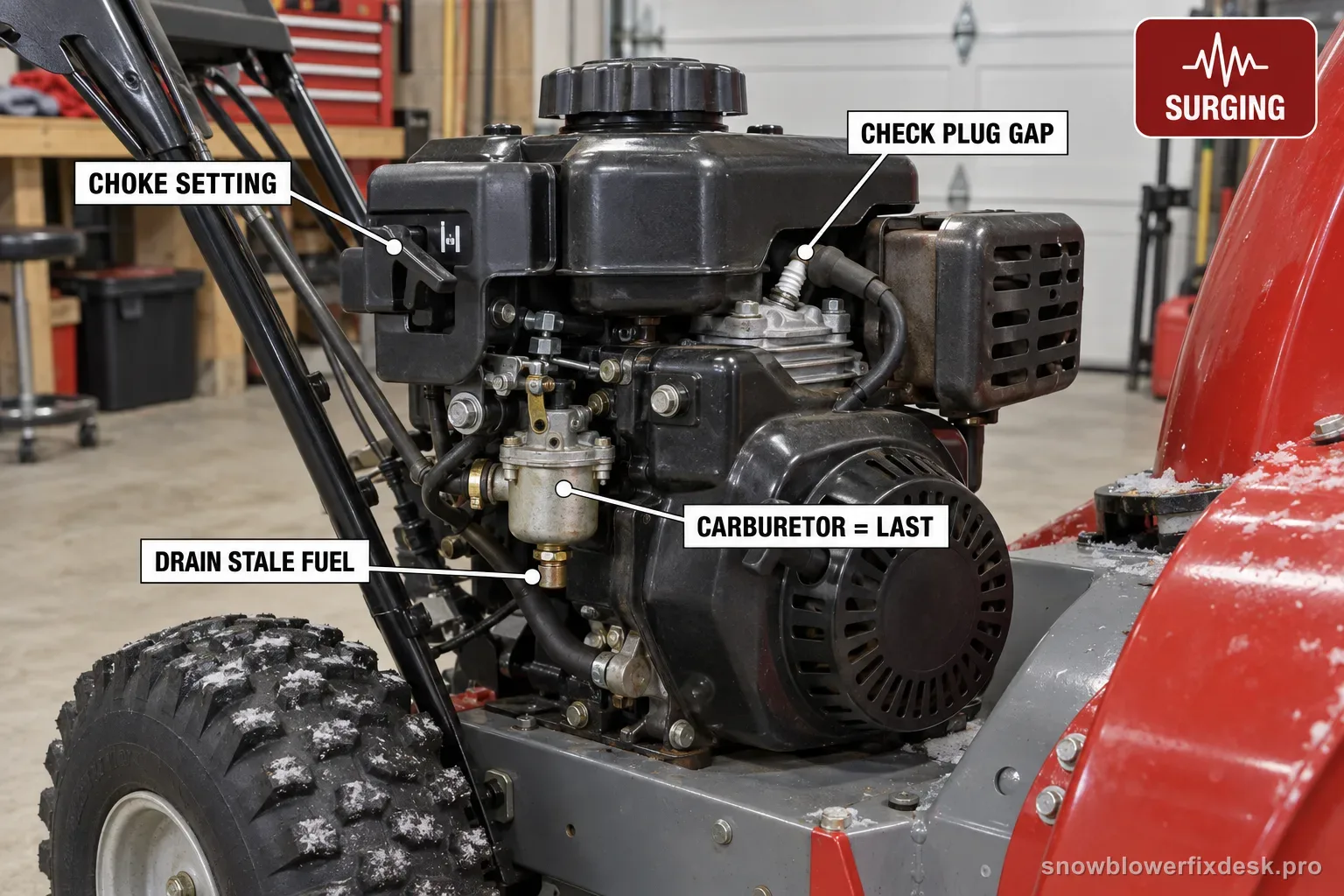
The MTD engine troubleshooting table lists a loose or defective/mis-gapped spark plug, stale fuel, choke left on, and water or dirt in the fuel system as separate erratic-running causes. Check those observable branches before treating a carburetor replacement as proven.
Run and test outdoors with auger and drive controls released. Let the engine cool before fuel or plug inspection, keep fuel away from sparks/flame, and never alter the governor to chase a surge.
Diagnostic sequence
Work in order. The early checks are intentionally low-disassembly and model-specific; stop once the symptom changes or the fault is confirmed.
Pair chassis identity with the engine label
Why this check: CMXGBAM1054541 maps to service chassis 31AS6BEE793, but engine-specific parts still depend on the label mounted on the engine.
What to do: Record both machine identifiers and the engine model/serial before using a plug, carburetor, starter or ignition part number.
Observe what happens as choke comes off
Why this check: The official engine manual says to move from FULL to half choke until smooth, then to NO CHOKE; it also gives a restart path if the engine falters or stops during that transition.
What to do: Warm the engine using the documented sequence and record whether it smooths out, falters as choke opens, or only stays running with added choke. Do not make partial choke the permanent operating setting.
Check fuel age and contamination history
Why this check: The troubleshooting table names stale fuel and water/dirt in the fuel system as erratic-running causes.
What to do: If fuel is old or contamination is plausible, drain/refill according to the matched manual before ordering carburetor parts.
Check plug wire and spark-plug condition
Why this check: A loose plug wire and a defective, scorched or incorrectly gapped plug are separate manufacturer-listed causes.
What to do: With the engine stopped and cool, seat the wire and inspect/service the plug only to the matched engine-label/manual specification.
Stop before generic carburetor or governor guessing
Why this check: The owner troubleshooting table gives specific external branches, while the engine manual warns against governor modification.
What to do: If the engine still runs erratically after the documented checks, preserve the exact choke/fuel/plug observations and use the matched MTD/Craftsman service path.
How to read this symptom on this model
The MTD engine manual gives several owner-visible reasons for erratic running before any internal fuel-system conclusion: loose spark-plug wire, a damaged or incorrectly gapped plug, stale fuel, choke left on, and water or dirt in the fuel system. That list is especially useful on a stored snowblower because more than one of those conditions can exist at the same time.
The same engine manual documents what to do when the engine falters as the choke is moved toward NO CHOKE. That makes the choke transition a legitimate observation, but not a parts diagnosis. The SB410 chassis identity still has to be paired with the actual engine label because the manufacturer service catalog spans an engine-manual family rather than proving one engine sub-model for every production unit.
Use the troubleshooting table as a branch list, not a reason to adjust everything at once. If the engine is erratic with the choke fully open, first confirm the plug wire is secure, fuel is fresh, and the plug is not scorched, defective or mis-gapped. If the engine smooths only when extra choke is added, preserve that observation but do not translate it into a proven carburetor defect: the same manufacturer table still requires fuel contamination and ignition checks, and the engine manual warns against changing governor speed to mask poor running.
The manufacturer engine table gives a useful order for a machine that hunts or surges: secure the spark-plug wire, inspect the plug and electrode gap, replace stale fuel, move the choke fully to its normal RUN/OFF position, and address water or dirt in the fuel system. Work those observable branches before treating 'runs better on choke' as permission to alter mixture screws. The symptom only shows that changing enrichment changes combustion; it does not identify which fuel or ignition component is at fault.
Fuel history should be captured before draining anything. If the SB410 sat with fuel for months, or the symptom began immediately after refueling from an old container, stale or contaminated fuel is stronger evidence than an unexplained carburetor defect. Conversely, if fresh fuel and a verified plug/wire do not change a warm engine that still requires choke, the owner-level table is exhausted and deeper carburetor/service work belongs under the matched engine documentation rather than a generic tutorial.
Treat “only runs with choke” as a run-quality clue, not proof that one carburetor part has failed. Confirm that the choke is moving fully to RUN after warm-up, check fuel age/contamination and verify the spark-plug connection under the correct engine information. If the engine still hunts with normal choke position and known fuel, stop at the carburetor/governor service boundary; changing governor settings or mixture screws by guess can create unsafe engine speed and destroy the evidence from the original symptom.
The phrase “needs choke” should be preserved as an observation, not converted directly into “needs a carburetor.” After warm-up, verify that the choke can return fully to the normal run position, then compare behavior with known fresh fuel and the correct spark-plug connection. If partial choke smooths the engine, record that result because it can support a fuel-mixture restriction diagnosis, but do not clear snow indefinitely with the choke left on. If the engine remains rough even with those external conditions correct, keep the manual-revision ambiguity of the 31AS6BEE793 chassis visible and move to matched engine service rather than adjusting governor or mixture settings by guess.
Before you order parts
Record CMXGBAM1054541, 31AS6BEE793 and the engine label before ordering anything engine-specific. Then correct fuel age/contamination, verify the plug wire and inspect the spark plug to the matched engine specification. Do not alter the governor or use an unverified carburetor adjustment to make a surge disappear; that trades a diagnostic symptom for a potentially unsafe engine-speed change.
Keep the chassis and engine identities together in the service note: CMXGBAM1054541 / 31AS6BEE793 for the machine, plus the engine label for engine-specific parts. The MTD engine manual covers a family of engines, so the chassis cross-reference does not by itself authorize a carburetor, jet or spark-plug part number for every SB410 production run.
Back to the exact model hub →Retest without creating a second problem
Retest outdoors with auger and drive released. Use the normal cold or warm start sequence for the matched engine, allow the engine to transition off choke, and listen for stable running at the normal operating setting. If it still requires extra choke or surges after the documented branches are corrected, stop there and carry the observations into the manufacturer service path.
Make only one correction at a time, then repeat a short unloaded run with the choke in its normal RUN/OFF position. A stable engine after fresh fuel, a seated plug wire or correct plug service identifies a useful cause without a carburetor swap. If it continues to hunt or requires choke after those manufacturer-listed branches are ruled out, stop adding adjustments and carry the exact engine-label information into service.
After each correction, let the engine warm and move the choke to the normal running position before judging the result. A cold engine that temporarily needs choke is not the same symptom as a warm engine that surges unless enriched. Use the same throttle/load state for each comparison so a change in operating condition is not mistaken for a repair.
Make sure this is the right symptom
If your machine is showing an adjacent symptom instead, switch paths before changing parts: won't start.
The same search phrase can lead to a different branch on another machine. Compare the nearest model-specific examples: Ariens Deluxe 24 (921069): runs briefly then stops · Troy-Bilt Storm 2410 family: runs rough or surges.
Model-specific notes
- “Only runs with choke” narrows the symptom but does not prove one failed carburetor component.
- The engine-family manual is manufacturer material, but the machine still requires an engine-label check before engine-specific replacement parts.
Questions people get wrong on this model
Does surging mean I should replace the carburetor immediately?
No. The manufacturer table lists spark-plug connection/condition, stale fuel, choke position and water or dirt in the fuel system as separate erratic-running causes. A loose plug wire and a defective, scorched or incorrectly gapped plug are separate manufacturer-listed causes. The MTD engine manual covers a family of engines, so the chassis cross-reference does not by itself authorize a carburetor, jet or spark-plug part number for every SB410 production run.
Can I adjust the governor to smooth out the surge?
No. The engine manual specifically warns not to change the governor setting or overspeed the engine. The official engine manual says to move from FULL to half choke until smooth, then to NO CHOKE; it also gives a restart path if the engine falters or stops during that transition.
Can old or contaminated fuel mimic a carburetor problem on the SB410?
Yes. The matched manufacturer engine-family troubleshooting includes stale fuel and water or dirt in the fuel system among erratic-running causes. Correct fuel condition and normal choke use before treating the symptom as proof of one failed carburetor part. If fuel is old or contamination is plausible, drain/refill according to the matched manual before ordering carburetor parts.
Primary-source trail
Manufacturer material used for this diagnosis. Verify the model/serial range before ordering parts or applying an adjustment.
MTD / Craftsman warranty-service supplement 769-20758Manufacturer-hosted supplement maps Craftsman CMXGBAM1054541 to chassis/service model 31AS6BEE793.apps.mtdproducts.com →Genuine Factory Parts — Craftsman SB410 / 31AS6BEE793Secondary exact-chassis catalog for CMXGBAM1054541 / 31AS6BEE793 and its manual-form history; manufacturer-hosted MTD PDFs remain the primary procedural sources.www.genuinefactoryparts.com →MTD 179/208/243/272cc OHV Engine Operator Manual 769-15010Official engine manual with fuel, start, maintenance and troubleshooting guidance. Match the engine label before engine-specific parts.apps.mtdproducts.com →