Ariens Deluxe 24 921069 Starts Then Dies: Fuel-Tank Pressure Check First
A narrow 921069 guide for an engine that starts normally but stops after a short run, using Ariens’ own troubleshooting row before generic carburetor guesses.
Applies to Deluxe 24 (921069)
Identifiers: 921069 · Deluxe 24
Engine ID: Ariens AX 252cc current specification — verify engine label for parts
Guide scope: Applies to Ariens Deluxe 24 model 921069, serial 000101+, under operator manual 30219300A. Keep engine-service work tied to the separate engine documentation where the unit manual directs it.
Operator manual 30219300A identifies model 921069 serial 000101+. Current Ariens product data lists AX 252cc; keep the serial number and engine label with the machine before engine-specific parts.
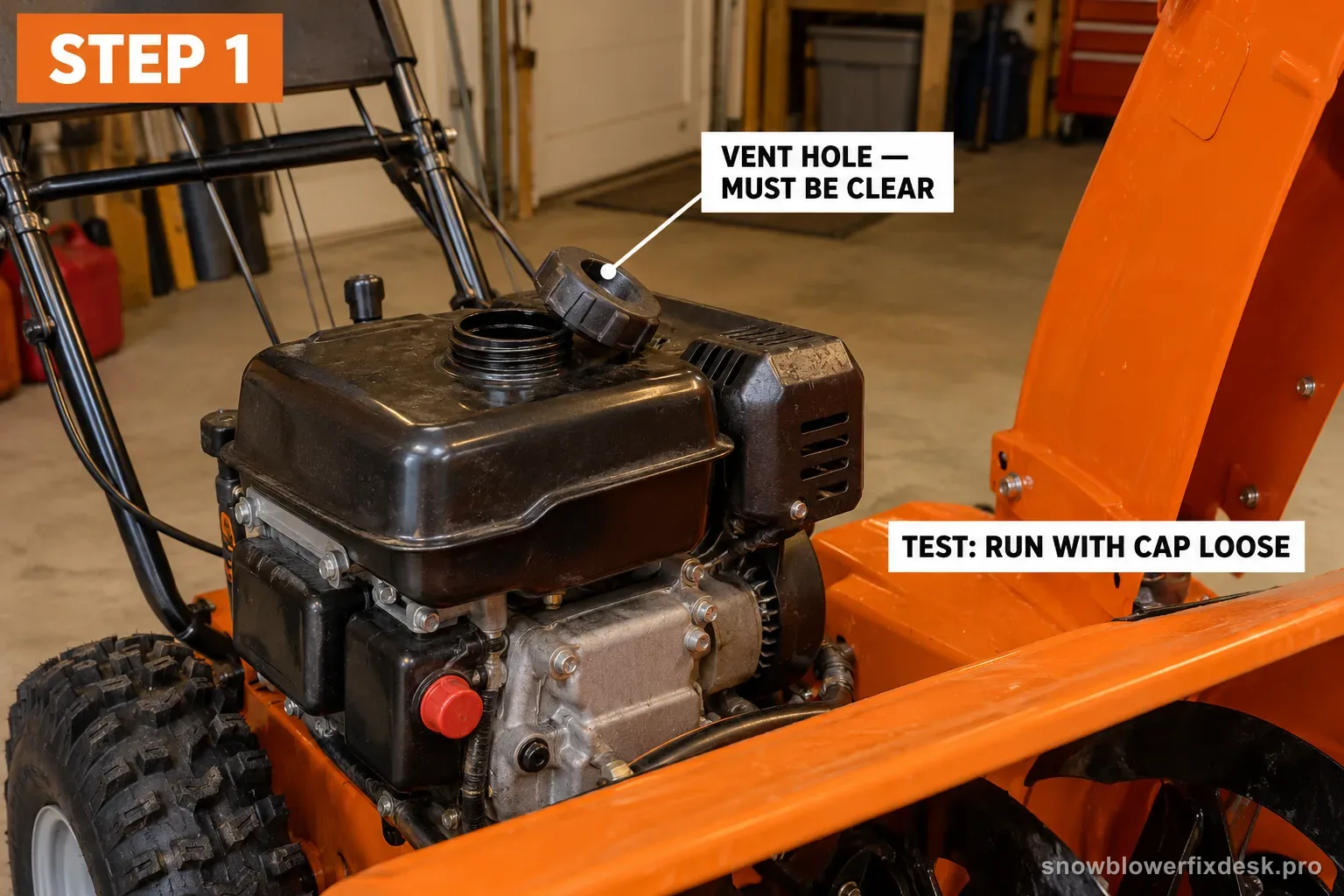
For the covered 921069 manual, “runs briefly then stops” has a specific first branch: excessive fuel-tank pressure. Loosen the fuel cap slowly as directed and separate that symptom from a true no-start.
Work outdoors away from ignition sources. Stop the engine before touching the fuel cap, and loosen it slowly because the manual identifies excess tank pressure as the condition.
Diagnostic sequence
Work in order. The early checks are intentionally low-disassembly and model-specific; stop once the symptom changes or the fault is confirmed.
Confirm it actually starts first
Why this check: Ariens separates “engine will not start” from “unit runs briefly then stops.”
What to do: Use this page only if the engine fires and runs for a short period before quitting. If it never starts, use the 921069 no-start path.
Fuel-cap pressure clue
Why this check: The 30219300A troubleshooting table links this exact symptom to fumes building pressure in the fuel tank.
What to do: With the engine stopped and away from ignition sources, loosen the fuel-tank cap slowly as the manual directs. Do not remove hot fuel-system parts.
Blocked cap vent / recurring pressure
Why this check: The same troubleshooting section also identifies a blocked fuel-cap vent in engine-running faults.
What to do: If the symptom changes when cap pressure is relieved but returns, stop using improvised venting and replace/service the cap per Ariens guidance.
If the symptom does not match
Why this check: Stale fuel, spark and carburetion can cause other run-quality problems, but they are not the manual’s single row for “runs briefly then stops.”
What to do: Return to the full troubleshooting table or engine service information rather than replacing a carburetor solely from this symptom.
Separate idle shutdown from attachment-load shutdown
Why this check: Ariens gives a narrow brief-run pressure branch and a broader engine-stops branch that includes auger/impeller obstruction.
What to do: Note whether the engine quits before the auger is engaged or exactly when attachment load is applied. A load-triggered stall belongs on the obstruction/load path rather than being forced into the fuel-cap diagnosis.
How to read this symptom on this model
This symptom is unusually useful because Ariens gives it its own troubleshooting row rather than burying it inside a generic no-start list. The machine has already demonstrated fuel, spark and compression well enough to run briefly, so the first branch should preserve that fact instead of resetting the diagnosis to “replace the carburetor.”
The current Deluxe manual points to excessive pressure from fumes in the fuel tank and directs the operator to loosen the cap slowly. The same troubleshooting area also treats a blocked cap vent as a separate running fault, making fuel-tank breathing a stronger first hypothesis than a random parts swap.
Ariens gives 'unit runs briefly then stops' its own row in operator manual 30219300A for model 921069 serial 000101+. That is important because it is narrower than the neighboring 'engine stops' row. The brief-run row points specifically to pressure building in the fuel tank, while the broader engine-stops row also includes empty fuel, a closed fuel valve, auger/impeller obstruction, contaminated fuel, spark-plug trouble, a blocked fuel-cap vent and deeper engine faults.
Use run time and load as evidence. If the engine starts normally, idles briefly and then quits before the attachment is loaded, keep fuel-tank venting and fuel delivery above auger-drive theories. If it dies exactly when the auger is engaged, move to the obstruction/load branch instead of assuming the same brief-run cause.
The manual says to slowly loosen the fuel-tank cap for the specific pressure-build-up symptom. Treat a change in behavior as diagnostic evidence, not as permission to operate indefinitely with a loose cap. The cap and vent are safety-critical fuel-system components; never drill, modify or permanently defeat the venting system to keep the engine running.
A machine that runs longer after fresh fuel or after correcting the fuel-valve position has given you a useful result. Change one condition at a time. Replacing a plug, cap and carburetor together destroys the ability to tell whether the actual problem was contaminated fuel, venting or ignition.
This page starts only after the engine has actually run. That sounds obvious, but it keeps three Ariens symptom patterns from being confused: an engine that never fires, one that runs poorly, and one that starts normally then quits after a short interval. On 921069, record how long it runs and whether it stops before any auger load is applied. A stop that occurs only when the attachment is engaged belongs to the obstruction/load branch, not automatically to the brief-run fuel-cap clue.
Ariens gives fuel-tank pressure and the cap vent special weight for the brief-run pattern. With the engine stopped and the fuel area handled safely, the diagnostic observation is whether relieving cap pressure changes the next run. That is not permission to operate with the cap loose. If the symptom changes and then returns with the cap secured, the vent/cap branch has gained evidence and should be serviced correctly rather than bypassed to keep the machine running.
If cap pressure makes no difference, stop forcing this narrow symptom row to explain every shutdown. Preserve the negative vent result and move back to the wider engine troubleshooting or engine-service information for fuel quality, ignition, or other run-quality causes. The useful service note is specific: model 921069, time-to-stop, cold or warm state, whether the auger was engaged, and whether controlled pressure relief changed the next run. That record is much stronger than a generic note that the machine “dies.”
The time-to-stall pattern can separate a startup-setting mistake from a fuel-delivery problem. If the engine fires and dies almost immediately as the choke is moved, record choke position and whether the engine was truly cold. If it runs normally for a short period and then fades, fuel age, fuel flow and tank venting deserve more attention than repeated priming. Do not keep adding primer after the engine has already run; that can flood the cylinder and blur the original symptom. A clean retest with known fuel and correct warm choke position is more informative than several increasingly enriched attempts that each end differently.
Before you order parts
Do not buy a carburetor, ignition coil or fuel pump merely because the engine stopped. First confirm that the symptom is truly a short run followed by shutdown, and whether safely relieving cap pressure changes it. A recurring cap/vent problem should be corrected with the proper part or service—not by permanently loosening, drilling or modifying the cap.
Before ordering a fuel cap, carburetor or ignition part, verify 921069 / SN 000101+, note exactly how long the engine runs, whether loosening the cap changes the symptom, whether the fuel valve is fully open and whether the fuel is clean. If the cap/vent branch is implicated, use the correct replacement/service path rather than altering the cap.
Back to the exact model hub →Retest without creating a second problem
After the machine is cool and the fuel-cap condition is corrected, restart outdoors and let it run unloaded long enough to exceed the previous failure time. If it continues running, make a light snow-clearing pass. If it dies again at nearly the same interval, return to the full engine troubleshooting path rather than repeating the pressure test indefinitely.
Retest outdoors with auger and traction released. Let the engine stabilize through the time interval that previously caused it to stop, then apply load only if the no-load run is normal. If the engine still quits, record whether it dies at idle, under auger engagement or after a repeatable number of seconds; that timing determines the next manual branch.
Make sure this is the right symptom
If your machine is showing an adjacent symptom instead, switch paths before changing parts: won't start · starts hard or runs poorly.
The same search phrase can lead to a different branch on another machine. Compare the nearest model-specific examples: Troy-Bilt Storm 2410 family: runs rough or surges · Honda HSS928A track family (HSS928AAT / HSS928AATD): engine stalls when auger engages.
Starts, then dies problem hub → · Ariens troubleshooting hub →
Model-specific notes
- Use this narrow branch only when the engine starts normally and then quits after a short run; a no-start or load-triggered stall needs a different diagnosis.
- Never operate permanently with a loosened or modified fuel cap; the pressure check is diagnostic, not a bypass.
Questions people get wrong on this model
Does this mean the carburetor is definitely fine?
No. It means Ariens gives fuel-tank pressure a specific first branch for this exact symptom. If that check does not change the behavior, use the broader engine troubleshooting path. Ariens gives a narrow brief-run pressure branch and a broader engine-stops branch that includes auger/impeller obstruction.
Can I drill or modify the fuel cap vent?
No. Replace or service the correct cap rather than altering a fuel-system safety component. A recurring cap/vent problem should be corrected with the proper part or service—not by permanently loosening, drilling or modifying the cap. If the symptom changes when cap pressure is relieved but returns, stop using improvised venting and replace/service the cap per Ariens guidance.
What if slowly relieving fuel-cap pressure does not change the symptom?
Do not force the fuel-cap theory. Ariens gives the brief-run symptom a narrow pressure branch, but the broader engine-stops table also covers fuel supply, obstruction, contaminated fuel, spark-plug and venting faults. Move to the matched broader path instead of modifying the cap. If the symptom changes when cap pressure is relieved but returns, stop using improvised venting and replace/service the cap per Ariens guidance.
Primary-source trail
Manufacturer material used for this diagnosis. Verify the model/serial range before ordering parts or applying an adjustment.
Ariens Deluxe Series Operator Manual 30219300AModels 921069–921072; troubleshooting and adjustment tables.apache.ariens.com →Ariens Deluxe 24 current product page — model 921069Official current Deluxe 24 page identifies model 921069 and the current Ariens AX 252cc specification.www.ariens.com →Ariens manuals lookupOfficial model-and-serial manual resolver. Use it as the stable path if a deep PDF URL changes.www.ariens.com →