Snowblower Model and Serial Number Lookup: Find the Right Manual
A brand-by-brand method for locating a snowblower’s product label, separating the machine ID from the engine ID, and using the exact model and serial range to find the correct manual or parts record.
Applies to Cross-brand Snowblower Field Reference
Identifiers: model number · machine serial number · engine ID
Guide scope: Locations and serial formats below are limited to the manufacturer support material cited. They are identification starting points, not a universal serial-number decoder. Product families and labels change across model years and revisions.
This is not a physical model. Use the manufacturer’s own label location, model/serial lookup and applicable serial range for the exact machine.
Start with the machine’s product identification label and copy every character before searching. A model number identifies a product family; the serial number can narrow production or manual revisions, but the format is manufacturer-specific. Never infer a production year from a generic decoder or an engine tag alone.
Park on a stable, level surface, shut the engine off, remove the key, disengage the controls, and let hot parts cool before reaching around the frame or opening a cover. Do not lift the machine or reach near the auger to find a label. Use a phone camera or mirror from a safe position; the operator manual takes priority if label access would require disassembly.
Diagnostic sequence
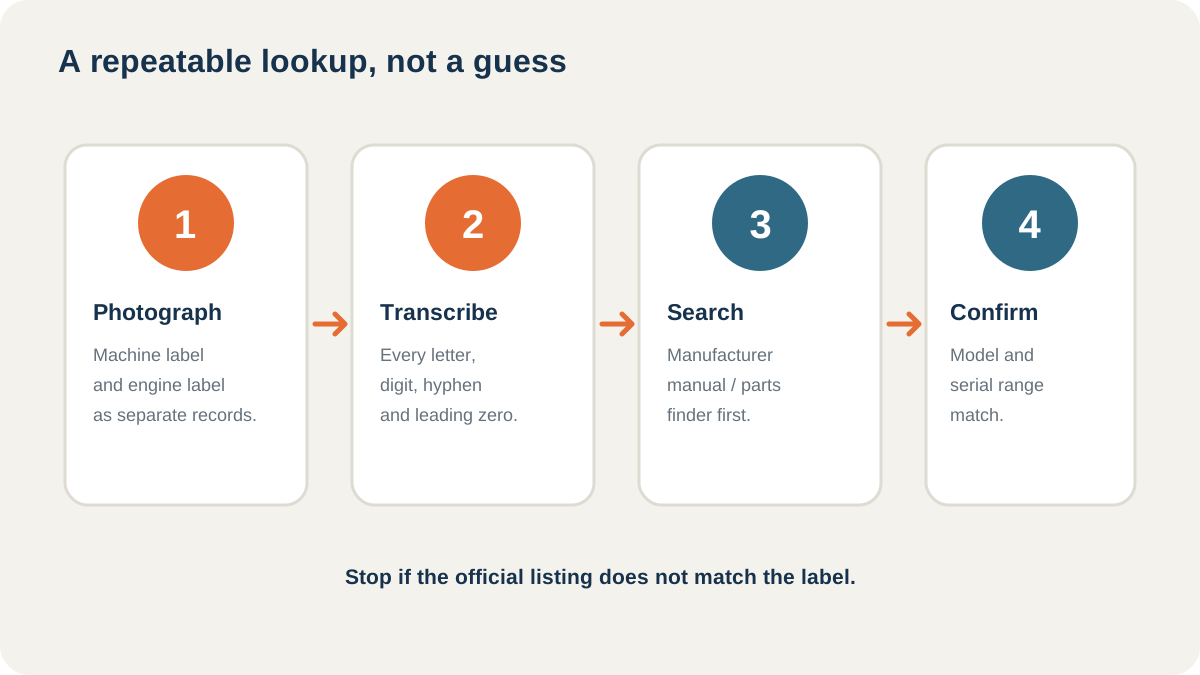
Work in order. The early checks are intentionally low-disassembly and model-specific; stop once the symptom changes or the fault is confirmed.
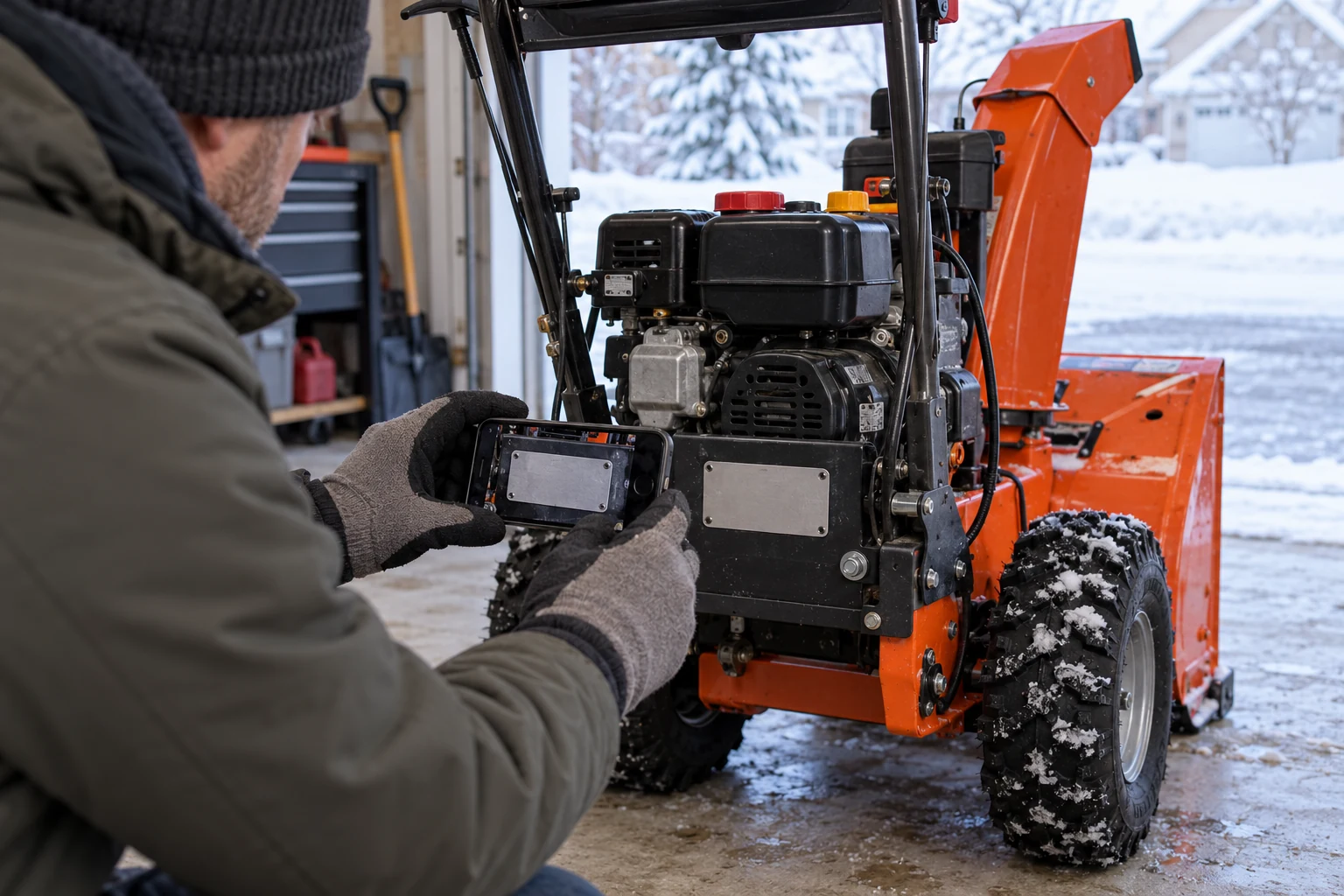
Photograph the machine label, not only the engine label
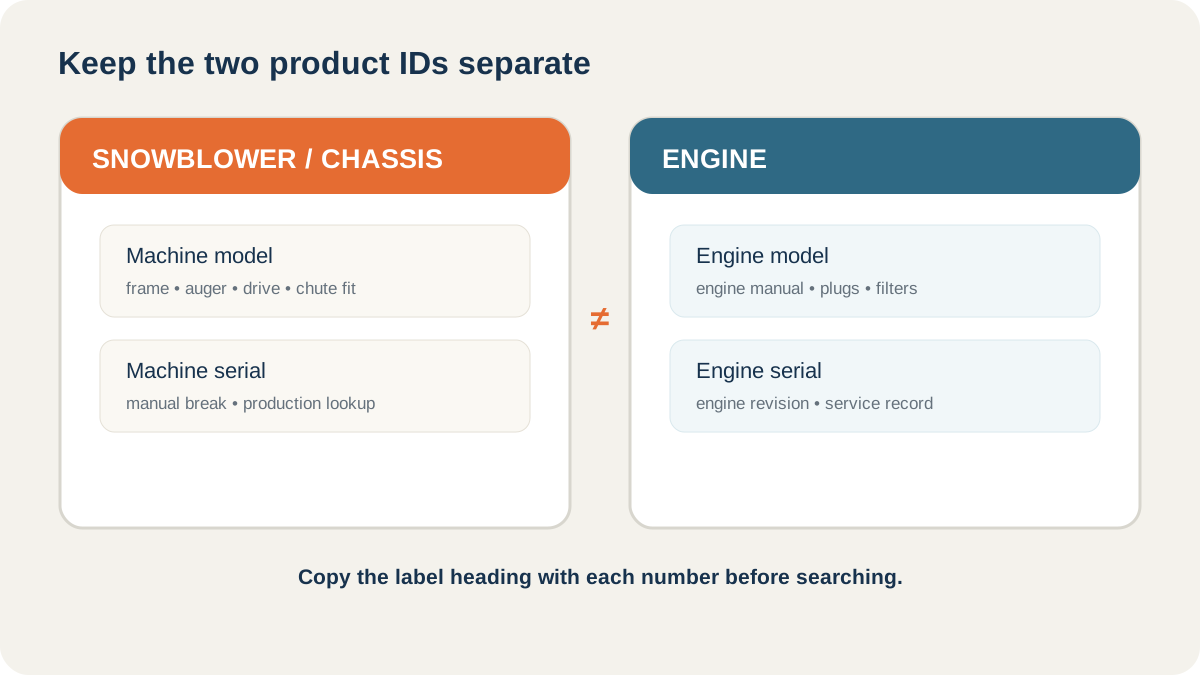
Why this check: A snowblower chassis and its engine can carry separate identification numbers. The correct manual, belt, chute or chassis part often follows the machine model and serial, while engine service may require the engine ID too.
What to do: Take one clear photo of the machine product label and a second of the engine label if it is safely visible. Copy the printed headings beside each number so the two IDs do not get mixed.
What the result means: You can send the correct machine ID for the frame/manual lookup and retain the engine ID for engine-specific parts.
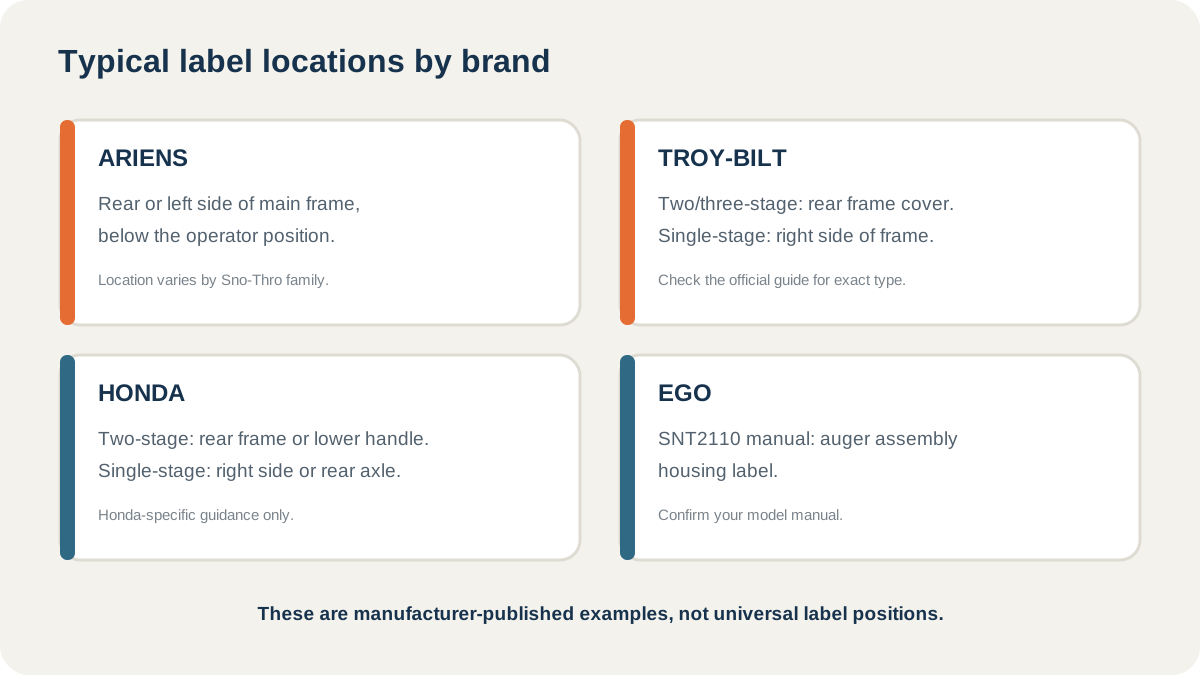
Use the brand’s typical label location only as a search starting point
Why this check: Ariens, Toro, Troy-Bilt, Honda and EGO publish different label locations; the location can also vary by machine style and production revision.
What to do: Compare the unit with the cited brand guide. Check only reachable frame or housing areas with the engine off. If the label is hidden behind a guard, do not remove the guard just to continue an online lookup.
What the result means: If the label is not where expected, use the matched operator manual, official support page or authorized dealer rather than guessing.
Copy the full model string exactly
Why this check: A missing suffix, hyphen or final digit can send a parts search to a different machine. Some Troy-Bilt snow thrower model numbers share a category prefix, while Ariens snow thrower numbers are commonly six digits beginning with 9.
What to do: Transcribe letters, digits, spaces and hyphens. Take a second photo at a slight angle if glare hides a character; compare the typed string against the photo before opening the parts catalog.
What the result means: The exact string becomes the query for the manufacturer manual and illustrated parts list.
Record the machine serial separately
Why this check: The serial may select a manual or parts break, show a production period, or help a manufacturer research an older product. These capabilities vary by brand; not every manufacturer publishes a public year decoder.
What to do: Write “machine serial” beside the chassis number. Preserve any leading zeroes and letter prefixes. Record the purchase date from the receipt in a separate field; purchase date is not the production date.
What the result means: A support agent can distinguish the machine’s serial from its engine, battery, attachment or stock number.
Match the manual to model and serial range
Why this check: A model name can remain unchanged while controls, parts or service instructions change between serial ranges. Toro explicitly asks owners to use both model and serial to obtain the correct manual; Ariens likewise directs users to its manual and parts lookup.
What to do: Enter the machine model and serial in the manufacturer’s official manual/parts finder. Read the manual cover and identification page and confirm that the listed model and serial range include your machine.
What the result means: If the model matches but the serial range does not, do not borrow a nearby manual’s adjustment, wiring or maintenance values.
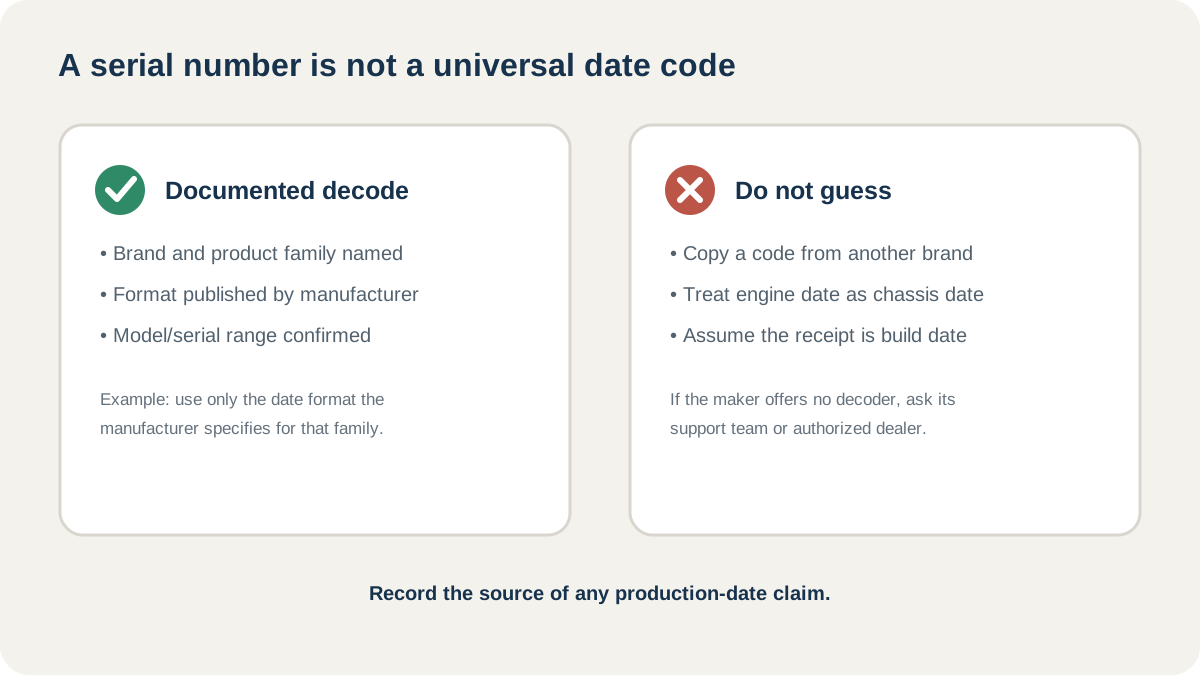
Treat date decoding as a brand-specific claim
Why this check: Some manufacturers document production data in a serial number; others require a dealer or technical-support lookup. A generic online decoder may apply a format from another product line.
What to do: Use a year/week explanation only when the manufacturer publishes that format for the relevant wheeled product family. For other brands, ask official support to confirm production data from the complete model and serial.
What the result means: You avoid ordering by a guessed year or applying a serial rule that belongs to a different brand or product type.
Keep the engine ID and attachment ID in their own fields
Why this check: The engine maker may be different from the snowblower brand. A replacement engine or attachment can also have its own tag, while the product label still controls chassis fitment.
What to do: Use a small record with separate lines for machine brand/model/serial, engine brand/model/serial, battery model if applicable, and attachment or kit number. Mark an item unknown instead of filling it from memory.
What the result means: The dealer can route each question to the right catalog without mistaking the engine model for the snowblower model.
Escalate a damaged, missing or conflicting label
Why this check: Manufacturers sometimes need photographs or physical measurements to identify an older production series. Troy-Bilt says illegible or invalid tags may require technical support and historical manufacturing research.
What to do: Send official support the label photo, full machine photos, purchase information if available, and any stamped or secondary number. Ask them to confirm the identity in writing before ordering a serial-gated part.
What the result means: A confirmed identity is stronger than a marketplace listing or a visually similar machine.
How to read this symptom on this model
The fastest lookup begins with the product label on the snowblower itself. A machine can have a brand name on the chute, a model badge on the housing, a chassis identification tag on the frame, and an engine label in a different place. Those are not interchangeable identifiers. For a belt, auger, wheel, chute, cable or frame part, start with the manufacturer’s machine model and serial. For an engine filter, spark plug or engine repair document, the engine model may also be necessary. Photograph both labels when they are safely reachable and keep the label that belongs to the question at hand.
Read every character before searching. A six-digit Ariens Sno-Thro model may begin with 9, while the serial is a different string. Troy-Bilt describes an eleven-character model number and says snow throwers use a product-category prefix; the serial remains separate. Honda snowblower serials use a brand-specific prefix and number format. These examples illustrate why a generic decoder is unreliable: format, label position and available lookup tools differ by brand and sometimes by product family.
Once you have the number, use the manufacturer support page or manual finder rather than an image search alone. Open the PDF or official product result and compare its model designation, serial range, controls and machine style to the label. A result that shares the same marketing name may cover a different production series. The manual may also state that the serial break applies only to one machine or engine configuration. Keep the full URL and retrieval date in the repair record so another person can reproduce the lookup.
A serial number sometimes encodes date information, but there is no all-brand snowblower year code. Husqvarna publishes production-date examples for certain wheeled products and warns that formats vary. Honda directs owners to its own manual and product records; its recall search covers defined models and production periods, not every historical manufacturing question. Troy-Bilt says an illegible tag may need direct support research through its historical manufacturing archive. Where the maker does not publish a decoder for the relevant family, treat “year” as unconfirmed until the manufacturer or dealer verifies it.
Parts catalogs can add a second identity check. Search the exact model and inspect the parts diagram heading, serial note and component view before selecting an item. Compare the diagram with the physical machine and retain the old part number if it is readable. If the catalog asks for a serial break and the serial is missing, pause the purchase: the visually similar part may not fit a different frame revision. A dealer can often identify a product from clear photographs, stamped identifiers and measured details, but measurements should be supplied only when the manufacturer requests them.
A clean identification record prevents future rework. Save the original label photo, typed machine model/serial, separate engine ID, purchase receipt, manual link and any support confirmation together. Do not publish a full serial number in a public forum if the manufacturer warns against exposing it; send it through the company’s official support path when a lookup needs it. If the label is loose, corroded or unreadable, photograph what remains without scraping away the printing. Ask support how to proceed before removing paint or a riveted plate.
Before you order parts
Before ordering, compare four things: the machine model, serial range in the manual or parts listing, the part diagram callout and the old component if available. If any one conflicts, stop and ask the manufacturer or authorized dealer to confirm the selection. Do not substitute a part because an online seller lists a familiar marketing name.
For production-date questions, tell support what you actually know: full model, complete serial exactly as printed, approximate purchase date, product type and country. Ask whether the manufacturer can confirm production week or model revision for that specific family. A receipt date is purchase evidence, not a production date; an engine date is not automatically the chassis date.
If the machine combines an engine from one supplier with a chassis from another brand, maintain both identities. The snowblower maker controls chassis, auger and drive fitment; the engine maker controls engine-specific specifications. When a claim involves warranty, emissions or a recall, use the manufacturer and database that cover that component, then verify how the result applies to the complete machine.
Back to the exact model hub →Retest without creating a second problem
After a manual or part lookup, write down the exact manual form or catalog URL, the serial range shown, and the label characters used to reach it. If the manual does not match the number on the product, do not continue with its adjustment or repair procedure.
Keep a second photo that shows where the label sits on the machine, not only a close crop. This helps a technician distinguish the chassis tag from an engine, battery or accessory label when several numbers are visible.
If support supplies a corrected identity, preserve the message and date. Update the repair record and any saved parts list so a future order does not revert to a guessed model year.
Model-specific notes
- Ariens says its snow thrower model numbers are commonly six digits beginning with 9, with exceptions for very early products; its label guide shows separate model and serial fields and identifies snow-thrower label locations by product family.
- Troy-Bilt describes an 11-character product model number and lists different label locations for two/three-stage and single-stage snow blowers. Its support article directs owners to a technician when a tag is illegible or invalid in the online lookup.
- Honda places two-stage snow blower identification tags typically at the rear of the frame or lower handlebar, and single-stage tags typically at the right side or rear axle. Its serial-number prefix and database rules are Honda-specific.
- EGO’s SNT2110 manual places model and serial numbers on a label attached to the auger assembly housing. Husqvarna publishes serial-date examples for its wheeled products; do not reuse that rule for another manufacturer.
- An engine serial or emissions label may be useful for engine parts, but it does not replace the snowblower chassis model/serial when selecting frame, auger, drive or chute parts.
Questions people get wrong on this model
Where is a snowblower model number usually located?
There is no single location across brands or machine styles. Manufacturer guides commonly point owners to a rear frame cover, the back of the frame, a lower handlebar, the side of a single-stage frame, or an auger housing. Use the matching company guide and inspect only a safely reachable label with the engine off; do not remove a guard to find it.
Can I identify the production year from any snowblower serial number?
No. Some makers publish a date format for a defined product family, while others require a dealer or support agent to research the record. Even within one brand, formats can differ by product type and year. Treat a decoded year as unconfirmed unless official documentation applies to that exact machine family and serial.
Is the engine number the same as the snowblower model number?
Usually not. A snowblower can have a chassis/product label plus a separate engine label, and those identifiers may belong to different manufacturers. Use the machine model and serial for frame, auger, drive and snowblower-manual questions; keep the engine ID for engine-specific service. Photograph and record them separately so a parts lookup starts with the right one.
What if the label is missing or unreadable?
Take clear photos of the full machine and any remaining label, stamp or secondary identifier, then contact the manufacturer or an authorized dealer. Include the approximate purchase date if known, but distinguish it from a production date. Ask support to confirm the model and applicable serial range before ordering a serial-gated part.
Does the receipt show the machine’s production date?
A receipt normally shows when and where the machine was sold, which can be months or years after manufacture. Keep the purchase date as useful ownership evidence, but do not use it as a serial-date decoder. If production timing affects a manual or part, ask the manufacturer to verify it from the complete machine model and serial.
Primary-source trail
Manufacturer material used for this diagnosis. Verify the model/serial range before ordering parts or applying an adjustment.
Ariens — How to Identify Model and Serial NumbersOfficial label guide describes Ariens model-number format and Sno-Thro label locations by product family.www.ariens.com →Ariens — Operator’s ManualsOfficial manual search; match the exact product model and applicable serial range.www.ariens.com →Troy-Bilt — How to Find Your Model NumberOfficial model-number guide lists separate two/three-stage and single-stage snowblower label locations and a support path for unreadable tags.www.troybilt.com →Toro — Residential Help TopicsToro asks users to use machine model and serial to locate the correct manual and parts.www.toro.com →Honda Power Equipment — Frequently Asked QuestionsOfficial snowblower tag locations differ between two-stage and single-stage machines; Honda serial rules are brand-specific.powerequipment.honda.com →Husqvarna — Finding a Serial Number and Product InformationHusqvarna explains serial-date formats for its wheeled products and warns that formats vary.www.husqvarna.com →EGO SNT2110 Operator ManualThe SNT2110 manual locates the snowblower model and serial label on the auger assembly housing.egopowerplus.com →Husqvarna — Snow Blower SupportOfficial support hub for current manuals, parts, troubleshooting and product selection.www.husqvarna.com →