Snowblower Starts Then Dies After Storage: Safe Checks in Order
Separate a control-setting issue from stale-fuel or deeper engine trouble when a snowblower fires briefly and quits after months in storage. The checks stay external and defer to the exact operator manual.
Applies to Cross-brand Snowblower Field Reference
Identifiers: model number · machine serial number · engine ID
Guide scope: This is a cross-brand observation and safe owner-check guide, not a universal starting procedure. Choke, primer, throttle, fuel valve, key, starter duty limits and fuel instructions vary by engine and serial range; the matched operator and engine manuals control.
This is not a physical model. Use the manufacturer’s own label location, model/serial lookup and applicable serial range for the exact machine.
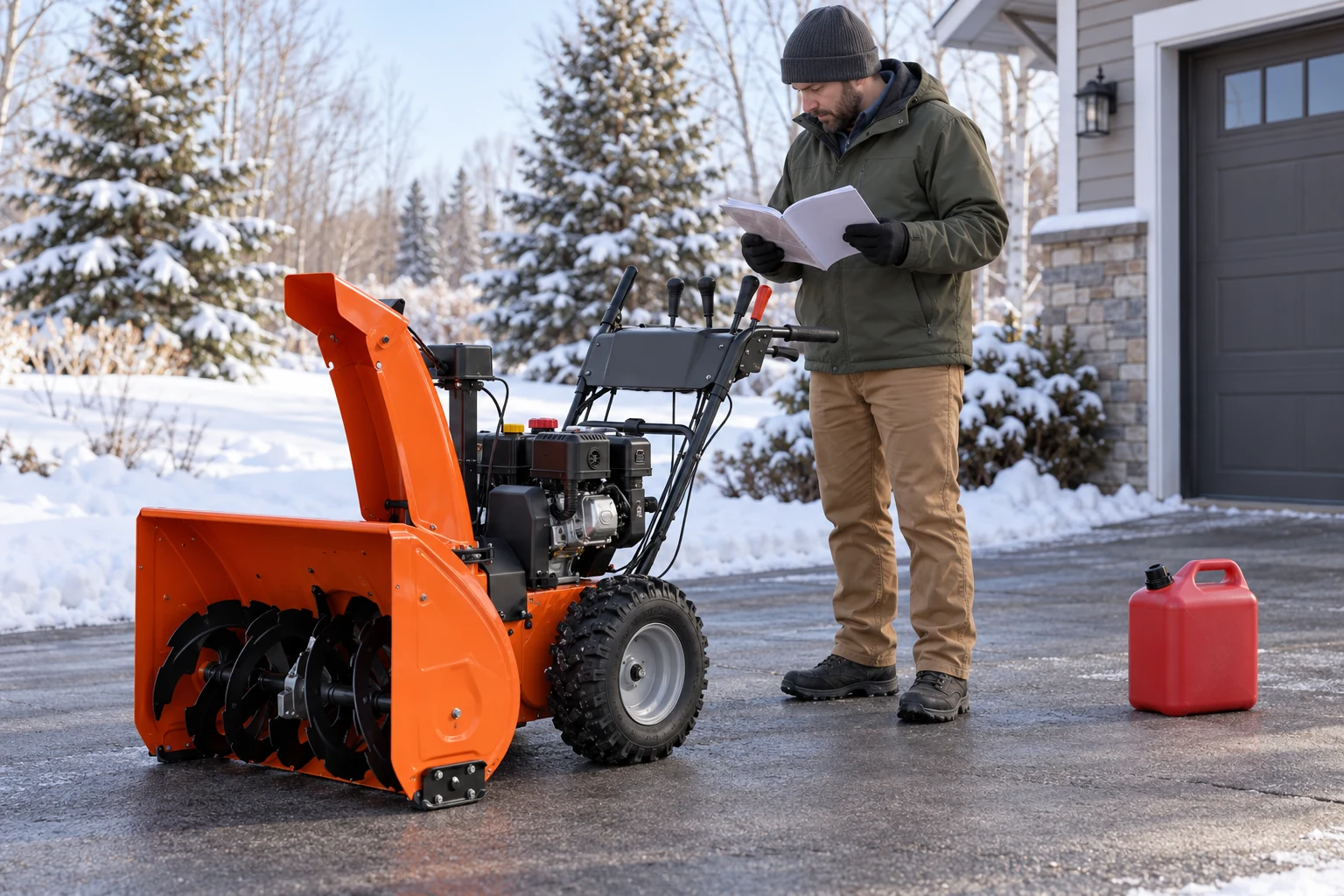
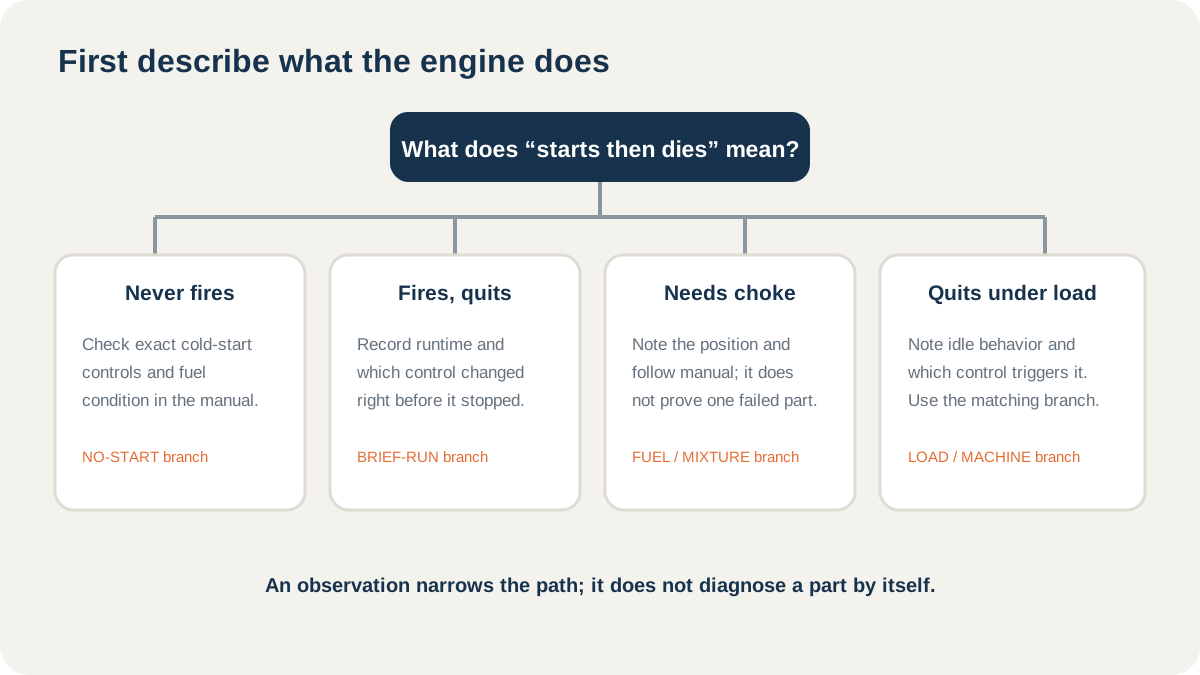
Write down what “starts then dies” means before changing anything: never fires, catches for a second, runs only with choke, or runs at idle but quits under load are different branches. Confirm the exact model, use the matched manual, and inspect fuel only with a cool engine outdoors and away from ignition sources.
Never run or troubleshoot a gasoline snowblower in a garage, shed or other enclosed area because carbon monoxide can build up. Shut it down, remove the key and let it cool before fuel or plug checks. Keep fuel away from flames, sparks and hot surfaces, use an approved container, and stop immediately for leakage, damaged wiring or repeated starter overheating.
Diagnostic sequence
Work in order. The early checks are intentionally low-disassembly and model-specific; stop once the symptom changes or the fault is confirmed.
Name the exact failure pattern
Why this check: A machine that never fires differs from one that catches and immediately stops. “Runs only on choke” and “dies when the auger engages” also point to different manual sections.
What to do: From a safe outdoor position, record whether the engine fires at all, how many seconds it runs, whether the choke position changes the symptom, and whether it quits at idle or only after a control is engaged. Do not repeat a long start attempt to collect data.
What the result means: The symptom can be matched to the correct manual branch instead of defaulting to carburetor replacement.
Start outside and verify the machine is safe to approach
Why this check: Engine exhaust can contain carbon monoxide, and fuel vapor is flammable. A storage-start problem is not a reason to run the machine indoors or near a heater.
What to do: Move the machine to a clear outdoor area. Keep people away from the discharge path, release auger and drive controls, remove snow and ice from safe exterior controls, and let the engine cool fully before inspecting fuel or the plug.
What the result means: If there is a fuel leak, damaged wiring, smoke from the fuel system, or a hot starter, stop and arrange service.
Match the controls to the cold-start instructions
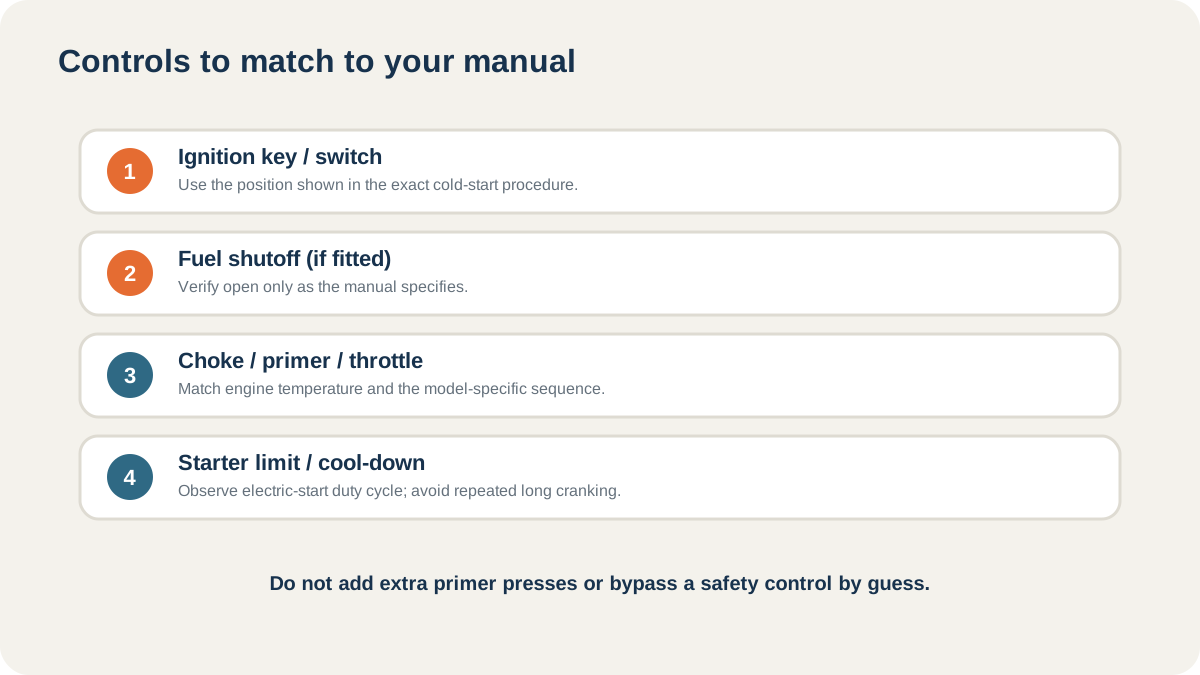
Why this check: The ignition key, fuel shutoff, choke, primer and throttle sequence differs among models. A warm start may require a different choke setting than a cold start.
What to do: Use the model/serial-matched manual. Confirm the key is in the prescribed position, fuel valve is open if fitted, and choke/primer/throttle are set exactly as directed. Do not add repeated primer presses unless the manual calls for them.
What the result means: If the engine now stays running, the starting sequence—not a confirmed internal failure—was the cause to address.
Separate old fuel from fresh fuel
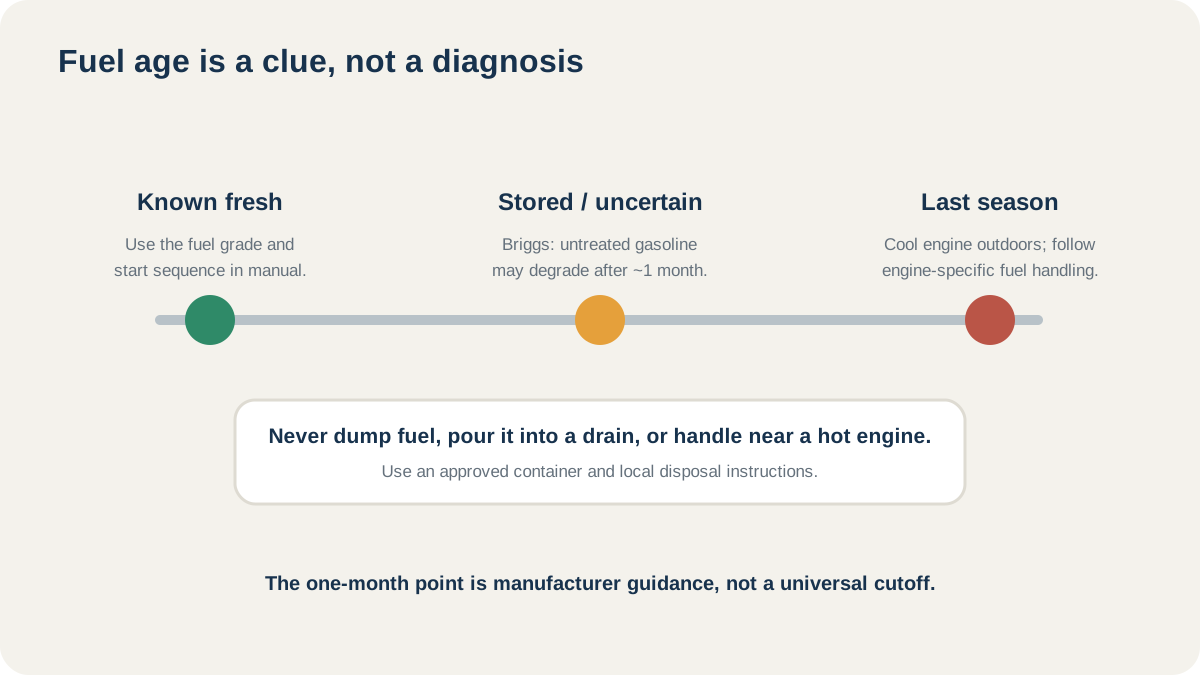
Why this check: Briggs & Stratton says untreated gasoline can begin to degrade after about a month and may contribute to starting or carburetor problems. That is a manufacturer guidance point, not a promise that every engine fails on day 31.
What to do: Check when the fuel was purchased and how it was stored. If it is last-season or uncertain fuel, follow the engine and machine manuals for safe removal and replacement; use fresh, correct fuel in a suitable clean container. Do not pour old fuel onto the ground or into a drain.
What the result means: If a safe fresh-fuel change resolves the symptom, record the change. If it still dies, continue with the manual’s next checks rather than assuming that fuel was the only fault.
Observe whether choke changes runtime
Why this check: A machine that runs only while partially choked is telling you the mixture or fuel delivery may need further diagnosis, but it does not identify one failed part.
What to do: If the manual’s normal start sequence allows it, make one controlled observation outdoors: note whether the engine dies as the choke opens or only after it has warmed. Do not operate continuously with a non-normal control setting to finish the job.
What the result means: Use the observation for the manufacturer’s troubleshooting or service technician; do not adjust carburetor screws by guess.
Check the fuel cap and visible fuel controls only when cool
Why this check: A blocked vent or closed shutoff can be relevant on some machines, but cap and valve arrangements vary. Opening a hot fuel system can release vapor near ignition sources.
What to do: With the engine stopped and cool, inspect the cap for ice, packed snow or obvious damage and verify any manual-listed fuel shutoff position. Do not run with the cap loose as a test, and do not probe a vent with wire unless the exact manual instructs it.
What the result means: If the cap or valve is damaged or the engine stalls again, stop and use the manual’s service path.
Check a spark plug only if the manual marks it as an owner task
Why this check: A wet, fouled, loose or incorrectly matched plug can affect starting, but the correct plug, gap and safe handling are engine-specific.
What to do: Let the engine cool, remove the ignition key and disconnect the plug lead only as directed. Photograph the plug and read its part number; install or gap a replacement only to the exact engine manual specification. Do not test spark near spilled fuel.
What the result means: If the plug is correct and the machine still catches then dies, move to the service boundary rather than repeatedly swapping parts.
Stop before carburetor or ignition disassembly
Why this check: A short run can result from several causes: fuel quality, an obstructed passage, a vent, a control setting, ignition or a separate machine fault. A brief symptom is not enough to identify a component.
What to do: Keep the model and engine IDs, fuel age, control settings, runtime, choke effect and any plug observation together. Ask the manufacturer or authorized service provider which manual section applies to that exact serial range.
What the result means: You can request a focused diagnosis without changing adjustments or installing unrelated parts.
How to read this symptom on this model
Start with the observation, not the part. If the engine never fires, the manual’s no-start path is relevant. If it catches for a second and quits, the immediate stop may be related to a control setting, fuel condition or another engine system. If it runs only with choke, that is evidence to report, not proof of a clogged carburetor. If it idles but quits when the auger or drive is engaged, the problem may involve load, a machine control or an engine that cannot maintain speed. Write down the difference before you change anything.
Use the exact model and serial to retrieve the operator manual first. The same brand can use different engines and controls across single-stage, two-stage, battery and older machines. A primer sequence shown for one single-stage model is not a universal sequence for all snowblowers. Confirm key, fuel shutoff, choke, primer, throttle, electric-start limit and warm-versus-cold instructions from that manual. A correct control sequence is a low-risk check; repeated extra priming can flood some engines and obscure the original symptom.
Fuel left in storage deserves a careful check. Briggs & Stratton notes untreated gasoline can begin degrading after roughly a month, while its equipment-specific storage steps depend on fuel type and engine. That timing is a manufacturer guideline, not an exact failure deadline for every machine. If the fuel is from last season or its history is unknown, let the engine cool, move outdoors, use an approved container and follow the engine manual for removal and replacement. Do not blend old and fresh fuel as a diagnostic shortcut, and do not pour unwanted fuel onto the ground or into a drain.
A controlled choke observation can help describe the issue. If the manual permits a normal start attempt, note whether the engine dies as the choke is moved toward its run position or after a fixed interval. Do not keep the choke closed to force operation if the manual says to open it as the engine warms. The observation may help a service technician decide which branch to test, but it does not establish a particular carburetor jet, fuel pump or vent fault.
A spark plug is a later check and only if the engine documentation treats it as owner maintenance. Let the machine cool, remove the key, disconnect the ignition lead as directed and match the plug number and gap to the engine manual. A wet plug can be consistent with fuel reaching the cylinder; it does not alone prove the ignition is bad. A dry plug can point to a fuel-delivery question, but it also does not identify the failed part. Avoid spark tests near fuel vapor or a spill.
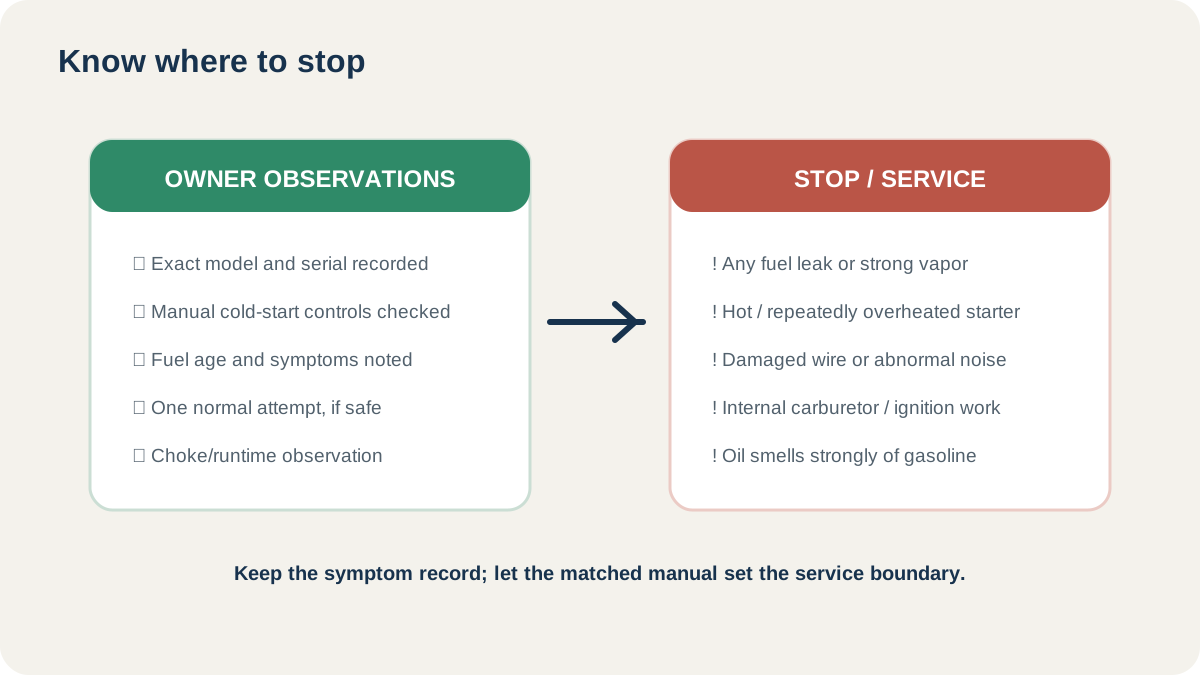
Stop before internal fuel-system work unless the matched manual explicitly covers the task and you have the required skill. Carburetor disassembly, mixture changes, ignition testing and repeated attempts around a leaking line can create hazards or damage. A dealer can use the machine and engine IDs, fuel age, runtime, choke behavior, plug observation and serial range to select the correct service information. That is more useful than replacing a carburetor based solely on “starts and dies.”
Before you order parts
Before ordering a part, confirm that the engine has fresh fuel of the specified type, the controls follow the cold-start procedure, and any visible cable or key issue is addressed. Note exactly what changes the symptom. If the engine catches only with the choke in one position, report that result; do not assume it points to one interchangeable carburetor.
Use the engine manufacturer’s documentation for engine-specific procedures and the snowblower maker’s manual for machine controls. The frame model and engine model can be different brands and have separate serials. Keep both IDs with the service request, particularly if a replacement engine was installed during the machine’s life.
Do not purchase a plug, coil, carburetor or fuel cap by appearance. Compare the part listing to the exact engine or machine number and applicable serial range. If the official catalog does not resolve the part, ask an authorized service provider to confirm fitment.
Back to the exact model hub →Retest without creating a second problem
After a permitted control or fresh-fuel correction, make only the normal start attempt and warm-up described in the matched manual. Record whether the same symptom returns and at what point. Do not continue repeated cycles if the starter overheats or fuel leaks.
If the engine runs normally after the safe external check, note what changed and monitor the next ordinary use. If it still starts and dies, provide the complete observation log to the dealer instead of expanding into unverified adjustments.
Stop and seek service for fuel smell or leak, damaged ignition wiring, oil that smells strongly of gasoline, smoke from the fuel system, abnormal mechanical noise or a starter that exceeds its duty cycle. Safety conditions override the desire to complete the driveway job.
Model-specific notes
- Briggs & Stratton describes stale fuel as a common contributor to outdoor-equipment starting or running problems and recommends storage handling according to its fuel guidance. Fuel type, stabilization and removal steps still depend on the engine and machine instructions.
- Toro’s snowblower help guidance asks owners to use fresh fuel and the correct model/serial manual; its single-stage starting checklist is not a universal sequence for two-stage machines or other brands.
- Ariens manuals list controls and fuel among operator-level no-start checks, then hand off deeper engine ignition or carburetor work to the engine documentation or service provider.
- A short runtime does not prove that a carburetor is clogged. Record whether the engine ever fires, the choke transition, fuel age, and the exact point at which it stops.
- Do not use starting fluid, bypass an interlock, loosen a hot fuel cap, or keep cranking beyond the starter duty cycle specified in the matched manual.
Questions people get wrong on this model
Why does a snowblower start and then shut off after summer storage?
Several branches can produce that pattern: a control setting, old or contaminated fuel, a fuel-delivery problem, ignition or another engine fault. The timing alone does not identify a failed part. Use the exact model manual and record whether it fires briefly, dies as the choke opens, or stops only under load before asking for service.
Does running only with the choke on prove the carburetor is clogged?
No. It is a useful observation about how the engine responds to the normal start controls, but it does not prove a clogged carburetor or identify a particular passage. Note the choke position and when the engine stops, then share that with a technician. Do not adjust mixture screws or keep operating with an abnormal setting.
Can old gasoline cause a snowblower to start and die?
Old or contaminated fuel can contribute to starting and running trouble. Briggs & Stratton says untreated gasoline may begin degrading after about a month, but that is manufacturer guidance rather than a universal failure deadline. If the fuel is last-season or uncertain, let the machine cool and follow the exact engine manual for safe handling and replacement.
Should I keep pulling the starter until the engine stays on?
No. Repeated long cranking can overheat an electric starter, flood some engines or erase useful evidence without resolving the cause. Use the starting-attempt and cool-down limits in the matched manual. If one normal attempt still produces the same brief run-and-stop pattern, record it and continue with the manual’s next safe check.
Is it safe to run the snowblower inside the garage with the door open?
No. Run a gasoline snowblower outdoors, away from doors, windows and air intakes. Carbon monoxide can build up in a garage even with the main door open, and fuel vapors can ignite near a heater or spark. If the machine cannot be moved safely outside, do not start it there; arrange a safe service location.
Primary-source trail
Manufacturer material used for this diagnosis. Verify the model/serial range before ordering parts or applying an adjustment.
Briggs & Stratton — Small Engine Problem-Solving TipsManufacturer guidance on stale fuel and small-engine starting or poor-running checks.www.briggsandstratton.com →Briggs & Stratton — Prepare a Snow Blower for WinterSnowblower-specific seasonal guidance on fuel, spark plug and oil checks.www.briggsandstratton.com →Briggs & Stratton — Fuel RecommendationsFuel storage and handling instructions; use only where they match the engine and local fuel requirements.www.briggsandstratton.com →Toro — Residential Snowblower Help TopicsModel-specific owner guidance for manuals, start conditions and winter preparation.www.toro.com →Ariens — Deluxe 24 921069 Operator Manual 30219300AA model-specific example of operator-level starting checks and the engine-service handoff; not a universal control sequence.apache.ariens.com →Troy-Bilt — Snowblower Troubleshooting: Auger or Drive LossManufacturer support entry point and reminder to follow machine-specific troubleshooting.www.troybilt.com →