EGO SNT2110 Red or Orange Light: Solid vs Flashing Mean Different Things
A direct SNT2110 power-indicator decoder for solid red, flashing red, solid orange and flashing orange, with the action EGO assigns to each state.
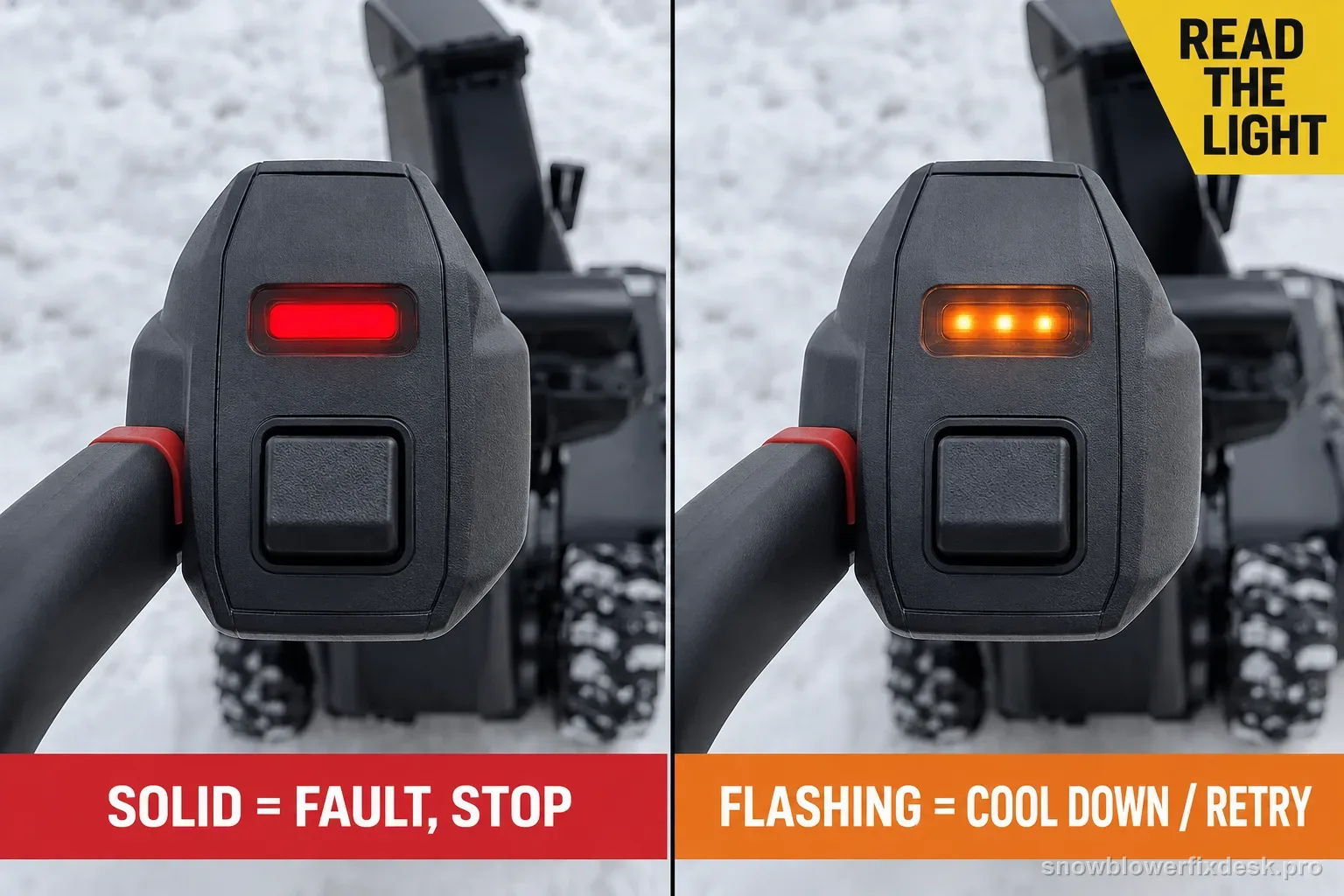
Applies to SNT2110 / SNT2110-FC
Identifiers: SNT2110 · SNT2110-FC
Guide scope: Applies to EGO SNT2110 / SNT2110-FC and its documented snow-blower power-indicator states. Do not assume the same red/orange light meanings for a different EGO machine or a battery-pack LED system.
EGO operator manual troubleshooting table is specific to SNT2110/SNT2110-FC.
Indicator state vs. load trip
Use this page for the battery/power-indicator state you can observe at rest or during the normal start check. A flashing-orange shutdown that appears specifically under snow load has its own protection-trip diagnosis.
On SNT2110/SNT2110-FC: solid red means low charge, flashing red means nearly depleted, solid orange means overheat, and flashing orange means overload. Do not treat all four as the same battery fault.
Release the bail and remove battery pack(s) before clearing snow or ice from the auger/deck. Never bypass thermal or overload protection.
Diagnostic sequence
Work in order. The early checks are intentionally low-disassembly and model-specific; stop once the symptom changes or the fault is confirmed.
Solid red
Why this check: EGO defines a shining red power indicator as low battery charge.
What to do: Stop the snow blower and charge the battery pack(s). Re-test only after normal charge status is restored.
Flashing red
Why this check: EGO defines flashing red as a nearly depleted battery condition.
What to do: Stop immediately and recharge rather than continuing to force the machine through a low-voltage shutdown.
Solid orange
Why this check: A shining orange indicator means the snow blower or a battery pack is overheated.
What to do: Stop and allow the machine/battery pack(s) to cool. Do not chill a hot battery with water or snow.
Flashing orange
Why this check: EGO defines flashing orange as overload, often after snow/ice accumulates or the machine is fed too aggressively.
What to do: Remove the battery pack(s), clear lodged snow/ice with the clean-out tool, then reduce pace or clearing width before restarting.
Repeated orange shutdown
Why this check: Recurring protection in ordinary load can indicate a condition beyond normal heavy-snow operation.
What to do: After clearing and cooling, test in a lighter/narrower pass. If protection returns immediately, stop before opening sealed electronics and use EGO service support.
How to read this symptom on this model
The SNT2110 indicator is effectively a built-in diagnostic code system. The important distinction is not simply “red versus orange” but solid versus flashing: charge states are red, heat protection is solid orange and overload is flashing orange. Treating all four as a bad battery erases information the machine is already giving you.
A flashing-orange event after a deep or wet pass is compatible with overload. A solid-orange event points toward temperature protection. Those histories should lead to different first actions even if the machine stops in both cases.
Read the machine’s power indicator as a state, not just a color. On the SNT2110/SNT2110-FC troubleshooting table, solid red is a low-charge state, flashing red is nearly depleted, solid orange is an over-temperature condition, and flashing orange is overload. The solid/flashing distinction is therefore part of the diagnosis; ‘orange light’ by itself throws away half of the information EGO provides.
Tie the indicator to the event that immediately preceded it. Flashing orange after a dense windrow, packed snow or an obstructed auger fits an overload history and should lead to shutdown, battery removal, clearing and a lighter feed rate. Solid orange after extended hard use or a warm battery environment fits thermal protection and should lead to cooling rather than repeated immediate restarts. Red states lead first to charging, not auger disassembly.
Do not confuse the snow blower power indicator with every possible LED pattern on every EGO battery generation. Battery packs can have their own state-of-charge and protection displays. This page decodes the indicator on the SNT2110 machine; if a battery itself shows a separate abnormal pattern, match that battery model’s documentation instead of assuming the machine’s color table applies to the pack.
A protection event can be normal evidence that the protection system did its job. The deeper-fault threshold is recurrence after the triggering condition is corrected: charged packs for red, normal temperature for solid orange, and a clear auger plus modest snow load for flashing orange. One protective shutdown in extreme conditions is not enough evidence to buy a controller or motor.
The power-indicator colors on SNT2110 are useful because EGO assigns different meanings to steady and flashing states. A solid red indication is a low-charge state, while flashing red means the battery is near depletion; both point first to restoring normal charge rather than opening the snow blower. Record whether the light is steady or flashing before the batteries are removed, because “red light” alone throws away the distinction the troubleshooting table is giving you.
Orange needs the same steady-versus-flashing split. A steady orange indication is the over-temperature branch, so the machine and battery packs should be allowed to cool naturally. Flashing orange is the overload path: remove the packs, clear lodged snow or ice safely, and reduce pace or clearing width before the next attempt. Cooling a hot pack with snow or water, or repeatedly resetting an overload without clearing the cause, would turn a protection signal into a second problem.
This page is intentionally different from the SNT2110 guide for flashing-orange shutdown under load. Here the task is to identify what the indicator state means and correct the external condition it reports. If normal charge, normal temperature, a clear auger path, and a light test load still produce repeated protection, stop before sealed battery or controller work. Bring the exact light pattern, which battery pair was installed, and the condition that triggered it to EGO support.
Before you order parts
Do not buy a battery, controller or motor because the indicator changed color once. Charge low/depleted packs for red states; cool the machine/packs for solid orange; remove batteries and clear/reduce load for flashing orange. Only recurring protection under ordinary load after those conditions are corrected justifies deeper service.
Before replacing a battery, test the state EGO actually assigned to the light. Charge low/depleted packs fully, allow an overheated machine or pack to return to a normal condition, and clear overload causes with batteries removed. A battery purchase made before that state-specific correction can replace a healthy pack while leaving the real load or temperature issue untouched.
Do not bypass, repeatedly cycle or ‘power through’ thermal/overload protection. Repeated immediate restarts destroy the diagnostic value of the indicator and can add heat or mechanical load. If the same protection state returns promptly under ordinary conditions, preserve the exact light pattern and use EGO service support.
Back to the exact model hub →Retest without creating a second problem
Restart only after the indicator/protection condition has cleared. Use a narrow, light pass first and watch the power indicator. If flashing orange returns immediately with a clear auger and modest feed rate, stop and use EGO support rather than repeatedly cycling protection.
Retest with a known charge state, normal-temperature packs and a clear auger/deck. Start with no snow load and verify that the indicator remains normal. If a red or orange state returns before the auger is fed snow, that is different evidence from a protection state that appears only under a heavy pass.
For the load retest, use a narrow light pass and increase feed gradually. If flashing orange appears only as the machine is overloaded, reduce pace/swath. If it appears immediately with a clear auger and modest load, stop repeated resets and escalate with the exact indicator pattern, battery models and load conditions documented.
Model-specific notes
- This page preserves the distinction between machine power-indicator color and the separate LED behavior on different EGO battery-pack generations.
- Overheat and overload are protective states; defeating them can damage batteries, electronics or the drive system.
Questions people get wrong on this model
Is flashing orange the same as solid orange?
No. EGO assigns flashing orange to overload and solid orange to overheat. EGO defines flashing red as a nearly depleted battery condition. If the same protection state returns promptly under ordinary conditions, preserve the exact light pattern and use EGO service support. If flashing orange appears only as the machine is overloaded, reduce pace/swath.
Why can the battery LED look different from the snow blower indicator?
EGO notes that different battery-pack models can show overheat with flashing orange or solid red on the battery itself, while the snow blower power indicator shows its own status. EGO defines flashing orange as overload, often after snow/ice accumulates or the machine is fed too aggressively.
What should I record before the indicator resets?
Record whether the light is solid or flashing, which battery position is involved, whether the symptom appeared under load and whether the auger was obstructed. Cooling, charging or removing the batteries can clear the indication and erase useful evidence about the original protection state. If it appears immediately with a clear auger and modest load, stop repeated resets and escalate with the exact indicator pattern, battery models and load conditions documented.
Primary-source trail
Manufacturer material used for this diagnosis. Verify the model/serial range before ordering parts or applying an adjustment.
EGO SNT2110/SNT2110-FC Operator ManualOfficial troubleshooting table for battery, frozen auger, drive belt and scraper conditions.egopowerplus.com →EGO SNT2110 steel-auger product pageOfficial product identity for the SNT2110 platform, including the two-56V-battery architecture and supported accessories.egopowerplus.com →EGO product supportOfficial support path for manuals, service help and model-specific support when external checks do not resolve the fault.egopowerplus.com →EGO 56V battery informationOfficial battery-system information used as a companion source for battery state, temperature and pack-handling boundaries.egopowerplus.com →