EGO SNT2110 Won't Start: Battery, Frozen Auger, Heat Protection or Safety Button
The official EGO troubleshooting table gives four model-specific first checks before deeper service.
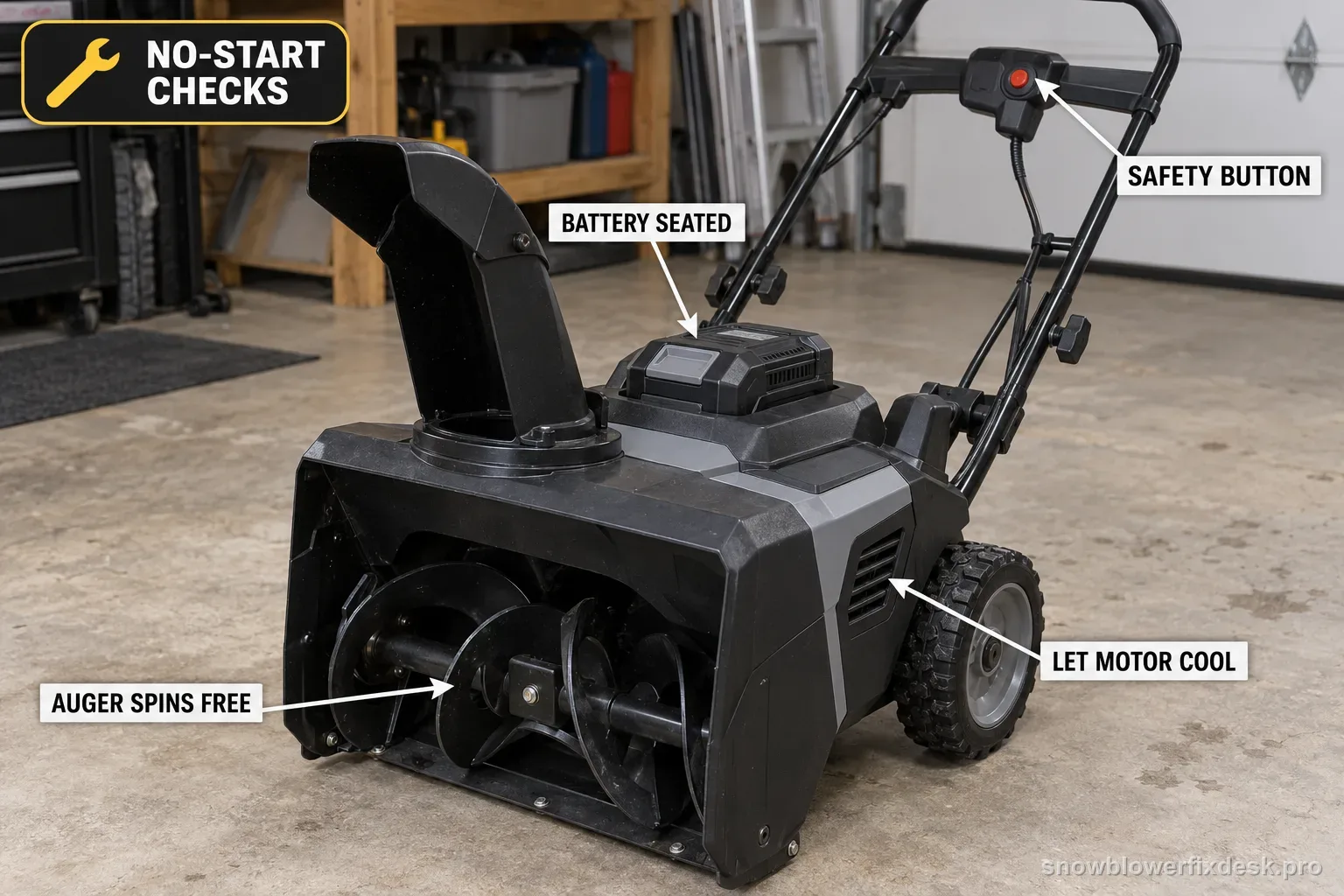
Applies to SNT2110 / SNT2110-FC
Identifiers: SNT2110 · SNT2110-FC
Guide scope: Applies to EGO SNT2110 / SNT2110-FC under the official SNT2110 operator manual. Keep this battery/auger/safety-sequence no-start path separate from other EGO snow-blower generations.
EGO operator manual troubleshooting table is specific to SNT2110/SNT2110-FC.
For SNT2110/SNT2110-FC, EGO lists low battery charge, a frozen steel auger, an overheated battery and the safety-button/bail sequence as no-start causes.
Remove the battery pack(s) before servicing, transporting or clearing the auger. Wear gloves around the auger/scraper.
Diagnostic sequence
Work in order. The early checks are intentionally low-disassembly and model-specific; stop once the symptom changes or the fault is confirmed.
Battery charge and seating
Why this check: Low charge is the first listed cause.
What to do: Charge the battery pack(s) and reinstall them fully.
Frozen steel auger
Why this check: Snow or ice can physically lock the auger and prevent startup.
What to do: Remove batteries first, then clear obstructing snow/ice with a clean-out tool.
Battery temperature indicator
Why this check: EGO lists orange flashing or red battery indication for overheat protection.
What to do: Remove the overheated battery and allow it to cool before reinstalling.
Safety-button/bail sequence
Why this check: The motor will not start if the safety sequence is not completed.
What to do: Press and hold the safety button, then pull the bail switch upward to meet the handle.
Preserve the battery-indicator evidence
Why this check: Low charge and high-temperature protection are different manual-listed branches.
What to do: Before charging or cooling resets the display, record whether the pack is low, flashing orange or red. If charged, cool, fully seated packs, a free auger and the exact safety-button/bail sequence still produce no response, stop at the service boundary.
How to read this symptom on this model
The SNT2110 no-start path is unusually useful because EGO lists four operator-visible conditions before any sealed electrical diagnosis: low battery charge, a steel auger frozen by snow or ice, battery high-temperature protection, and the required safety-button/bail sequence. All four can make the machine appear dead, but the observations are different. A low battery needs charging; a frozen auger needs the batteries removed and the obstruction cleared; an overheated battery needs time to return to its operating range; and a missed start sequence needs no part at all.
Start by recording what the battery indicators do and whether both battery packs or positions used for the test are fully seated. A battery that was just under heavy load can be charged yet temporarily unavailable because of temperature protection. Conversely, a battery at a normal temperature can still be low on charge. Treat indicator state, charge state and seating as separate checks instead of reducing them to “the battery looks fine.”
Next rule out a frozen or obstructed auger with all battery packs removed. EGO explicitly directs removal of the power source before clearing snow or ice. Do not use the start button repeatedly to hammer a frozen auger free; that converts a simple freeze-up into unnecessary electrical and mechanical load. If the machine was stored with wet snow packed around the steel auger, thawing and cleaning the housing is a higher-value test than replacing a switch.
Finally repeat the actual start sequence: safety button depressed, then pull the bail switch upward to the handle. If charge, battery temperature, battery seating, auger freedom and the safety sequence are all confirmed and the machine remains completely unresponsive, that is the point to stop opening the diagnosis wider. EGO does not support guessing at a controller, motor or internal wiring fault from the outside; service becomes the safer next step.
The temperature branch also has a concrete reset clue. EGO states that an overheated battery can prevent starting and instructs the user to remove it and wait until it cools to about 152°F (67°C) before reinstalling and restarting. That is different from a low-charge battery: one needs cooling, the other charging. Record which LED behavior is present before putting the pack on a charger or letting the machine sit, because once the indicator resets you lose useful evidence about why it was unavailable.
A model-specific guide also needs a clear stopping point. For SNT2110 / SNT2110-FC, “Preserve the battery-indicator evidence” is that boundary in this sequence: Low charge and high-temperature protection are different manual-listed branches. Follow the action given there—Before charging or cooling resets the display, record whether the pack is low, flashing orange or red. If charged, cool, fully seated packs, a free auger and the exact safety-button/bail sequence still produce no response, stop at the service boundary. If it does not resolve won't start, the next useful step is an evidence-backed service decision, not another round of unrelated adjustments that erase what the earlier checks already established.
Read the battery indicator before resetting the machine, because low charge, temperature protection and overload do not mean the same thing. Remove the pack before checking a frozen or obstructed auger, then reinstall only after the snow path is free. If charged, temperature-normal packs are fully seated and the safety-button/bail sequence is correct but the motor still gives no response, stop at the service boundary instead of buying a controller or switch from the symptom alone.
A no-start on this battery machine should preserve the startup sequence as evidence. Seat the battery packs fully, confirm they are in an acceptable temperature/charge state, then use the bail/start controls in the order shown in the SNT2110 manual. A machine that produces no indicator response is different from one that powers the controls but will not turn the auger, and both differ from a unit that starts then immediately trips a protection light. Record which stage is reached before removing the packs. That observation keeps a battery/contact/start-control complaint from being merged with the separate mechanical “motor runs but auger does not turn” or overload-shutdown pages.
Before you order parts
Do not buy a controller, motor, switch or battery until you have written down charge indication, temperature indication, battery seating, auger freedom and whether the exact safety-button/bail sequence was used.
If the failure followed a hard, heavy-snow pass, allow the battery to cool and clear the auger with the batteries removed before treating the shutdown as a permanent fault.
A machine that starts normally after thawing or after the battery returns to operating temperature has already disproved the need for a random electrical part swap. Fix the storage, loading or charging condition that produced the symptom instead.
If the no-start immediately follows heavy use, do not substitute a different battery merely to make the symptom disappear without first checking the original pack's temperature indication. A successful restart after the documented cool-down points toward normal thermal protection; a machine that stays dead with charged, cool packs, a free auger and the correct safety-button/bail sequence has crossed into the service boundary rather than a random battery-purchase branch.
Back to the exact model hub →Retest without creating a second problem
With the auger area clear, reinstall charged battery packs, place the machine on a stable surface with the chute aimed safely and repeat the exact start sequence unloaded. Do not begin the retest in deep snow, because load would hide whether the no-start condition is actually gone.
If it starts unloaded, make a short low-load pass and watch the battery indicators for renewed temperature or overload protection. Note whether the fault returns immediately or only after the auger enters snow; that distinction separates a basic start-sequence problem from a condition triggered by load. If it remains dead after all four manual-listed branches are ruled out, remove the batteries again and move to EGO service rather than probing sealed high-current components.
Make sure this is the right symptom
The same search phrase can lead to a different branch on another machine. Compare the nearest model-specific examples: Ariens Deluxe 24 (921069): won't start · Ariens Deluxe 24 (921069): starts hard or runs poorly.
Model-specific notes
- Do not diagnose a controller failure until these four manual-listed conditions are ruled out.
- Battery thermal protection can look like a dead machine even when the battery still has charge.
Questions people get wrong on this model
Why does it refuse to start after heavy snow?
A frozen auger or an overheated battery can trigger the exact symptom, both listed by EGO. If the no-start immediately follows heavy use, do not substitute a different battery merely to make the symptom disappear without first checking the original pack's temperature indication. With the auger area clear, reinstall charged battery packs, place the machine on a stable surface with the chute aimed safely and repeat the exact start sequence unloaded.
Can I clear ice with the batteries installed if the switch is off?
No. EGO says to remove the battery pack(s) when servicing and clearing the auger. If the failure followed a hard, heavy-snow pass, allow the battery to cool and clear the auger with the batteries removed before treating the shutdown as a permanent fault. Remove batteries first, then clear obstructing snow/ice with a clean-out tool.
Does a flashing-orange or red battery light prove the battery is bad?
No. On the SNT2110 troubleshooting table, an orange-flashing or red indication can be the high-temperature protection branch. Let the pack cool as EGO directs and keep low charge, temperature and seating as separate observations before condemning the battery. Do not buy a controller, motor, switch or battery until you have written down charge indication, temperature indication, battery seating, auger freedom and whether the exact safety-button/bail sequence was used.
Primary-source trail
Manufacturer material used for this diagnosis. Verify the model/serial range before ordering parts or applying an adjustment.
EGO SNT2110/SNT2110-FC Operator ManualOfficial troubleshooting table for battery, frozen auger, drive belt and scraper conditions.egopowerplus.com →EGO SNT2110 steel-auger product pageOfficial product identity for the SNT2110 platform, including the two-56V-battery architecture and supported accessories.egopowerplus.com →EGO product supportOfficial support path for manuals, service help and model-specific support when external checks do not resolve the fault.egopowerplus.com →EGO 56V battery informationOfficial battery-system information used as a companion source for battery state, temperature and pack-handling boundaries.egopowerplus.com →