Husqvarna ST224 970528602 Loss of Traction: Belt, Cable, Friction Disc
A current-SKU traction path that separates cable/belt slip, a wet friction disc and the worn-friction-wheel service branch.
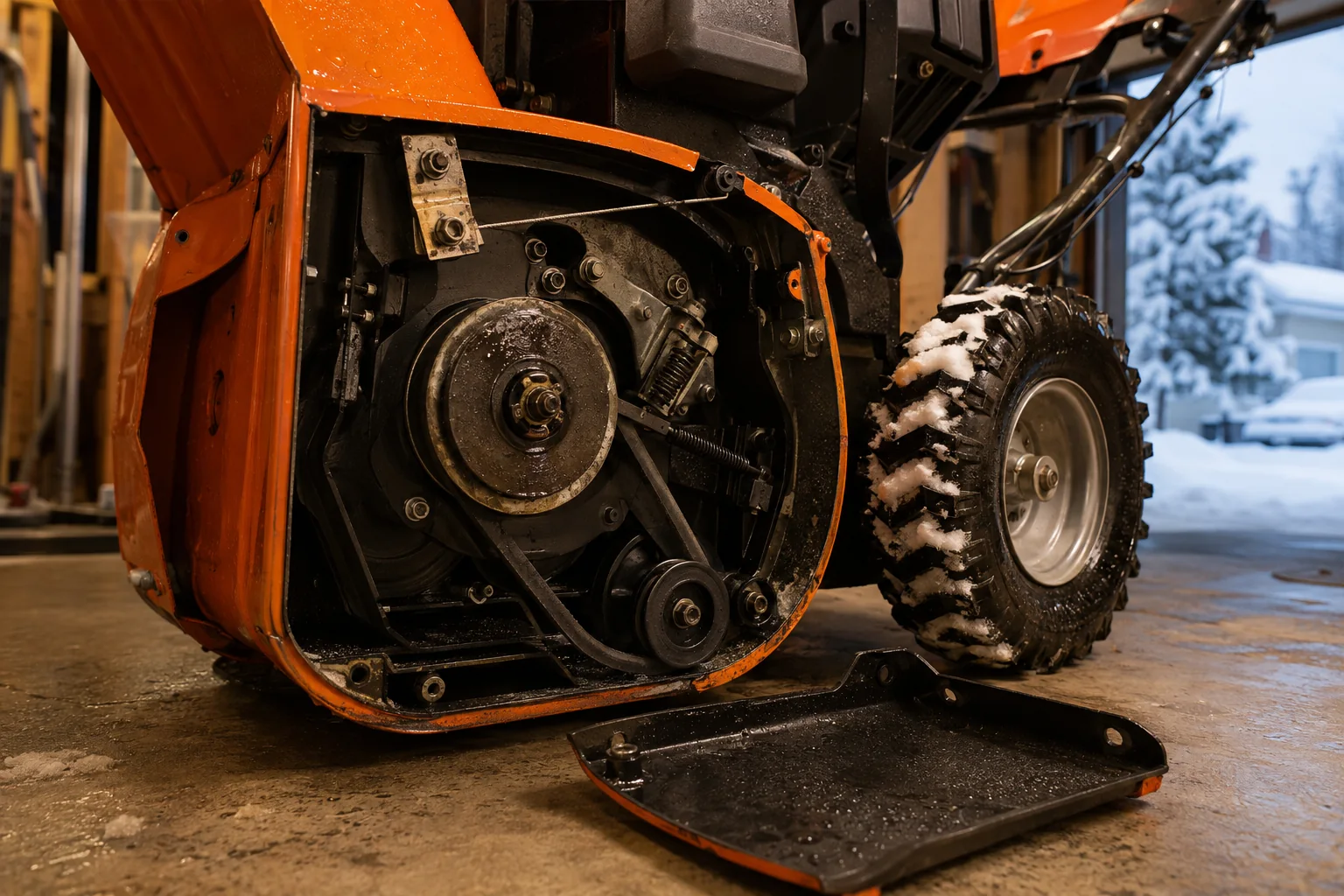
Applies to Current ST 224 NA — 970528602
Matched SKU identifiers: 970528602 · 970 52 86-02
Engine ID: Husqvarna engine — generation dependent
Generation engine: Husqvarna 212cc / 12.9 cu.inch current engine family
Guide scope: This repair path is for current North American SKU 970528602 / 970 52 86-02 and manual 2069-003. Legacy ST 224 SKU 961930096 is identity-only here; select its exact Husqvarna manual before applying adjustments or parts.
Husqvarna support requires choosing the SKU before manuals and parts. Troubleshooting coverage here is explicitly scoped to current North American SKU 970528602; support-listed SKUs 970468501 and 961930096 remain identity-only until their exact manual revisions are selected.
For current ST 224 970528602, Husqvarna lists a slipping, worn or off-pulley belt, a wet friction disc and a worn friction drive wheel among the traction-loss causes.
Test traction only on level open ground with the auger off. Stop the engine and disconnect the spark-plug cable before opening belt or drive areas.
Diagnostic sequence
Work in order. The early checks are intentionally low-disassembly and model-specific; stop once the symptom changes or the fault is confirmed.
Match 970528602 before diagnosing
Why this check: Husqvarna sells and supports more than one ST 224 generation under the same marketing name.
What to do: Read the product/SKU label. Continue with this path only for 970528602 / 970 52 86-02; do not transfer current-SKU adjustments to 961930096.
Separate no-drive from weak drive
Why this check: A belt/cable problem can remove drive completely, while moisture or wear can show up first as slipping under load.
What to do: On level ground, record whether all forward/reverse drive is gone, whether it slips only in snow, or whether it improves after the machine dries.
Control, cable and drive belt
Why this check: The current troubleshooting table pairs belt slip with cable/belt adjustment and separately lists a worn belt or a belt off its pulley.
What to do: With the machine disabled, inspect control travel, cable condition, belt wear and belt routing using the matched manual. Do not add tension simply until the machine moves.
Wet friction-disc evidence
Why this check: Husqvarna explicitly lists a wet friction disc and tells the owner to let it dry.
What to do: If the symptom followed wet snow, thawing or wash-down, allow the friction-drive area to dry before treating the complaint as permanent wear.
Friction-wheel service boundary
Why this check: The current table routes a worn friction drive wheel to an authorized service center.
What to do: If SKU, cable, belt routing/condition and dryness checks are credible but traction is still lost, preserve those results and move to service rather than lubricating or over-adjusting the friction drive.
How to read this symptom on this model
Start with the failure pattern, not a part name. A current 970528602 that has no forward and no reverse has a different evidence pattern from one that moves on bare pavement but slips when pushing snow. The current Husqvarna troubleshooting table groups the likely traction branches around belt transfer and the friction drive: belt slip, belt wear, a belt off the pulley, a wet friction disc and a worn friction drive wheel. That makes a normal-sounding engine largely irrelevant to the first traction checks.
The wet-friction-disc branch is especially useful because it can create a temporary failure that looks like worn friction material. If the complaint began after wet snow, thawing in a warm garage or wash-down, allow the drive area to dry and repeat the same low-speed test before ordering parts. A strong improvement after drying is diagnostic evidence; it should not be erased by adjusting several components at once.
Belt evidence should also be separated into route, condition and engagement. A belt that has left its pulley can remove drive suddenly. A worn or glazed belt can slip progressively under load. A cable/adjustment problem may leave the belt looking serviceable but fail to apply enough drive. Photograph or note the belt route before removal so the repair does not create a second routing problem.
A worn friction drive wheel is a later branch, not the default diagnosis for any ST 224 that will not move. Husqvarna routes that item to an authorized service center in the current manual. That boundary is useful: if belt route/condition, the applicable cable adjustment and a dry friction disc have been verified, the remaining failure deserves deeper inspection instead of ever-increasing control tension.
Do not let the legacy ST 224 identity contaminate this diagnosis. Husqvarna still surfaces 961930096 in support, but its shared ST 224 name does not make current 970528602 adjustment details interchangeable. The SKU label is therefore part of the diagnostic procedure, not administrative paperwork.
On ST 224 family (970528602 / 961930096), the order between “Match 970528602 before diagnosing” and “Separate no-drive from weak drive” matters because each answers a different question. Husqvarna sells and supports more than one ST 224 generation under the same marketing name. Meanwhile, a belt/cable problem can remove drive completely, while moisture or wear can show up first as slipping under load. Preserve which check passed and which did not before moving deeper. That record is especially useful when the owner describes everything simply as “loss of traction drive,” because the phrase alone does not identify the failed branch.
Compare drive engagement with the engine running normally and the auger disengaged. If the machine creeps or slips only under heavier traction load, cable/belt/friction-disc transfer becomes more relevant than engine power. Check the current-SKU control cable and belt path before opening the friction-drive area, and keep lubricants off the friction surfaces. A machine that loses engine rpm at the same time belongs partly on the decreased-power path, so preserve whether the engine stayed strong while traction disappeared.
Compare traction loss with engine sound and auger state. If the engine continues to hold normal speed and the auger is disengaged while wheel drive slips, the problem stays on the traction-transfer side—control cable, belt or friction-drive evidence—rather than the decreased-power page. If engine rpm falls at the same moment the machine stops moving, preserve that combined symptom because overloading or engine power may be contributing. Test low forward and reverse on level ground after any owner-level correction, and make sure propulsion stops when the drive control is released. Do not improve grip by contaminating friction surfaces with lubricant; the drive depends on dry friction to transmit torque.
Before you order parts
Before buying a friction wheel, establish three things: the machine is actually current SKU 970528602, the belt is on its intended pulley route and not obviously failed, and the friction area has had a fair chance to dry if the symptom followed wet conditions. Those checks can eliminate several manufacturer-listed causes without replacing a part.
Before buying a belt, note whether the failure was sudden or progressive. A sudden loss after service can fit a belt off its pulley; gradual under-load slip can fit wear or adjustment. Inspecting the existing belt and cable first is more useful than ordering both and losing the original evidence.
Do not spray lubricant into the friction-drive area. The mechanism depends on dry friction, and contamination can create or intensify the very slipping symptom being diagnosed. If service is required, tell the technician whether the drive changed after drying and whether all selector positions were affected.
Back to the exact model hub →Retest without creating a second problem
Reinstall all guards and test on level open ground with the auger disengaged. Start in the lowest forward speed, apply traction smoothly, then release the control and confirm the machine fully stops driving. Repeat in reverse so the repair is not judged from only one selector position.
If dry no-load drive is normal, add a modest snow load rather than immediately pushing into a deep berm. A machine that slips only under load still has useful belt/friction evidence even if it moves normally on concrete.
Stop if the machine creeps with the traction control released, engagement becomes abrupt, or the belt/friction area still slips. Those are failed retest conditions; do not compensate by adding more cable tension outside the matched manual procedure.
Make sure this is the right symptom
If your machine is showing an adjacent symptom instead, switch paths before changing parts: excessive vibration or handle movement · pulls to one side.
The same search phrase can lead to a different branch on another machine. Compare the nearest model-specific examples: Ariens Deluxe 24 (921069): won't move · Troy-Bilt Storm 2410 family: won't propel.
Model-specific notes
- A normally running engine can coexist with zero wheel drive because combustion and traction are separate systems.
- Keep grease, oil and spray lubricant off the friction disc and friction wheel; adding lubricant to a slipping friction drive makes the evidence worse, not better.
Questions people get wrong on this model
Can wet snow temporarily remove drive?
Yes. The current Husqvarna troubleshooting table explicitly lists a wet friction disc and advises letting the friction disc dry. The current troubleshooting table pairs belt slip with cable/belt adjustment and separately lists a worn belt or a belt off its pulley. The current table routes a worn friction drive wheel to an authorized service center.
Should I tighten the drive cable until the wheels finally pull?
No. Use the matched adjustment procedure and then verify full disengagement. Excess tension can create creep or a new control/safety problem. Those are failed retest conditions; do not compensate by adding more cable tension outside the matched manual procedure. A belt/cable problem can remove drive completely, while moisture or wear can show up first as slipping under load.
How do I keep a slipping belt separate from a friction-disc problem?
Start with the manual's cable/belt branch and note whether drive fades under load or across all selector positions. If belt condition and adjustment are correct, then dry friction-disc condition becomes more relevant; do not lubricate the friction surfaces. A belt/cable problem can remove drive completely, while moisture or wear can show up first as slipping under load.
Primary-source trail
Manufacturer material used for this diagnosis. Verify the model/serial range before ordering parts or applying an adjustment.
Husqvarna ST 224 current product page — SKU 970528602Official current North American product identity: ST 224 NA 970 52 86-02, 24-inch width, friction-disc transmission and 12.9 cu.inch engine displacement.www.husqvarna.com →Husqvarna ST 224 / ST 227 / ST 230 Operator Manual 2069-003Official current-family manual with starting, rough-running, recoil, traction, discharge, vibration and chute troubleshooting tables.www-static-nw.husqvarna.com →Husqvarna ST 224 US support pageOfficial ST 224 support and SKU-selection path; use the machine SKU here before choosing manuals or parts.www.husqvarna.com →