Husqvarna ST224 970528602 Runs Rough or Surges: Choke and Fuel Branches
A current ST 224 run-quality path grounded in the Husqvarna table for choke position, blocked fuel line, old/watery fuel and service escalation.
Applies to Current ST 224 NA — 970528602
Matched SKU identifiers: 970528602 · 970 52 86-02
Engine ID: Husqvarna engine — generation dependent
Generation engine: Husqvarna 212cc / 12.9 cu.inch current engine family
Guide scope: Use only for current North American Husqvarna ST 224 SKU 970528602 / 970 52 86-02 under operator manual 2069-003. Do not transfer current-SKU engine/control assumptions to legacy 961930096 without its exact manual.
Husqvarna support requires choosing the SKU before manuals and parts. Troubleshooting coverage here is explicitly scoped to current North American SKU 970528602; support-listed SKUs 970468501 and 961930096 remain identity-only until their exact manual revisions are selected.
Run quality vs. reduced power
Use this diagnosis for unstable or surging engine behavior. An engine that runs smoothly but feels weak only under working load belongs to the separate decreased-power path.
For current 970528602, first verify the choke is fully moved out of the start position and preserve the fuel-history clues before assuming a carburetor replacement.
Diagnose outdoors with the auger disengaged. Let hot engine/exhaust parts cool before fuel-line or air-intake inspection and keep fuel away from sparks or flame.
Diagnostic sequence
Work in order. The early checks are intentionally low-disassembly and model-specific; stop once the symptom changes or the fault is confirmed.
Confirm current SKU 970528602
Why this check: The ST 224 name spans generations with different support records.
What to do: Match 970 52 86-02 / 970528602 before using the current manual table.
Choke position after warm-up
Why this check: Husqvarna lists the choke remaining in ON/FULL as a rough-idle cause.
What to do: After normal warm-up, move the choke to the documented OFF/CLOSE running position and observe whether the behavior changes.
Fuel line and fuel age
Why this check: The table names a blocked fuel line and water/old fuel as separate branches.
What to do: Do not immediately adjust the carburetor. Preserve whether the symptom began after storage, a refill, or icing and follow the manual fuel-service boundary.
Cool-engine air/muffler checks
Why this check: The adjacent decreased-power table includes blocked air intake/muffler conditions.
What to do: Only after shutdown/cooling, inspect accessible intake/exhaust blockage without dismantling or defeating emissions/safety components.
Authorized-service boundary
Why this check: The current manual routes a carburetor-replacement conclusion to an authorized service center.
What to do: If control/fuel branches do not change the symptom, stop before mixture-screw improvisation or generic carburetor swaps.
How to read this symptom on this model
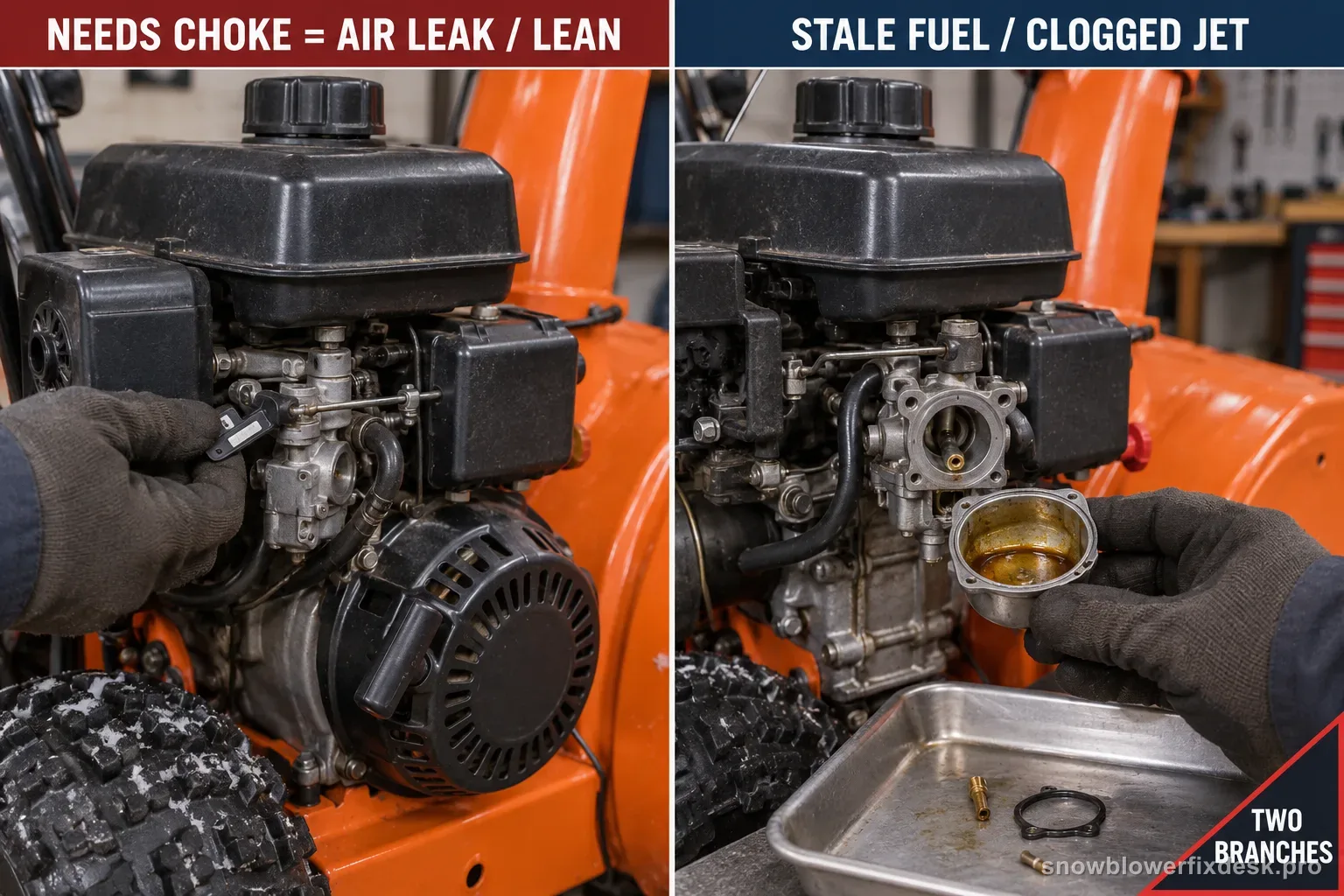
Rough running on the current ST 224 should preserve whether the choke is still in the starting position, whether the symptom began after storage/refueling, and whether it changes as the engine warms. Husqvarna explicitly lists choke ON/FULL, a blocked fuel line and water/old fuel in the rough-running table. That is a more disciplined first pass than calling every surge a carburetor failure.
The manual routes a carburetor-replacement conclusion to an authorized service center. This is an important boundary: the public guide can help prove that the simple branches are not responsible, but it should not invent mixture-screw settings or promise that a generic replacement carburetor fits the exact current engine.
The current product identity is ST 224 NA 970 52 86-02 / 970528602, and Husqvarna’s current support path publishes a current-family operator manual for ST 224. Keep that SKU gate visible because the same ST 224 name also appears under older support records. The diagnosis below is intentionally tied to the current 970528602 manual rather than generalized to every orange ST 224 ever sold.
Husqvarna’s current troubleshooting table gives a compact but useful rough-running sequence: choke left in the starting position, a blocked fuel line, and water/old fuel. Those branches describe different histories. A choke error can change immediately when the control is corrected; contaminated or old fuel usually tracks with storage/refueling history; a blocked fuel path can persist with fresh fuel. Preserve which change affects the symptom instead of replacing the carburetor first.
Do not blur ‘runs rough’ into ‘decreased power.’ The same manual has additional causes under decreased-power troubleshooting, but this page is for an engine that idles or runs roughly/surges. If the engine is smooth at no load and merely loses power while ingesting heavy snow, use the load/discharge diagnosis instead of expanding this article into every performance problem.
Partial choke is a clue, not a repair. If the engine becomes smoother only when the choke is moved back toward the start position after it should be warm, record that behavior for fuel/engine service. Do not operate the snow blower indefinitely with the choke used as a compensation device; the manual’s normal running state and its authorized-service boundary still apply.
Observe the engine after warm-up with the choke fully in the normal run position. If the surging disappears only when choke is partly applied, preserve that pattern but do not operate permanently that way. Husqvarna’s rough-running row keeps choke position, fuel line, stale fuel, carburetor and belt-related load branches separate. Correct fuel condition and visible control position first; persistent hunting with known fuel belongs at service rather than being treated as automatic proof of a carburetor replacement.
Read Husqvarna’s rough-running row literally before blaming the carburetor. On the ST 224 manual, an engine that idles or runs roughly can be linked to the choke remaining in the wrong position, a blocked fuel line, water or old fuel, a carburetor that needs service, or a stretched auger V-belt. Start with what can be observed without disassembly: warm the engine, move the choke fully to the normal run position and listen for whether the hunting changes; verify fuel condition; and inspect only the owner-accessible fuel path. If partial choke makes it run better, preserve that clue but do not leave the machine operated that way as a permanent fix.
The belt entry in the same troubleshooting row is a reminder to compare roughness unloaded and under attachment load. If the engine is smooth with the auger disengaged but begins to hunt or lose speed only when the attachment is engaged, do not collapse that into a fuel-only diagnosis; inspect the auger-belt/load branch and make sure the snow path is not adding abnormal drag. If it surges even with the attachment off and known fresh fuel, the fuel/carburetor side becomes stronger. Do not alter governor settings or mixture screws by guess. Persistent rough running after the external checks belongs at authorized service, especially on current SKU 970528602 where exact manual identity should travel with the machine.
Before you order parts
Before buying engine parts, confirm current SKU 970528602, correct choke position after warm-up and the fuel history. If the machine only continues running with choke applied, record that fact but do not use partial choke as the permanent operating state.
Before buying a carburetor or fuel-line component, confirm 970528602 on the product label and document the fuel age, recent refueling history, choke position after warm-up and whether the symptom changes at no load versus snow load. That four-item record prevents an old-SKU part recommendation from hiding inside a generic ST 224 diagnosis.
Do not treat one rough-running event immediately after a cold start as proof of a defect. Let the machine complete its normal warm-up/control transition, then judge the running condition with the choke in the correct operating position. If the symptom only exists during an improper choke state, fix the operating sequence before buying parts.
Back to the exact model hub →Retest without creating a second problem
After one fuel/control correction, let the engine stabilize unloaded outdoors. Move the choke to the normal running position and note whether the roughness returns immediately, only under snow load, or not at all. That pattern is more useful for service than multiple simultaneous part changes.
Make the first retest outdoors with the auger and traction controls released. Once the engine is warm and the choke is in the normal running position, observe whether the idle/run quality is stable long enough to establish a baseline. If it still hunts unloaded, stop before adding snow load.
If unloaded operation is stable, apply only a modest attachment load and note whether the symptom returns. Roughness that appears only under heavy feed belongs in a different diagnostic branch than roughness that persists with no load. Keep that distinction when escalating to Husqvarna service.
Make sure this is the right symptom
If your machine is showing an adjacent symptom instead, switch paths before changing parts: won't start.
The same search phrase can lead to a different branch on another machine. Compare the nearest model-specific examples: Ariens Deluxe 24 (921069): runs briefly then stops · Troy-Bilt Storm 2410 family: runs rough or surges.
Model-specific notes
- “Only runs with choke” is useful evidence because the manual expects the choke to be OFF/CLOSE after starting.
- Choke-dependent running is evidence, not proof that the carburetor itself has failed.
Questions people get wrong on this model
If it runs better with choke partly on, should I leave it there?
No. The current manual lists choke left ON/FULL as a rough-running cause; use the condition as diagnostic evidence rather than a permanent workaround. “Only runs with choke” is useful evidence because the manual expects the choke to be OFF/CLOSE after starting. If the machine only continues running with choke applied, record that fact but do not use partial choke as the permanent operating state.
Should I adjust the carburetor mixture myself?
The current troubleshooting table sends the carburetor-replacement branch to authorized service rather than giving an owner mixture-adjustment procedure. The table names a blocked fuel line and water/old fuel as separate branches. The adjacent decreased-power table includes blocked air intake/muffler conditions. Before buying a carburetor or fuel-line component, confirm 970528602 on the product label and document the fuel age, recent refueling history, choke position after warm-up and whether the symptom changes at no load versus snow load.
Can old or water-contaminated fuel cause rough running on the ST224?
Yes. Husqvarna's troubleshooting material includes water in the fuel or fuel that is too old as an engine-running cause. Correct fuel condition and normal choke position before using carburetor adjustment as the explanation. Move the choke to the normal running position and note whether the roughness returns immediately, only under snow load, or not at all.
Primary-source trail
Manufacturer material used for this diagnosis. Verify the model/serial range before ordering parts or applying an adjustment.
Husqvarna ST 224 current product page — SKU 970528602Official current North American product identity: ST 224 NA 970 52 86-02, 24-inch width, friction-disc transmission and 12.9 cu.inch engine displacement.www.husqvarna.com →Husqvarna ST 224 / ST 227 / ST 230 Operator Manual 2069-003Official current-family manual with starting, rough-running, recoil, traction, discharge, vibration and chute troubleshooting tables.www-static-nw.husqvarna.com →Husqvarna ST 224 US support pageOfficial ST 224 support and SKU-selection path; use the machine SKU here before choosing manuals or parts.www.husqvarna.com →