Cub Cadet 2X 24 31AM5HVRB10 Won't Move: Drive Cable, Belt and Friction Disc
A wheel-drive diagnosis for exact model 31AM5HVRB10, which Cub Cadet specifies with friction-disc all-wheel drive.
Applies to 2X 24 IntelliPOWER (31AM5HVRB10)
Identifiers: 31AM5HVRB10 · 2X 24 IntelliPOWER
Engine ID: 875-W0
Guide scope: This guide is for exact model 31AM5HVRB10. Its product page lists the 31X 500/600/800 operator manual form 769-26795 plus model-specific supplement/engine forms; use the exact product page/manual set rather than a different 2X 24 generation.
Cub Cadet identifies this exact machine as 31AM5HVRB10. The product ID is 11 characters and is printed on the Product Identification Label.
Cub Cadet’s official drive-loss flow checks control/cable adjustment and belt condition before the friction-wheel rubber branch; that order avoids replacing the friction wheel for a simpler engagement problem.
Shut the engine off, remove the ignition key, disconnect the spark-plug wire and work on a flat surface before drive-system inspection.
Diagnostic sequence
Work in order. The early checks are intentionally low-disassembly and model-specific; stop once the symptom changes or the fault is confirmed.
Confirm exact 31AM5HVRB10
Why this check: The 2X 24 name spans different years and configurations.
What to do: Match the 11-character Product Identification Label before applying drive adjustments or ordering a belt/friction-wheel part.
Preserve the symptom pattern
Why this check: A machine that runs and throws snow but will not propel isolates the complaint to the traction side more cleanly.
What to do: Record whether every forward and reverse speed is affected, whether the machine only slips under load, and whether the auger remains normal.
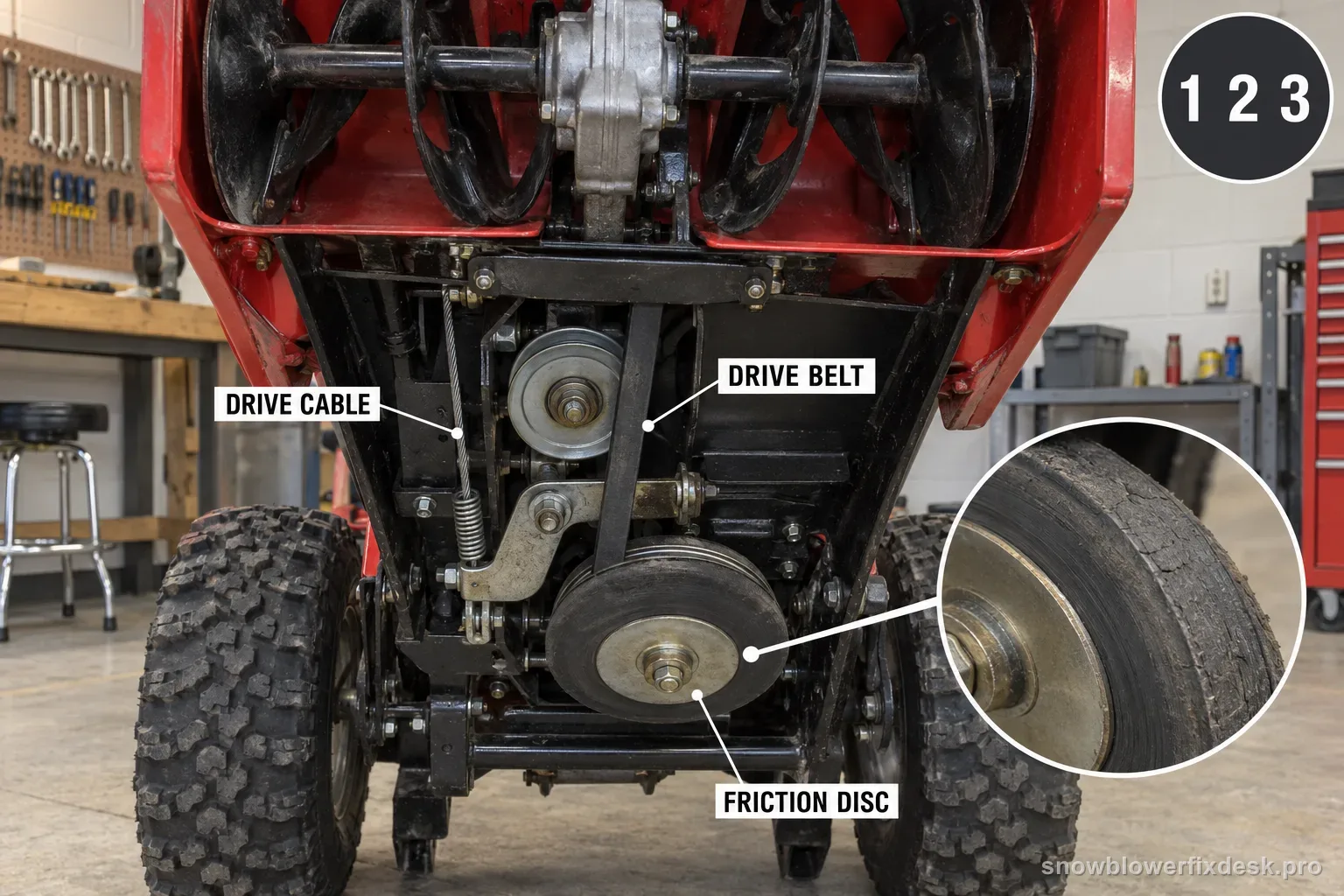
Drive-control cable
Why this check: Cub Cadet identifies cable adjustment early in its official auger/drive-loss troubleshooting path.
What to do: Inspect cable condition and control travel. Use the exact manual procedure; do not keep increasing tension if the released control no longer disengages normally.
Wheel-drive belt
Why this check: The official flow calls for belt inspection before the friction-wheel conclusion.
What to do: With the machine safely disabled and the correct cover removed, inspect the drive belt for cracking, glazing, damage or an obvious routing/tension problem.
Friction-wheel rubber
Why this check: Cub Cadet specifically names worn friction-wheel rubber for wheel-drive loss and gives an approximate 1/8-inch exposed-rubber wear criterion.
What to do: Use that wear evidence only after cable and belt checks. If the rubber is worn to the service threshold, follow the exact model service path rather than compensating with cable tension.
Retest low forward and reverse
Why this check: A friction drive can appear fixed in one selector position while still slipping or dragging elsewhere.
What to do: Reinstall guards, test low forward and reverse on level ground with the auger off, and verify the machine stops driving when the traction control is released.
How to read this symptom on this model
31AM5HVRB10 is useful diagnostically because Cub Cadet identifies the exact machine and specifies a friction-disc, all-wheel-drive system. That removes the common mistake of treating every premium two-stage drive complaint as hydrostatic. When the engine and auger remain normal but the wheels will not pull, stay on the traction side: control/cable engagement, wheel-drive belt and friction-wheel rubber.
Preserve the selector pattern before adjusting anything. No movement in all six forward and both reverse speeds points toward a common drive-engagement problem. Movement in some positions but severe slip in others can give different evidence about friction-wheel contact or selector geometry. If the machine moves unloaded but stalls under snow load, write that down too; replacing parts before preserving the pattern makes later diagnosis harder.
Cub Cadet’s official auger/drive-loss article deliberately puts cable adjustment and belt inspection before friction-wheel rubber. That order is valuable because cable stretch or a damaged belt can create the same user-facing complaint as worn friction material. It also prevents using cable tension to hide a belt or friction-wheel problem.
The friction-wheel wear threshold should be treated as evidence, not as a reason to replace the wheel because the machine is old. Cub Cadet cites approximately 1/8 inch of exposed rubber as the replacement point in its drive-loss article. Inspect only after the earlier control and belt branches are credible, and keep oil/grease away from the dry friction surfaces.
The exact product page lists manual forms for this machine, including 769-26795 for the 31X 500/600/800 operator family. Use that exact-model page as the gateway. A video or manual for another 2X 24 may look similar while using a different engine, supplement or control detail.
Do not treat the last branch as permission to keep experimenting. “Retest low forward and reverse” on 2X 24 IntelliPOWER (31AM5HVRB10) exists because a friction drive can appear fixed in one selector position while still slipping or dragging elsewhere. The documented next action is: Reinstall guards, test low forward and reverse on level ground with the auger off, and verify the machine stops driving when the traction control is released. Once that boundary is reached, preserve the results from the preceding checks. That gives service or parts lookup a concrete history of won't propel instead of a machine that has been changed in several undocumented ways.
The friction-disc wear threshold is meaningful only after engagement and belt checks. If the drive cable cannot pull the mechanism fully into engagement, a healthy friction wheel can look worn because it never receives normal clamping force. If cable travel is correct and the belt is intact but the machine still slips in several speed positions, inspect the friction wheel using the Cub Cadet service criterion. Keep oil and grease away from the friction surfaces; contamination creates the same symptom as wear.
Use the exact 31AM5HVRB10 drive layout when interpreting the symptom. Cub Cadet specifies this machine with a friction-disc, all-wheel-drive system and six forward plus two reverse speeds, and its official drive-loss guidance separates cable adjustment, drive-belt condition and friction-wheel wear. Compare more than one selector position before opening the lower drive area. If every forward and reverse speed is absent but the traction lever has obvious slack or incomplete travel, the control/cable branch remains stronger than a worn friction wheel. If some positions pull while others slip, preserve that pattern because it gives better evidence about selector and friction-drive behavior than the statement “won’t move.”
After the control check, inspect the wheel-drive belt before using the friction-wheel wear criterion. A belt that is damaged, glazed or not transferring load can mimic a friction-disc problem. Only when cable travel and belt condition are credible should the approximately 1/8-inch exposed-rubber wear guidance become a parts decision. Keep oil and grease away from the friction wheel and drive plate because the system depends on dry friction. Reassemble all covers, test low forward and reverse on level ground with the auger disengaged, and then release the traction control. A successful repair must both propel normally and stop driving cleanly after release; new creep is not an acceptable trade for restored motion.
Before you order parts
Before ordering a friction wheel, verify the 11-character model, record the all-speeds symptom, inspect cable/control travel and inspect the wheel-drive belt. If the friction-wheel rubber is then below the manufacturer’s wear criterion, the purchase has a documented reason instead of being a guess.
Before ordering a belt, look for cracking, glazing, damage or route/tension evidence under the matched procedure. Do not replace the belt and friction wheel together just to “cover everything”; doing so destroys the chance to learn which branch actually fixed the failure.
If the machine was recently serviced, verify that covers, belt route and controls were restored correctly before assuming a new component failed. A post-service no-drive symptom deserves a routing/assembly check first.
Back to the exact model hub →Retest without creating a second problem
Reassemble guards, keep the auger disengaged and test the lowest forward speed on level ground. Engagement should be predictable and the machine should stop pulling when the control is released. Then test reverse.
Move through additional selector positions only after low forward/reverse behave normally. This catches a repair that appears successful in one position while the friction drive still slips or binds elsewhere.
Stop if the machine creeps with the control released, engagement is violent, or drive remains weak under a modest load. Recheck the exact manual adjustment rather than tightening the cable beyond its intended setting.
Make sure this is the right symptom
The same search phrase can lead to a different branch on another machine. Compare the nearest model-specific examples: Ariens Deluxe 24 (921069): won't move · Troy-Bilt Storm 2410 family: won't propel.
Model-specific notes
- Cub Cadet specifies 31AM5HVRB10 with friction-disc drive, all-wheel drive and six forward/two reverse speeds.
- Do not lubricate the friction wheel or drive plate; the system depends on dry friction.
Questions people get wrong on this model
Does 31AM5HVRB10 use a hydrostatic transmission?
No. The 31AM5HVRB10 uses a friction-disc drive, but a no-propel complaint does not prove the friction wheel is worn. Confirm the 11-character product ID, verify drive-control/cable movement and inspect the belt branch first; only then use friction-wheel condition as a parts decision. Retest with the auger off.
When is the friction-wheel rubber actually evidence?
After the cable and belt branches are checked. Cub Cadet’s drive-loss article cites approximately 1/8 inch of exposed rubber as the replacement threshold. Cub Cadet identifies cable adjustment early in its official auger/drive-loss troubleshooting path. Cub Cadet specifically names worn friction-wheel rubber for wheel-drive loss and gives an approximate 1/8-inch exposed-rubber wear criterion.
Why test more than one forward and reverse speed after a drive repair?
The pattern can separate a common engagement problem from selector/friction-drive behavior that only appears in certain positions. Cub Cadet specifies this exact model with a friction-disc drive and six forward/two reverse speeds, so one working position is not a complete retest. Move through additional selector positions only after low forward/reverse behave normally.
Primary-source trail
Manufacturer material used for this diagnosis. Verify the model/serial range before ordering parts or applying an adjustment.
Cub Cadet 2X 24 IntelliPOWER product + manual pageExact model 31AM5HVRB10, engine 875-W0, friction-disc drive, overhead-crank chute and official manual forms 769-26924, 769-26938 and 769-26795.www.cubcadet.com →Cub Cadet operator-manual lookupOfficial manual resolver. Enter the exact 11-character product ID and serial number before using an engine or snowblower manual revision.www.cubcadet.com →Cub Cadet: Troubleshooting Auger or Drive LossOfficial two-/three-stage diagnostic order: cable adjustment, belts, shear pins and friction-wheel rubber.www.cubcadet.com →