EGO SNT2110 Battery Drains Fast: Separate Snow Load, Heat and Battery Wear
A runtime diagnosis for the SNT2110 that uses battery capacity, two-pack Peak Power behavior, snow load, auger speed, temperature protection and controlled pack comparison before calling a battery bad.
Applies to SNT2110 / SNT2110-FC
Identifiers: SNT2110 · SNT2110-FC
Guide scope: Applies to EGO SNT2110/SNT2110-FC. EGO recommends two 5.0Ah 56V batteries or two greater-capacity packs for best performance. The product page advertises a maximum clearing benchmark with two recommended 5.0Ah packs, but that is a test-condition benchmark rather than a guaranteed number of minutes for every snowfall.
EGO operator manual troubleshooting table is specific to SNT2110/SNT2110-FC.
Short runtime vs. overload or indicator fault
Use this page when charged batteries deliver unusually short working time. A flashing-orange shutdown under snow load belongs to the overload-protection path, while a red/orange state present before a runtime comparison belongs to the indicator-state diagnosis.
stops under load / flashing orange · red or orange power indicator
Short runtime is not a battery diagnosis by itself. First reproduce the complaint with two appropriately charged packs, note snow depth and wetness, watch the power indicator for overload or temperature protection, reduce clearing load and auger speed where practical, then compare packs under similar conditions. A large, repeatable runtime loss in light standardized work after a full charge is much stronger evidence of battery aging.
Remove both battery packs before clearing snow or ice from the auger/deck. Let hot packs cool naturally and use only EGO-approved chargers. Do not open, heat, puncture or bypass protection on a battery pack to test runtime.
Diagnostic sequence
Work in order. The early checks are intentionally low-disassembly and model-specific; stop once the symptom changes or the fault is confirmed.
Start with two suitable batteries, not an unknown mixed setup
Why this check: EGO says Peak Power combines two 56V packs and recommends two 5.0Ah packs or two greater-capacity packs for best SNT2110 performance.
What to do: Record both battery capacities and charge states before the test. Fully charge them with an approved charger and use two packs together for the baseline instead of comparing a single small pack against the published two-pack benchmark.
Treat the “12-car driveway” figure as a condition-specific benchmark
Why this check: EGO publishes up to a 12-car driveway with 8 inches of snow using two recommended 5.0Ah batteries, but actual energy demand changes sharply with snow density, depth, pace, auger speed and repeated reprocessing.
What to do: Do not translate the marketing area into a promised runtime in minutes. Compare your machine to itself under similar snow conditions and pack capacities instead.
Read the machine and battery indicators before recharging
Why this check: Low charge, overload and high-temperature protection produce different indicator behavior and imply different causes for an early stop.
What to do: If the machine stops, note whether the indicator is red, flashing red, solid orange or flashing orange before removing packs. Preserve that state as evidence rather than immediately charging and losing the diagnostic clue.
Reduce snow load before blaming the batteries
Why this check: The SNT2110 manual tells the operator to slow pace and narrow the clearing swath when overload or high-temperature protection occurs.
What to do: Clear lodged snow with the batteries removed, then retest in a narrower swath at a slower walking pace. If runtime improves substantially, operating load was part of the complaint.
Use only as much auger speed as the throw requires
Why this check: The product uses variable auger speed to control throwing distance; higher snow-moving demand increases the electrical work the packs must deliver.
What to do: For a controlled comparison, use a consistent moderate setting that still moves snow where needed. Do not compare one run at maximum throw with another run at a much lower auger setting and call the difference battery health.
Separate heat protection from true capacity loss
Why this check: EGO says battery high-temperature protection can shut the snow blower down and specifically warns against relying on one battery in snow deeper than 3 inches or very wet/icy snow.
What to do: If the indicator shows the over-temperature state, release the control and let the packs cool naturally. Retest with two packs, a narrower bite and slower pace. A thermal shutdown under extreme load is not the same evidence as a fully charged pack that has lost usable capacity.
Compare packs under the same light workload
Why this check: A controlled A/B comparison is more informative than judging a battery from one storm because snow can change within a single driveway.
What to do: After full charging and normalizing pack temperature, use the same two-pack combination in a light, repeatable section. If possible swap one suspect pack with a known-good compatible EGO pack while keeping the other conditions similar; note which combination causes the early depletion.
Use persistent reduced runtime as the battery-service boundary
Why this check: EGO battery guidance says significantly reduced runtime after full charging can indicate the pack is near the end of usable life, but only after load and protection states are separated.
What to do: If one pack repeatedly depletes much faster or the pair gives markedly reduced runtime in light comparable work without overload/heat indicators, move to EGO battery/service support instead of opening the pack or replacing the snow blower.
How to read this symptom on this model
Battery-runtime complaints are unusually easy to misread because the SNT2110 does not consume energy at a fixed rate. Snow depth, water content, clearing width, walking pace, auger speed and repeated handling of the same pile can change demand from one pass to the next. EGO’s published clearing-area benchmark is useful product context because it names two 5.0Ah batteries and 8 inches of snow, but it is not a promise of a particular number of minutes in every storm. A fair diagnosis compares the machine to itself under similar conditions rather than converting a driveway-size claim into a universal stopwatch target.
Begin with pack configuration because Peak Power is a two-battery system. EGO recommends two 5.0Ah packs or two greater-capacity packs for best performance. A test with one smaller pack, one nearly empty pack or two very different states of charge is not equivalent to the recommended configuration. Record both Ah ratings and the starting charge indication. When one member of the pair is much weaker, the pair can feel like “both batteries drain fast” even though substitution later reveals one pack as the limiter.
Indicator state separates depletion from protection. A red or flashing-red state points toward low charge, while orange states belong to temperature or overload behavior. That distinction matters because an overload shutdown can happen before the packs have surrendered all usable stored energy. If the machine stops in packed wet snow with an orange condition, clear the auger/deck with both batteries removed, let hot packs cool when required, then reduce pace and swath width. Calling that event “the batteries went dead” would skip the protection branch entirely.
EGO specifically warns about high-temperature protection when a single battery is used in snow deeper than 3 inches or in very wet or icy conditions and recommends two batteries working together. That warning is valuable for runtime diagnosis because one-pack operation can create heat and shutdown that resemble poor capacity. It does not mean two packs can never overheat; heavy continuous load can still generate substantial heat. It means the baseline should use two suitable packs before battery health is judged.
Variable auger speed is another hidden comparison variable. The control changes throwing performance, and higher snow-moving demand asks more from the batteries. For diagnosis, pick a repeatable moderate setting that clears the test area and keep it the same across pack comparisons. If one run is at maximum throwing demand and the next is at a lower setting, the runtime difference cannot be assigned cleanly to battery health. Snow condition should also be held as constant as practical.
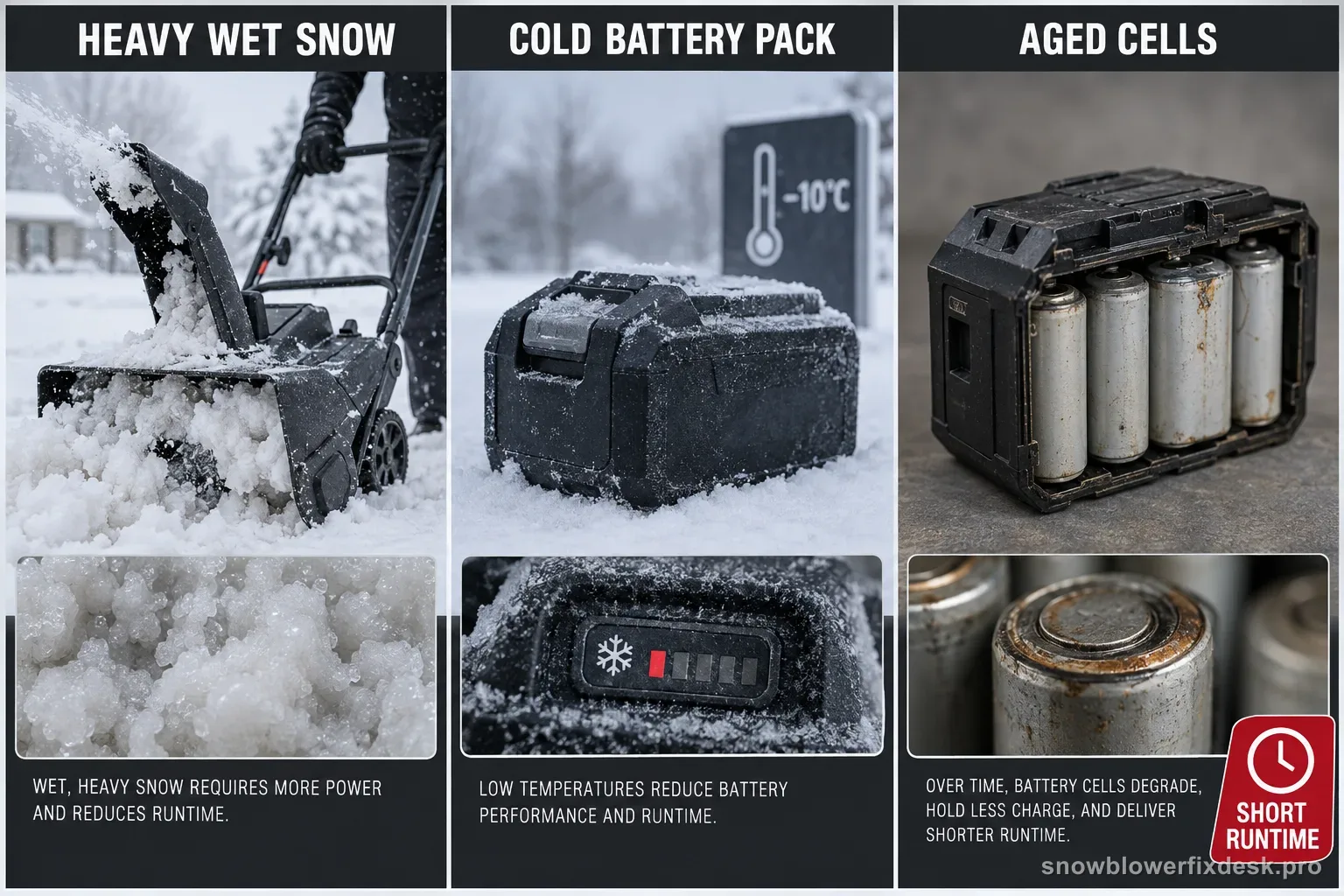
Temperature can affect both protection and perceived capacity. Do not compare packs that begin one test hot from charging or heavy work with packs that begin another test at a normal stable temperature. Let an overheated pack return to the normal state before repeating. Cold-weather behavior can also be different from room-temperature charging conditions. The safest useful comparison is after full charging with approved equipment, normal pack condition, the same machine and a light controlled snow load.
A/B substitution is the strongest owner-level way to identify one weak pack without opening anything. Keep one known-good compatible EGO pack in the pair and change only the suspect member, or compare two known combinations under the same light load. Note which pack reaches low-charge indication first. If the short-runtime complaint follows one pack across otherwise similar tests, battery wear becomes much more plausible than a snow-blower motor problem.
A tool-side problem should remain on the table when multiple known-good packs all lose runtime abnormally in the same light conditions without overload or heat indicators. At that point do not keep buying batteries. Use EGO support with the model, pack capacities, indicator history, snow/load conditions and controlled comparison result. Conversely, if one older pack repeatedly depletes far earlier after full charging while a substitute restores normal operation, EGO’s battery guidance recognizes significantly reduced run time as an end-of-life signal.
Before you order parts
Before buying higher-capacity batteries, establish a two-pack baseline with the batteries you already own, both fully charged and at normal temperature. A configuration problem or overload should not be solved with an expensive pack purchase.
Do not buy a replacement battery based only on one storm or on failure to match EGO’s maximum driveway benchmark. Wetness, depth, swath width, pace and auger speed can move energy demand dramatically.
Do not replace the snow blower because both packs show early shutdown until the indicator state is recorded. An orange overload/temperature event points to a different branch than repeat low-charge depletion in light work.
When one suspect pack is identified by controlled substitution, use EGO battery/service support and warranty information rather than opening the pack. Internal lithium-ion battery repair is outside this guide.
Back to the exact model hub →Retest without creating a second problem
Fully charge two suitable packs, let them reach normal operating condition, note their capacities and start with the same auger setting in a light repeatable section of snow.
If the first run shows overload or heat protection, clear the machine safely, reduce pace and swath width and repeat only after the packs return to a normal state. Improvement here supports a load-driven explanation.
Swap only one battery with a known-good compatible pack while keeping the other pack and operating conditions as similar as possible. A runtime problem that follows one pack is useful evidence of pack wear.
If multiple known-good pack pairs show the same abnormal depletion in light work without orange protection states, preserve the results and move to EGO tool/service diagnosis instead of purchasing more batteries.
Model-specific notes
- This page is for abnormal short runtime or batteries that seem to empty much faster than expected. If the machine stops specifically with a flashing-orange overload indication, use the under-load/flashing-orange diagnosis first.
- A red or flashing-red state near the end of a run is different from solid orange temperature protection. Record the indicator before resetting the machine because charging immediately can erase the most useful clue.
- EGO’s published clearing-area claim assumes a named battery configuration and snow condition. It is useful as product context, not a guarantee that every driveway or every pair of 5.0Ah packs will deliver the same minutes of operation.
- Heavy wet snow, a full-width bite and high throw demand can consume much more energy than light powder. Runtime comparisons only mean much when battery capacity, temperature, snow load and operating settings are reasonably similar.
- Do not condemn both batteries because one pack is weak. Peak Power uses two packs together, so controlled substitution can reveal whether one member of the pair is the limiting pack.
Questions people get wrong on this model
How long should EGO SNT2110 batteries last in snow?
EGO does not give one guaranteed runtime in minutes because snow and operating load vary. Its SNT2110 product benchmark says two recommended 5.0Ah batteries can clear up to a 12-car driveway with 8 inches of snow. Use that only as condition-specific context. For diagnosis, compare your fully charged packs under similar snow depth, wetness, auger speed and clearing width.
Why do my SNT2110 batteries die much faster in wet heavy snow?
Wet, deep or icy snow makes the auger work harder and increases current and heat. EGO’s manual tells users to slow their pace and narrow the clearing swath when the machine is overloaded or running into high-temperature protection. If a lighter, narrower pass substantially extends runtime and the indicator no longer goes orange, the original short run was at least partly load-related rather than proof of a failed pack.
Can I run the EGO SNT2110 on one battery to make the second battery last longer?
The SNT2110 can accept EGO 56V packs, but EGO recommends two batteries working together for Peak Power and specifically warns against relying on one battery when snow exceeds 3 inches or is very wet or icy because high-temperature protection may shut the machine down. For a runtime diagnosis, use two suitable charged packs so a one-pack thermal limitation is not mistaken for poor battery capacity.
How can I tell whether one EGO battery is worn out?
Fully charge both packs, let them reach a normal operating temperature and compare them under the same light workload. If substituting one known-good compatible pack repeatedly restores runtime, or one pack reaches low-charge indication much earlier while the machine is not overloaded or overheated, that is stronger evidence of a weak pack. EGO battery guidance also treats significantly reduced runtime after full charging as an end-of-life warning.
Primary-source trail
Manufacturer material used for this diagnosis. Verify the model/serial range before ordering parts or applying an adjustment.
EGO SNT2110/SNT2110-FC Operator ManualOfficial troubleshooting table for battery, frozen auger, drive belt and scraper conditions.egopowerplus.com →EGO SNT2110 steel-auger product pageOfficial product identity for the SNT2110 platform, including the two-56V-battery architecture and supported accessories.egopowerplus.com →EGO product supportOfficial support path for manuals, service help and model-specific support when external checks do not resolve the fault.egopowerplus.com →EGO 56V battery informationOfficial battery-system information used as a companion source for battery state, temperature and pack-handling boundaries.egopowerplus.com →