Honda HSS928A Weak Throw: Throttle, Snow Load, Chute and Belt
An HSS928A weak-discharge path that uses FAST throttle, hydrostatic ground speed and snow load as controlled tests before the belt/service branch.
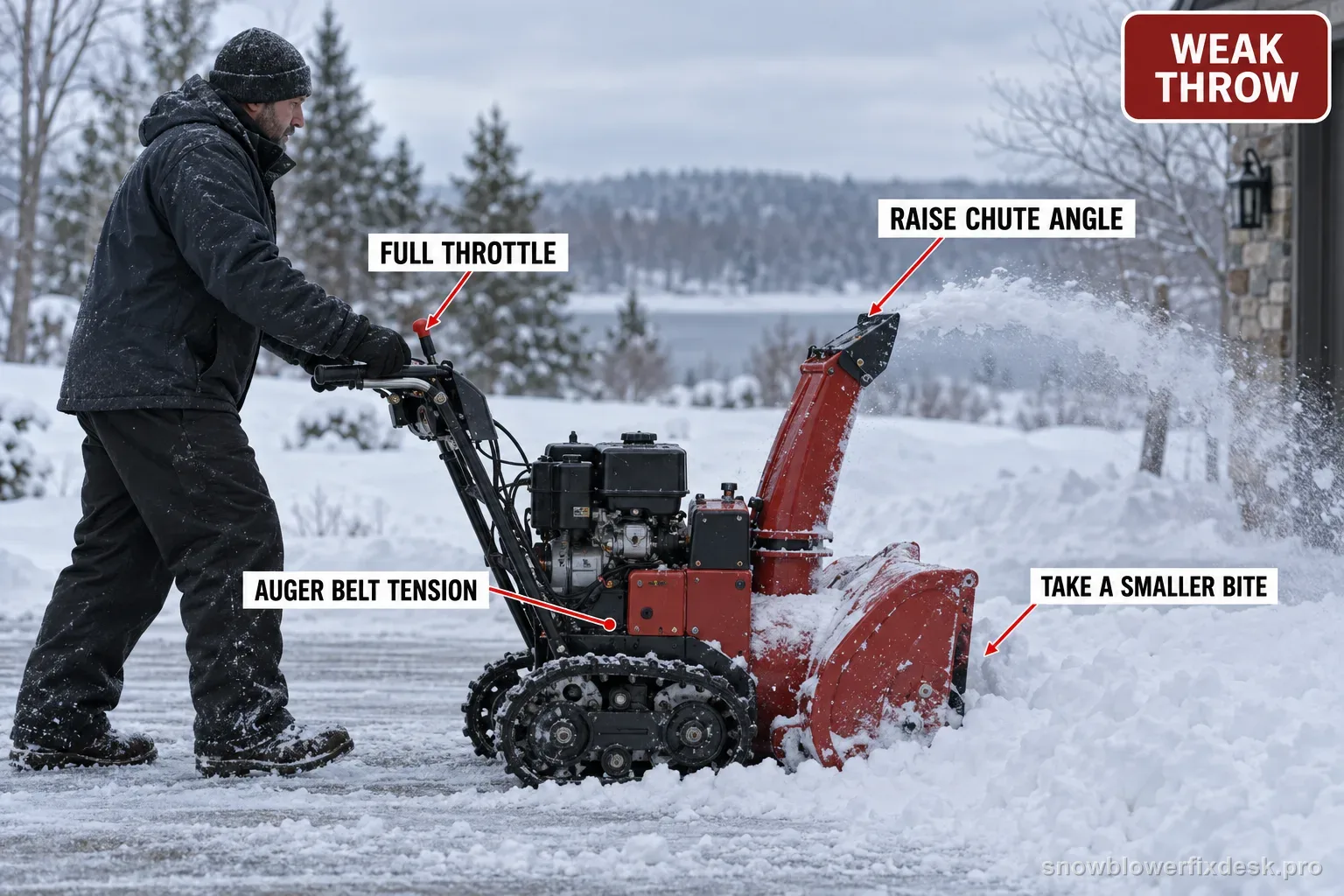
Applies to HSS928A track family (HSS928AAT / HSS928AATD)
Identifiers: HSS928A · HSS928AAT · HSS928AATD · HSS928APT · HSS928APTD · HSS928AT · HSS928ATD
Engine ID: Honda GX270
Frame / description code: SADA
Guide scope: Use the HSS928A frame serial before relying on a manual revision: Honda assigns owner manual A157 to SADA 1000001–2020200 and A159 to SADA 2020201+. The core weak-discharge branches are retained, but serial-to-manual matching still comes first.
Honda splits HSS928A owner manuals at frame serial SADA 2020201. Match the full model name, resolve the frame serial range, then record both frame and engine serial numbers before ordering parts or escalating service.
This model has serial-range boundaries — resolve the serial before using a manual →
Weak distance vs. no discharge
Use this page when the machine still throws snow but the distance is short. No snow leaving the chute belongs to the no-blow path; an engine that cannot hold rpm under load belongs to the low-power path.
Honda’s troubleshooting table for poor discharge points to low auger speed, wet/deep snow, excessive ground speed and belt condition; its low-power table also includes chute restriction.
Keep hands out of the chute and auger housing. Stop the engine and remove the spark-plug cap before clearing any restriction.
Diagnostic sequence
Work in order. The early checks are intentionally low-disassembly and model-specific; stop once the symptom changes or the fault is confirmed.
Match the HSS928A frame serial
Why this check: Honda splits HSS928A owner manuals at SADA 2020201.
What to do: Read the SADA frame serial and use Honda’s owner-manual index before applying revision-specific instructions or part references.
Keep throttle at FAST for the test
Why this check: Honda says the auger can spin too slowly when engine speed is too low during snow blowing.
What to do: Standardize the test at FAST throttle rather than comparing one pass at part throttle with another at full speed.
Reduce hydrostatic ground speed
Why this check: Honda lists moving too fast as a cause of snow not discharging properly.
What to do: Slow the travel setting while keeping engine speed at FAST. If throw improves immediately, the machine was being fed less snow per second and load becomes the stronger clue.
Narrow the swath in wet or deep snow
Why this check: Wet/deep snow is a separate Honda troubleshooting branch and can overwhelm discharge without a failed belt.
What to do: Take a narrower bite and compare in the same snow. Do not use a full-width pass through a dense berm as the only belt test.
Clear any chute restriction
Why this check: Honda includes a restricted discharge chute in its engine-low-power/snow-handling troubleshooting.
What to do: If throw suddenly collapses, stop the engine, remove the spark-plug cap and clear the chute safely before loading the machine again.
Move to belt/service only after controlled tests
Why this check: Honda lists a worn, off or incorrectly installed belt as a mechanical poor-discharge branch.
What to do: If throw remains weak in modest snow with FAST throttle, reduced travel speed and a clear chute, preserve those results and use the matched service/dealer path for the belt rather than guessing an adjustment.
How to read this symptom on this model
Honda’s HSS928A troubleshooting table gives an unusually clean way to separate operating load from mechanical attachment trouble. Under “snow not discharging properly,” it points to low auger speed, wet/deep snow, excessive ground speed and belt condition. The related engine-low-power table also includes chute restriction. Those branches mean throw distance should be diagnosed with engine speed, travel speed, snow load and chute condition controlled before the belt is blamed.
Hydrostatic ground speed is the best controlled variable on this machine. Keep engine throttle at FAST and reduce only travel speed. That lowers how much snow enters the housing per second without reducing the intended engine/auger speed. If discharge improves substantially, the observation supports load/feeding conditions. If it remains weak in a narrow light pass, the attachment-drive branch becomes stronger.
Wet or deep snow can mimic a weak machine because the housing fills faster and the discharge stream becomes denser. Honda’s answer is to reduce the clearing swath or speed, not to lower engine speed. Comparing a full-width pass through a plow berm with a narrow pass in powder is therefore not a valid before/after belt test.
A restricted chute can also shorten throw and make the engine sound loaded. Sudden performance loss during one pass deserves a safe chute check before any belt diagnosis. A clear chute that repeatedly re-packs in the same wet conditions may still be an operating-condition problem, while a clear chute with persistent weak discharge in modest snow points elsewhere.
The belt branch is a service boundary in the owner troubleshooting: worn, off or incorrectly installed belt conditions are listed, but the owner manual does not turn that into an invitation for arbitrary tension adjustment. Once the controlled external tests fail, preserve the evidence and move to the matched service information.
Serial matching remains important even though the core branches are similar. Honda’s owner-manual index maps SADA 1000001–2020200 to A157 and SADA 2020201+ to A159. Use the frame serial first so any later maintenance or service detail comes from the correct document.
Keep this symptom separate from both “nothing comes out” and true engine low power. Weak throw means snow still exits, but the distance stays short after the chute is clear. If the engine itself cannot hold normal speed under a light load, move to the low-power diagnosis; if the auger/impeller path stops moving snow altogether, use the no-discharge path. That three-way split matters on the HSS928A because the controlled FAST-throttle and slower-hydrostatic-speed test is useful only when the discharge system is still operating and the question is how strongly it throws.
Compare throw only after engine speed, ground speed and chute condition are controlled. Keep the throttle at FAST and reduce hydrostatic travel speed so less snow enters per second. If distance improves, feed rate is part of the symptom. If snow still exits only a short distance in modest conditions with a clear chute, belt/attachment service becomes more credible. Do not use a maximum advertised throw figure as a pass/fail test; moisture, depth, wind and snow density can change real distance dramatically.
Weak throw should still produce a visible, continuous snow stream. If nothing leaves the chute at all, move to Honda’s separate “won’t blow snow” causes such as clutch engagement, shear bolts, obstruction, or belt service. If snow does leave but falls short, the “not discharging properly” row makes FAST throttle, reduced ground speed, narrower feed and belt condition the relevant sequence. Keeping those two manual rows separate prevents a broken shear bolt from being diagnosed as “weak throw” and prevents ordinary wet-snow overload from being escalated straight to auger-drive parts.
Before you order parts
Before ordering an auger/attachment belt, repeat the symptom at FAST throttle with a clear chute, reduced hydrostatic travel speed and a narrower swath. A strong improvement under those controlled changes argues against immediately buying the belt.
Before comparing the machine with an advertised maximum throw figure, remember that throw distance varies with snow moisture/depth, wind and feed rate. Use your own controlled same-snow comparison instead of treating a marketing maximum as a repair specification.
Before escalating to engine work, ask whether the engine is actually low on power in a modest no/low snow load. If it runs normally but only the discharge stream is weak, stay on the snow-load/chute/attachment path first.
Back to the exact model hub →Retest without creating a second problem
Choose one short stretch of reasonably consistent snow. Set throttle to FAST, begin at a slow hydrostatic travel speed and make a narrow pass. Record the discharge behavior before changing another variable.
Increase only one load variable at a time—either travel speed or swath. If throw deteriorates predictably as feed rate rises, you have useful load sensitivity evidence rather than an uncontrolled “sometimes weak” complaint.
Stop if discharge suddenly collapses, the engine stalls, or abnormal belt/attachment noise appears. Clear restrictions safely and do not keep feeding snow into a possible jam. If controlled light-load throw remains weak, move to the matched belt/service path with the SADA serial and test results.
Make sure this is the right symptom
If your machine is showing an adjacent symptom instead, switch paths before changing parts: low engine power while blowing snow.
The same search phrase can lead to a different branch on another machine. Compare the nearest model-specific examples: Ariens Deluxe 24 (921069): not throwing snow · Toro Power Clear 721 E (38753): not throwing snow.
Model-specific notes
- Honda’s product specification lists maximum throw performance under favorable conditions, but real throw distance is not a fixed field diagnostic because moisture, depth, wind and feed rate vary.
- The hydrostatic transmission is useful diagnostically: it lets you reduce ground speed without reducing the engine/auger speed used for the comparison.
Questions people get wrong on this model
Does weak throw automatically mean the auger belt is bad?
No. Honda puts throttle/auger speed, wet or deep snow, ground speed and chute condition in the troubleshooting path before the belt conclusion. If throw remains weak in modest snow with FAST throttle, reduced travel speed and a clear chute, preserve those results and use the matched service/dealer path for the belt rather than guessing an adjustment.
Why keep the engine at FAST while slowing the machine?
That changes snow feed rate while keeping the auger/engine speed appropriate for clearing, which makes the comparison more informative. Honda says the auger can spin too slowly when engine speed is too low during snow blowing. The hydrostatic transmission is useful diagnostically: it lets you reduce ground speed without reducing the engine/auger speed used for the comparison.
What does it mean if throw improves when I take a narrower pass?
It shows snow load and feed rate are materially affecting performance. That does not prove the belt is perfect, but it makes an overload/operating-condition branch more credible than immediately replacing attachment parts. If throw improves immediately, the machine was being fed less snow per second and load becomes the stronger clue.
Primary-source trail
Manufacturer material used for this diagnosis. Verify the model/serial range before ordering parts or applying an adjustment.
Honda HSS928A owner manual 00X31V45 A157Official troubleshooting, serial-number, operating and specification tables for HSS928A frame serial SADA 1000001–2020200.cdn.powerequipment.honda.com →Honda HSS928A owner manual indexOfficial serial-to-manual crosswalk; HSS928A changes to manual A159 at SADA 2020201.powerequipment.honda.com →Honda HSS928A owner manual 00X31V45 A159Official current-range manual for HSS928A frame serial SADA 2020201+; troubleshooting tables retain the same core no-start, drive and snow-handling branches.cdn.powerequipment.honda.com →Honda HSS928AT / HSS928ATD product supportHonda Power Equipment product data for full model names, GX270 engine, hydrostatic track drive, electric joystick chute and AT versus ATD starting-system differences.powerequipment.honda.com →