Honda HSS928A Won't Blow Snow: Shear Bolts, Obstruction, Belt
The exact HSS928A snow-handling sequence from Honda’s owner troubleshooting table, with the shear-bolt safety function kept intact.
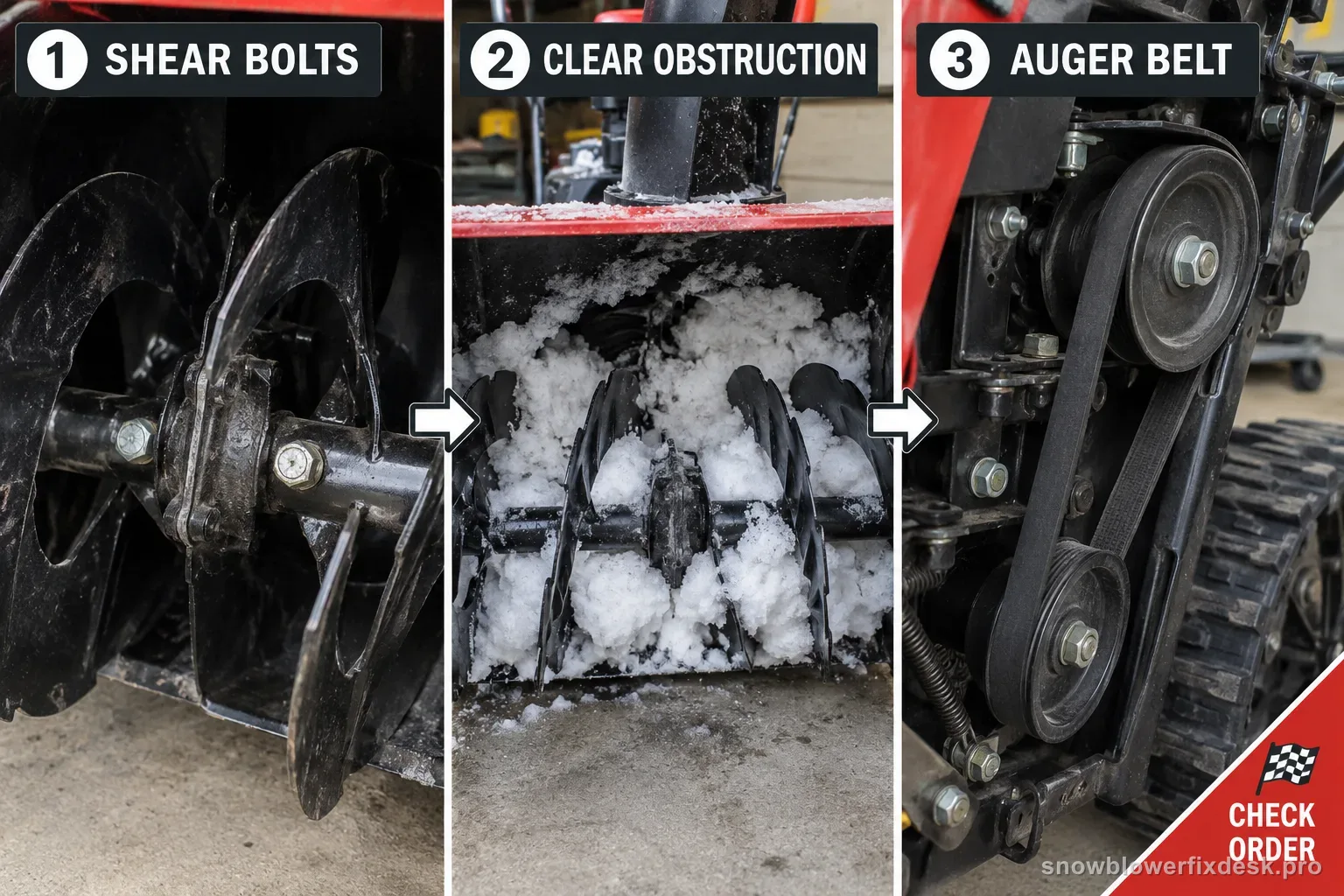
Applies to HSS928A track family (HSS928AAT / HSS928AATD)
Identifiers: HSS928A · HSS928AAT · HSS928AATD · HSS928APT · HSS928APTD · HSS928AT · HSS928ATD
Engine ID: Honda GX270
Frame / description code: SADA
Guide scope: Use only after matching the HSS928A frame serial to Honda's owner-manual split: A157 for SADA 1000001–2020200 and A159 for SADA 2020201+. Keep revision-specific shear, belt and service details with the matched manual.
Honda splits HSS928A owner manuals at frame serial SADA 2020201. Match the full model name, resolve the frame serial range, then record both frame and engine serial numbers before ordering parts or escalating service.
This model has serial-range boundaries — resolve the serial before using a manual →
Nothing comes out vs. weak throw
Use this page when snow does not leave the discharge path at all. If snow exits but lands unusually close, use the weak-throw diagnosis; if engine rpm falls under load, use the engine-low-power page.
Honda lists auger-clutch position, broken shear bolt(s), chute restriction/foreign object and an auger belt that is worn or off the pulleys.
Stop the engine, wait for all rotation to stop and remove the spark-plug cap before clearing the chute or auger. Use the clearing bar, never your hands.
Diagnostic sequence
Work in order. The early checks are intentionally low-disassembly and model-specific; stop once the symptom changes or the fault is confirmed.
Auger clutch actually engaged
Why this check: Honda starts the no-blow row with the auger clutch lever position.
What to do: Verify normal control engagement from the operator position before opening covers.
Shear bolts
Why this check: Honda designs these bolts to fail before more expensive auger/blower parts absorb an overload.
What to do: Inspect each specified shear-bolt location. Replace only with the correct shear hardware; never substitute an ordinary bolt.
Chute and auger obstruction
Why this check: A restricted chute or foreign object stopping the auger is explicitly listed.
What to do: Shut down completely, remove the spark-plug cap and use the Honda clearing bar to remove the obstruction.
Auger belt branch
Why this check: Honda lists a worn, displaced or improperly installed belt after the external checks.
What to do: If the chute is clear and shear bolts are intact, use Honda service/dealer support for the belt path rather than forcing the auger control.
How to read this symptom on this model
Honda’s sequence makes it possible to distinguish a control-state problem from an overload-protection event and from a deeper belt fault. If only one auger section stopped after hitting ice or an object, the shear-bolt branch deserves attention before belt covers or gearbox assumptions. If the whole snow path is packed or frozen, clearing the obstruction safely comes before any engagement test.
The shear bolt is part of the machine’s protection strategy, not merely a fastener. Honda warns against replacing it with ordinary hardware because a stronger substitute can pass the impact farther into the auger/blower system. That makes “use a normal bolt to finish the driveway” specifically bad advice for this model family.
Match the frame serial before borrowing any revision-specific page number or service detail. Honda’s manual index assigns A157 to HSS928A frame serial SADA 1000001–2020200 and A159 to SADA 2020201+. The current A159 troubleshooting table keeps the same owner-level ‘won’t blow snow’ branches, but the serial gate still matters because it prevents a future revision difference from silently becoming universal advice.
Keep ‘won’t blow snow’ separate from ‘snow not discharging properly.’ In Honda’s table, a machine that does not blow snow at all points first to the auger clutch, shear bolts, chute restriction or foreign-object blockage, then to a belt that is worn, off the pulleys or installed incorrectly. The neighboring poor-discharge row instead talks about auger speed, wet/deep snow, ground speed and belt condition. That distinction tells you whether to diagnose a missing drive path or an overloaded but still-functioning snow path.
Use the impact history as evidence. If the symptom appeared immediately after a buried object or hard ice strike and one auger section no longer transfers torque, a shear-bolt event becomes much more plausible. If both augers and the blower stop moving after the machine sat with wet snow packed inside, a frozen or obstructed path is a better first explanation. Neither observation proves a gearbox failure, so do not jump past the protective hardware and obstruction checks.
A clear chute does not prove the attachment drive is healthy. After the clutch position, shear bolts and obstructions are ruled out, Honda sends a worn/off/misinstalled belt condition to servicing-dealer work in the owner manual. That is the correct service boundary for this page: document whether the auger/blower responds at all and whether the symptom changes after clearing or shear-bolt replacement, then carry that evidence into belt service instead of inventing a cable dimension from another model.
“Nothing comes out” should begin with a stopped-machine inspection of the snow path. A plugged chute, foreign object or failed shear bolt can interrupt discharge even when the engine sounds normal. Clear the chute safely, then compare both auger sections and the impeller path before blaming belt tension or engine power. A single auger section that no longer follows the shaft after an impact is much stronger shear-bolt evidence than a general complaint that the machine will not throw.
Once the housing is clear and shear hardware is intact, watch what happens when the attachment is engaged without a heavy snow load. If the auger/impeller does not drive normally, the belt/service branch gains weight. If it spins normally but discharge collapses only in deep wet snow, reduce ground speed and swath instead. Keep this complete no-discharge pattern separate from the weak-throw article, where snow still exits and the question is distance rather than total loss of flow.
Honda’s no-discharge table is intentionally mechanical: confirm the auger clutch is engaged, then check broken shear bolts, a restricted chute or foreign object, and the auger/impeller belt. That makes “nothing comes out” different from an engine that simply cannot hold rpm or a machine that throws only a short distance. After clearing the chute and housing safely, observe whether one auger section is disconnected, whether the whole attachment fails to drive, or whether the system turns but slips under load. Each pattern points to a different row of the manual. Keeping those boundaries intact prevents an engine tune-up from being used to solve a broken shear bolt or packed discharge path.
Before you order parts
Before ordering an auger belt or gearbox part, establish whether the auger clutch was engaged, each correct shear bolt is intact and the chute/auger housing is clear. If those external checks are good but the attachment still does not drive, Honda places the belt branch at service/dealer level in this owner manual—use that boundary rather than inventing an adjustment dimension.
Do not order a gearbox because the auger does not turn after an impact. A shear bolt is deliberately cheaper and weaker than the driveline parts it protects. Confirm the correct Honda shear locations and inspect for an object that is still binding the auger before deciding that a replacement bolt ‘failed again’ or that the gearbox is damaged.
Do not buy a belt simply because discharge stopped. A disengaged auger clutch, a broken shear bolt and a packed chute can all produce a no-discharge complaint without a defective belt. The parts decision becomes stronger only after those external branches are eliminated and the exact frame serial/manual revision is known.
Back to the exact model hub →Retest without creating a second problem
After any obstruction or shear-bolt correction, restore the spark-plug connection, return the clearing bar to its holder and test the auger briefly from the operator position with no snow load. Confirm engagement and full stop on release before feeding a narrow light pass of snow.
Make the first retest with the machine unloaded. From the operator position, engage the auger only long enough to confirm that the attachment turns, then release and verify it stops. If the auger does not respond, do not feed snow into the housing merely to ‘see what happens’; the no-load failure already proves the repair is incomplete.
If the attachment behaves normally with no load, make one narrow pass in light snow at normal engine speed. A machine that now blows normally had an obstruction/shear/control-state problem; a machine that turns unloaded but immediately loses attachment drive under a modest load needs the belt/service branch rather than repeated shear-bolt or chute work.
Make sure this is the right symptom
If your machine is showing an adjacent symptom instead, switch paths before changing parts: low engine power while blowing snow.
The same search phrase can lead to a different branch on another machine. Compare the nearest model-specific examples: Ariens Deluxe 24 (921069): not throwing snow · Toro Power Clear 721 E (38753): not throwing snow.
Model-specific notes
- Honda explicitly warns that an obstructed auger or blower can move suddenly when the obstruction is released.
- Shear bolts are protective hardware. Stronger generic bolts can transfer impact into the gearbox/auger system.
Questions people get wrong on this model
If the shear-bolt head still looks present, can it still be broken?
A visual check should confirm the bolt actually connects the auger to the shaft; do not infer integrity only from one visible end. Confirm the correct Honda shear locations and inspect for an object that is still binding the auger before deciding that a replacement bolt ‘failed again’ or that the gearbox is damaged.
Why does Honda still require the clean-out tool after shutdown?
No. Honda says to disconnect the spark-plug cap and use the clearing bar, not your hands. After any obstruction or shear-bolt correction, restore the spark-plug connection, return the clearing bar to its holder and test the auger briefly from the operator position with no snow load.
Can a shear bolt still be the problem if the belt looks intact?
Yes. A belt can be present while a sheared fastener disconnects the auger from the shaft. Inspect the sacrificial hardware and obstruction path before assuming an intact-looking belt proves the attachment driveline is complete. Before ordering an auger belt or gearbox part, establish whether the auger clutch was engaged, each correct shear bolt is intact and the chute/auger housing is clear.
Primary-source trail
Manufacturer material used for this diagnosis. Verify the model/serial range before ordering parts or applying an adjustment.
Honda HSS928A owner manual 00X31V45 A157Official troubleshooting, serial-number, operating and specification tables for HSS928A frame serial SADA 1000001–2020200.cdn.powerequipment.honda.com →Honda HSS928A owner manual indexOfficial serial-to-manual crosswalk; HSS928A changes to manual A159 at SADA 2020201.powerequipment.honda.com →Honda HSS928A owner manual 00X31V45 A159Official current-range manual for HSS928A frame serial SADA 2020201+; troubleshooting tables retain the same core no-start, drive and snow-handling branches.cdn.powerequipment.honda.com →Honda HSS928AT / HSS928ATD product supportHonda Power Equipment product data for full model names, GX270 engine, hydrostatic track drive, electric joystick chute and AT versus ATD starting-system differences.powerequipment.honda.com →