Toro 721 QZE 38756 Electric Starter Frozen or Not Working: Check Serial First
A serial-aware 721 QZE electric-start path for later 38756 machines using Toro manual 3439-829, with cord safety, duty-cycle and freeze-up checks.
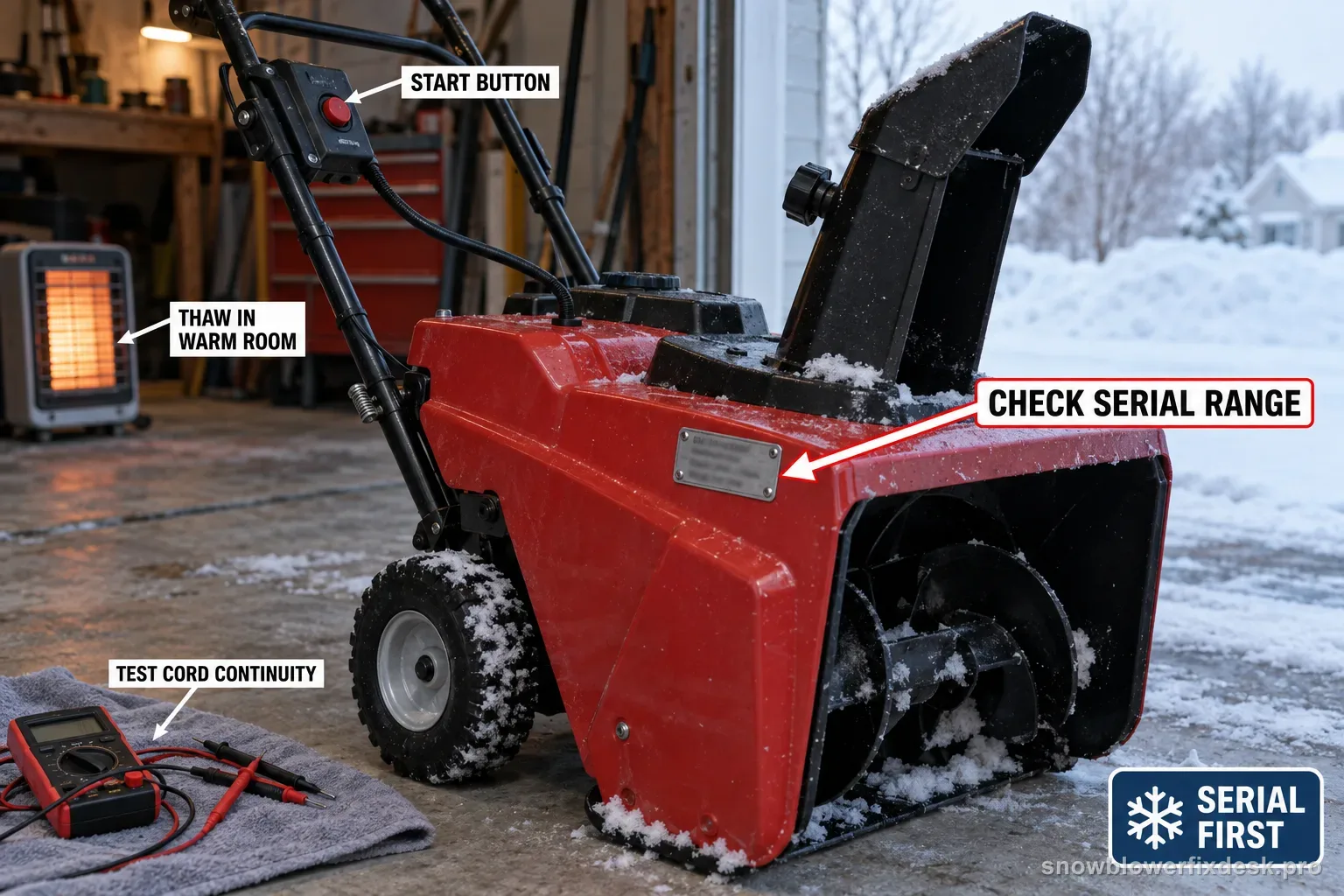
Applies to Power Clear 721 QZE (38756)
Identifiers: 38756 · 721 QZE
Engine ID: Toro 212cc
Guide scope: Manual 3439-829 applies to model 38756 serial 406728558 and up. Earlier serial 400000000–406728557 uses manual 3429-269 and should be resolved separately.
Model 38756 spans six verified serial ranges. Resolve the serial number before using manual or parts assumptions.
This model has serial-range boundaries — resolve the serial before using a manual →
721 QZE 38756 has its own chute-control context
This diagnosis is scoped to model 38756, the QZE variant with Quick Shoot. If the label says 38753, use the 721 E path rather than assuming the two pages are interchangeable.
For 38756 serial 406728558+, Toro confirms electric/recoil start, requires a GFCI-powered outdoor cord, limits starter cranking, and gives a specific post-use step to prevent recoil/electric starter freeze-up.
Use only the grounded electric-start procedure in the matched Toro manual. Unplug the cord whenever the machine is not being started, and never force frozen controls or open the 120V starter circuit.
Diagnostic sequence
Work in order. The early checks are intentionally low-disassembly and model-specific; stop once the symptom changes or the fault is confirmed.
Resolve model 38756 and serial
Why this check: Toro changed the operator-manual boundary within the same 721 QZE model number.
What to do: Use the model hub serial resolver. Continue with this guide only for serial 406728558 and up under manual 3439-829.
Check cord, GFCI outlet and connection order
Why this check: Toro specifies an outdoor UL-listed 16-gauge cord no longer than 50 ft and a GFCI outlet.
What to do: Inspect the cord, connect it to the machine first, then to the GFCI power outlet. Replace a damaged cord instead of testing around it.
Separate starter motion from engine firing
Why this check: A starter that spins the engine and an electric starter that does nothing are different faults.
What to do: If the starter operates but the engine does not fire, return to the 38756 no-start guide. If the starter/control itself is frozen or inactive, stay on this path.
Use the manual starter duty cycle
Why this check: Toro warns that extended electric-start use can overheat and damage the starter.
What to do: Use intervals of five seconds on and five seconds off, no more than 10 attempts in a series. If it still will not start, follow Toro’s cool-down/service boundary instead of continuous cranking.
Check freeze-up history
Why this check: Toro tells owners to exercise the recoil/electric starter after snow use specifically to prevent freeze-up.
What to do: If the problem followed wet snow/refreeze, remove snow/ice externally and let frozen parts thaw. Do not apply excessive force to controls or the starter.
How to read this symptom on this model
The serial boundary is the first diagnostic fact. Toro manual 3439-829 covers 38756 from serial 406728558 upward, while the earliest production range uses a different operator manual. Once the later range is confirmed, the manual supplies specific electric-start power-cord rules, a cranking duty cycle and a freeze-up prevention routine.
Recoil behavior helps classify the symptom. A machine that starts by recoil while the electric starter remains inactive is not the same case as a starter that cranks normally but the engine never fires. The latter belongs in the normal no-start path; the former stays in the starter/freeze branch.
For model 38756 in the later 3439-829 manual range, electric-start diagnosis begins with the power path. Toro specifies a GFCI outlet and a UL-listed 16-gauge outdoor-use power cord no longer than 50 ft. A damaged cord, unsuitable extension cord or dead/GFCI-tripped source can produce a no-crank complaint without any failed starter component.
Separate 'starter does not crank' from 'starter cranks but engine will not start.' The first keeps outlet, cord, plug-in, button and starter hardware in view. The second moves back to the normal engine-start controls and fuel/choke/primer state. Replacing the electric starter because the engine does not fire while it is clearly cranking is a category error.
Toro gives a strict duty cycle: no more than ten attempts at five seconds on and five seconds off, followed by at least 40 minutes of cooling if the engine still has not started. If a second series also fails, the operator manual sends the machine to an Authorized Service Dealer. This limit is both a safety boundary and a diagnostic boundary; overheating the starter can create a new fault.
Freeze prevention after snowy operation is also documented. With the key removed, Toro instructs the operator to work the recoil starter several times or briefly use the electric starter as described to help prevent the starting systems from freezing. That history matters: a starter that worked before wet snow and then became immobile after refreezing should be treated differently from an electrical system that was dead in a warm garage.
A silent starter, a starter that turns slowly and a starter that spins the engine normally are three different observations. Check the outdoor cord and GFCI source first, then use recoil only as a comparison. If recoil starts the engine but the electric starter remains inactive, do not keep enriching the engine with primer/choke; the fault is on the electric-start side. If the electric starter cranks normally but the engine does not fire, return to the 38756 no-start path instead.
Freeze-up history matters after wet snow. Toro specifically includes a post-use routine intended to reduce starter freezing, so a problem that appears only after slush refreezes deserves thawing and external ice removal before parts. Do not pour hot water into the starter area or force a frozen control. Let the machine thaw in a suitable area, remove accessible snow and repeat the starter check with a known-good power source.
Keep the duty cycle strict while diagnosing. Five-second cranking intervals and the attempt limit protect the starter from overheating; continuous cranking can create damage that was not present at the beginning of the test. If the correct cord, GFCI source, thawed condition and permitted attempt series still produce no starter action, stop there and bring the exact 38756 serial plus recoil comparison to Toro service.
Use recoil behavior only as comparison evidence, not as permission to ignore an electric-start fault. If recoil starts the engine normally while the electric starter remains inactive with the correct cord and GFCI supply, the engine’s fuel and ignition state has already been partly separated from the electric-start path. If neither method cranks or starts normally, return to the broader start diagnosis. After wet-snow use, follow Toro’s freeze-prevention routine before condemning the starter, and never extend the electric-start duty cycle beyond the manual’s timed attempts in an effort to “break it loose.”
Before you order parts
Do not order an electric starter until the serial range, GFCI outlet, outdoor 16-gauge cord and freeze history are checked. Do not open or jumper mains-voltage starter wiring. If a thawed machine with a known-good power setup remains electrically inactive, use Toro service information rather than creating a shock/fire hazard.
Before ordering an electric starter, record model 38756 and serial range, confirm the matched operator manual, inspect the cord, verify the GFCI source and compare recoil behavior. Do not transfer the later 3439-829 duty-cycle numbers to an earlier serial range without resolving that machine's manual first.
Back to the exact model hub →Retest without creating a second problem
Retest with the matched manual connection order and only one short duty-cycle-compliant attempt. If it operates, disconnect the cord as Toro directs. If it remains inactive or trips the GFCI, stop rather than repeatedly reconnecting it.
Retest with a known-good compliant cord and GFCI source, keeping the machine outdoors and the auger control released. Stay within Toro's 5-second on/5-second off limit and stop at the 10-attempt boundary. If the starter remains frozen or electrically dead after safe thawing/power checks, use the dealer/service branch rather than bypassing the circuit.
Make sure this is the right symptom
If your machine is showing an adjacent symptom instead, switch paths before changing parts: won't start.
The same search phrase can lead to a different branch on another machine. Compare the nearest model-specific examples: Ariens Deluxe 24 (921069): electric start button not working · Toro Power Clear 721 E (38753): electric starter not working.
Model-specific notes
- Toro manual 3439-829 explicitly includes model 38756 serial 406728558 and up; the model hub preserves the earlier 3429-269 boundary.
- The 721 QZE parts record identifies the starter as electric/recoil, so recoil behavior is useful comparison evidence without proving the electric circuit is safe to open.
Questions people get wrong on this model
Can I use this guide on an early 38756 below serial 406728558?
Not as the exact manual procedure. Resolve the earlier 3429-269 manual first; do not silently carry a later manual across Toro’s serial boundary. If it still will not start, follow Toro’s cool-down/service boundary instead of continuous cranking. Toro changed the operator-manual boundary within the same 721 QZE model number.
Can I keep holding the start button if the engine almost catches?
No. Toro specifies five-second starter intervals and a limited attempt series to prevent overheating. Toro tells owners to exercise the recoil/electric starter after snow use specifically to prevent freeze-up. Toro specifies an outdoor UL-listed 16-gauge cord no longer than 50 ft and a GFCI outlet.
What does a working recoil start tell me when the electric starter is dead?
It is useful separation evidence: the engine can still be cranked mechanically while the cord/outlet/electric-starter path remains suspect. Keep the later-serial manual gate and do not bypass electrical protection to prove the starter motor. Before ordering an electric starter, record model 38756 and serial range, confirm the matched operator manual, inspect the cord, verify the GFCI source and compare recoil behavior.
Primary-source trail
Manufacturer material used for this diagnosis. Verify the model/serial range before ordering parts or applying an adjustment.
Toro Power Clear 721 Operator Manual 3439-829 Rev BOfficial operator manual applies to model 38756 serial 406728558 and up; includes electric-start limits and freeze-up prevention.www.toro.com →Toro 38756 Parts & Manuals — verified later serial rangeOfficial 721 QZE model page confirms 38756, electric/recoil starter and manual 3439-829 for serial 409200000–411799999; use the site serial resolver for the exact production range.www.toro.com →Toro 38756 product / serial resolverOfficial Toro model page for 38756; use its serial selector before applying a manual or parts assumption.www.toro.com →Toro 38756 Parts & Manuals — serial 411800000–413986044Official U.S. parts/manual page identifies Power Clear 721 QZE model 38756 and exposes operator manual 3439-829 plus the serial-range selector.www.toro.com →