Toro 721 QZE 38756 Quick Shoot Won't Turn or Is Stiff: Freeze, Slack and Equal-Travel Checks
One consolidated 38756 Quick Shoot guide for a frozen/stuck control, excessive cable slack, stiffness after over-tensioning or unequal left/right chute travel.
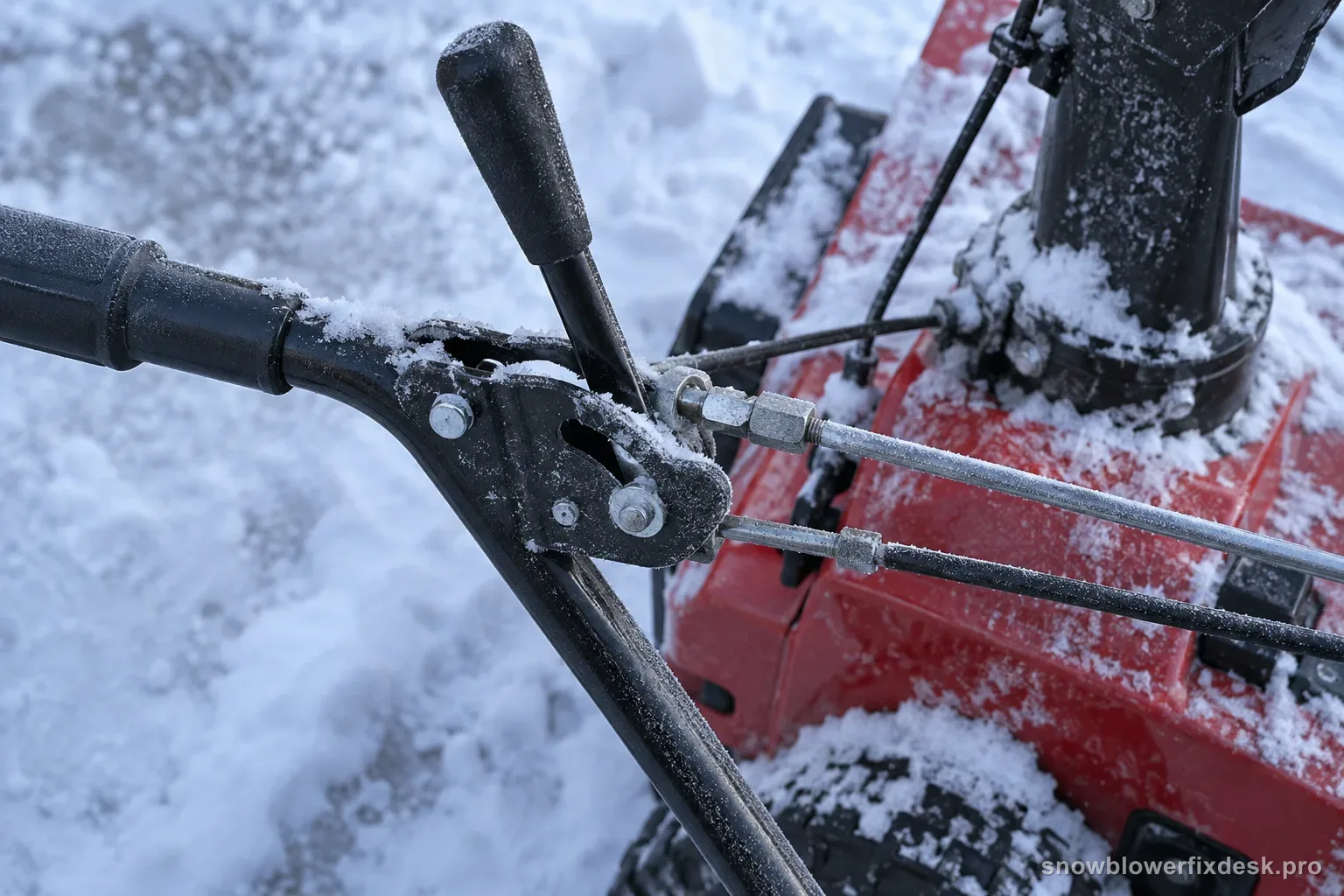
Applies to Power Clear 721 QZE (38756)
Identifiers: 38756 · 721 QZE
Engine ID: Toro 212cc
Guide scope: The 13 mm (1/2 in) Quick Shoot slack trigger, equal-left/right-travel check and cable-centering procedure here are scoped to model 38756 serial 406728558+ under Toro operator manual 3439-829. Earlier serial 400000000–406728557 uses manual 3429-269; resolve the serial before applying revision-specific dimensions.
Model 38756 spans six verified serial ranges. Resolve the serial number before using manual or parts assumptions.
This model has serial-range boundaries — resolve the serial before using a manual →
721 QZE 38756 has its own chute-control context
This diagnosis is scoped to model 38756, the QZE variant with Quick Shoot. If the label says 38753, use the 721 E path rather than assuming the two pages are interchangeable.
First rule out freeze-up. On later 38756 machines, Toro then calls for Quick Shoot adjustment when cable slack exceeds 13 mm (1/2 in) or the chute does not rotate left and right through equal angles, and warns that over-tensioning makes the control hard to operate.
Shut off the engine and keep hands away from the rotor and discharge opening before clearing ice around the chute.
Diagnostic sequence
Work in order. The early checks are intentionally low-disassembly and model-specific; stop once the symptom changes or the fault is confirmed.
Confirm model 38756
Why this check: The QZE uses Quick Shoot; 38753 uses a different chute control.
What to do: Read the model label before following this control path.
Ice at chute base
Why this check: Toro instructs users to clean snow/ice from the chute base and rotate the chute after use.
What to do: Thaw and remove ice without forcing the control.
Trigger/control travel
Why this check: The Quick Shoot trigger must release so the control can move along the handle.
What to do: With the machine off, inspect visible linkage and trigger travel for binding.
Persistent mechanical bind
Why this check: Once ice is ruled out, forcing the lever can damage linkage.
What to do: Use the model-specific parts diagram/service support rather than prying the chute.
Measure Quick Shoot slack and compare left/right travel
Why this check: Toro specifies adjustment when slack exceeds 13 mm (1/2 in) or chute rotation is unequal left versus right.
What to do: After ruling out freeze-up, check the later-serial 38756 control against those two criteria. If adjustment is required, use the matched cable-clamp/centering procedure rather than simply tightening both cables.
How to read this symptom on this model
The 38756 QZE uses Quick Shoot, so its chute-control diagnosis should not be copied from the 38753 721 E, which has a different control arrangement. The first divide is frozen versus mechanically bound. A control that works indoors after thawing points toward ice prevention; a control that remains stiff through the same part of its travel after thawing points toward linkage, cable or chute-base problems.
Toro’s Quick Shoot procedure gives a useful measurable trigger: if there is more than 13 mm (1/2 inch) of slack in the Quick Shoot cable, or the chute does not rotate left and right through equal angles, the control cables need adjustment. That measurement is much more useful than tightening cables by feel until the handle becomes stiff.
The official adjustment sequence also establishes a neutral reference. Toro positions the Quick Shoot control between the two arrows on the upper handle and points the discharge chute straight ahead before cable slack is removed at the clamps. That matters because adjusting one cable with the chute already off-center can create unequal left/right travel even if the control feels tighter afterward.
Freeze-up remains a separate branch. Snow and water around the chute base can freeze after the machine is parked. If the control is hard only when frozen, do not use the 13 mm cable spec as permission to tension a cable against ice. Thaw and clean the mechanism first, then measure slack and compare left/right travel with the chute free.
A repeatable stop at one physical point after thawing is different from general cable slack. Inspect the chute base and visible control path for packed debris, a kinked cable or hardware that is shifting instead of transmitting motion. The purpose is to identify whether the control lacks travel, lacks equal centering or is physically obstructed before ordering parts.
Quick Shoot stiffness should be checked at more than one chute angle. After external snow and ice are removed, operate the trigger and move the control through its range with the engine off. If it binds at the same point every time, cable routing, damage or a mechanical obstruction is more plausible than general freeze-up. If the stiffness disappears completely after thawing, focus on snow/ice accumulation and drying rather than immediately changing cable adjustment.
Toro’s equal-left/right travel check is useful because a cable can move the chute while still being incorrectly adjusted. Compare the maximum travel in both directions and measure slack only with the correct 38756 manual generation. More tension is not automatically better; excessive adjustment can trade a stiff control for poor release or limited travel. If correct slack and routing cannot restore smooth, reasonably symmetric movement, stop forcing the Quick Shoot handle and use the serial-matched service path.
Centering matters on the QZE because unequal cable travel can let the chute reach one side while running out of movement on the other. After the base is fully thawed and the trigger moves freely, compare left and right rotation from a centered starting position. A control that is simply stiff from ice should improve after thawing; a dry mechanism that consistently has extra travel to one side fits the cable-centering branch much better. Use the matched 38756 procedure when slack exceeds the stated limit or travel is unequal, then verify both directions before calling the adjustment complete.
Before you order parts
Do not order a Quick Shoot cable or chute gear while ice is still present. Thaw the machine, clean packed snow from the chute base and verify the trigger/control can travel normally without excessive force. If the chute rotates freely by the mechanism but the handle/trigger does not transmit movement, then the control linkage becomes more plausible.
Measure the Quick Shoot slack before replacing anything. If slack is within the manual limit and the chute still cannot reach equal left/right angles after thawing, inspect the cable clamps and routing for movement, kinks or damage. If slack is excessive, use the Toro centering procedure rather than shortening one side arbitrarily.
Keep the exact 38756 serial number with the diagnosis. Toro splits model 38756 into multiple serial ranges on its parts/manual portal. The Quick Shoot concept is consistent across the covered manual family, but parts and document revisions should still be resolved from the serial-number page before a cable, clamp or chute component is purchased.
Back to the exact model hub →Retest without creating a second problem
With the engine off, center the control and confirm the discharge chute points straight ahead at the neutral reference. Cycle it fully left and right several times and compare the final angles. The control should move without a hard spot, excessive slack or a one-sided loss of travel.
Make a short powered test only after guards and hardware are secure, keeping the discharge aimed into an open area. Recheck that the chute still reaches both directions and holds the intended direction under normal vibration. Do not accept a cable adjustment that improves travel but leaves the trigger unusually hard to operate.
After snow use, clear loose snow and exercise the chute mechanism before storage so water is less likely to freeze in place. A repair that works only in a warm garage but freezes immediately again still needs the moisture/freeze cause addressed; repeated cable tightening is not a freeze-prevention strategy.
Make sure this is the right symptom
The same search phrase can lead to a different branch on another machine. Compare the nearest model-specific examples: Ariens Deluxe 24 (921069): chute won't stay · Troy-Bilt Storm 2410 family: chute hard to rotate.
Model-specific notes
- This guide does not apply to 721 E model 38753 because that machine uses a different chute-control layout.
- Preventive post-use chute rotation is part of Toro’s freeze-up guidance.
Questions people get wrong on this model
Why does the QZE guide differ from the 721 E?
Model 38756 uses the Quick Shoot handle control while 38753 uses a chute handle at the chute. This guide does not apply to 721 E model 38753 because that machine uses a different chute-control layout. Do not order a Quick Shoot cable or chute gear while ice is still present.
Should I spray hot water on it?
That can refreeze and introduce water where you do not want it. Thaw in a controlled way and remove ice mechanically only when safely shut down. Toro instructs users to clean snow/ice from the chute base and rotate the chute after use. Once ice is ruled out, forcing the lever can damage linkage.
When does Toro say the Quick Shoot cables need adjustment?
For model 38756 under the later manual, Toro calls for adjustment when Quick Shoot cable slack exceeds 13 mm (1/2 in) or the chute does not rotate through equal left and right angles. Rule out ice first and keep the serial/manual gate. The Quick Shoot concept is consistent across the covered manual family, but parts and document revisions should still be resolved from the serial-number page before a cable, clamp or chute component is purchased.
Primary-source trail
Manufacturer material used for this diagnosis. Verify the model/serial range before ordering parts or applying an adjustment.
Toro Power Clear 721 Operator Manual 3439-829 Rev BOfficial operator manual applies to model 38756 serial 406728558 and up; includes electric-start limits and freeze-up prevention.www.toro.com →Toro 38756 Parts & Manuals — verified later serial rangeOfficial 721 QZE model page confirms 38756, electric/recoil starter and manual 3439-829 for serial 409200000–411799999; use the site serial resolver for the exact production range.www.toro.com →Toro 38756 product / serial resolverOfficial Toro model page for 38756; use its serial selector before applying a manual or parts assumption.www.toro.com →Toro 38756 Parts & Manuals — serial 411800000–413986044Official U.S. parts/manual page identifies Power Clear 721 QZE model 38756 and exposes operator manual 3439-829 plus the serial-range selector.www.toro.com →