Ariens Deluxe 24 921069 Belt Squeals Continuously: Frozen Impeller or Clutch Adjustment?
A current 921069 belt-squeal path that follows Ariens troubleshooting: thaw a frozen impeller first, then verify attachment-clutch, brake and idler clearances.
Applies to Deluxe 24 (921069)
Identifiers: 921069 · Deluxe 24
Engine ID: Ariens AX 252cc current specification — verify engine label for parts
Guide scope: Applies to Ariens model 921069, serial 000101+, under operator manual 30219300A.
Operator manual 30219300A identifies model 921069 serial 000101+. Current Ariens product data lists AX 252cc; keep the serial number and engine label with the machine before engine-specific parts.
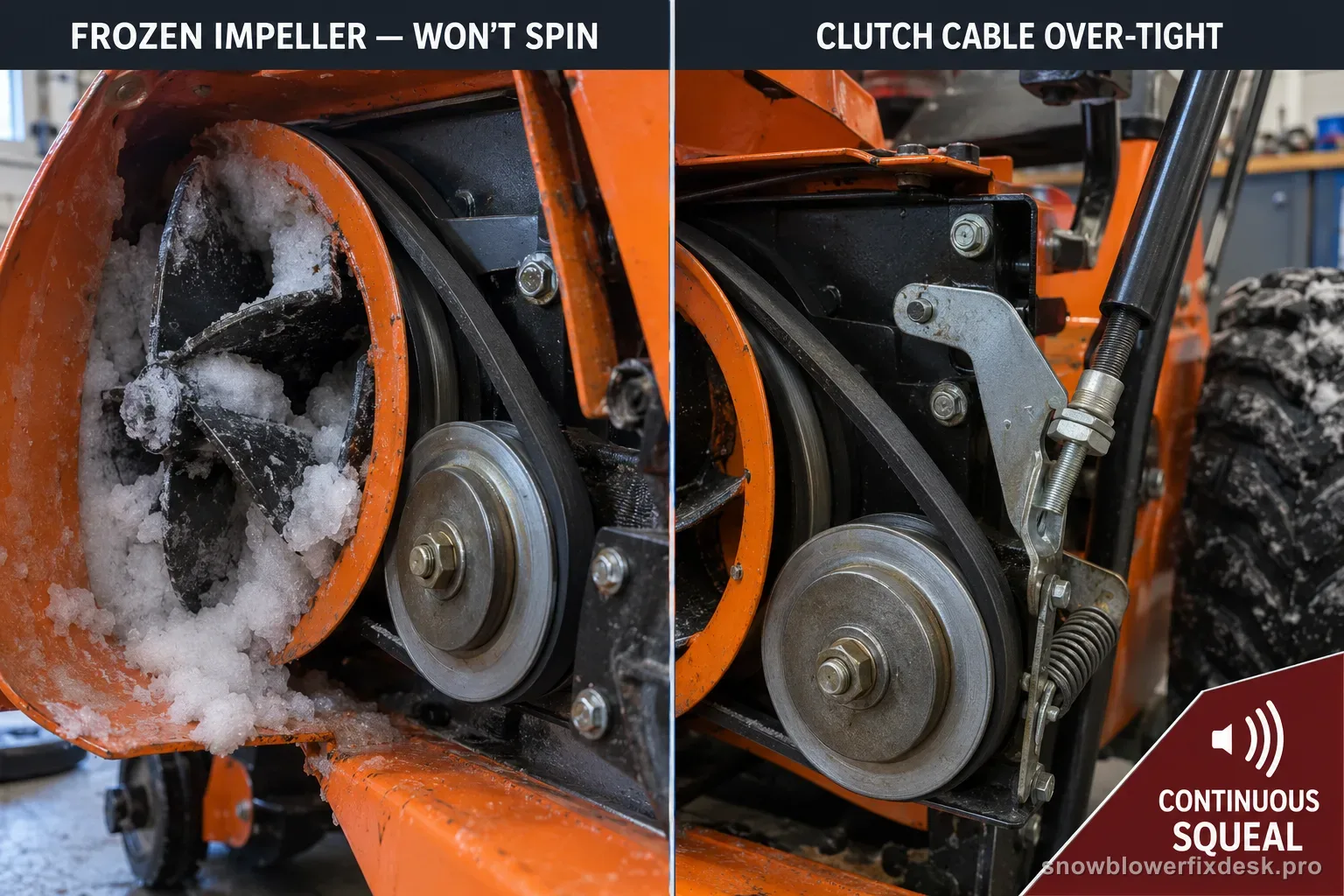
Ariens gives only two first causes for continuous belt squeal on the 921069: a frozen impeller or an attachment clutch that needs adjustment. Thaw before changing tension, then verify the manual clearances and 5-second auger stop requirement.
Stop the engine, remove the key, disconnect the spark-plug wire before clutch/belt adjustment, and keep the belt cover/bottom cover installed for powered testing. The auger and impeller must stop within 5 seconds after release.
Diagnostic sequence
Work in order. The early checks are intentionally low-disassembly and model-specific; stop once the symptom changes or the fault is confirmed.
Separate continuous squeal from a one-time wet-snow noise
Why this check: This exact Ariens troubleshooting row is for a belt that squeals continuously.
What to do: Confirm the noise repeats after the machine is cleared of snow and is not simply a brief sound during an unusually heavy bite.
Rule out a frozen impeller first
Why this check: Ariens lists a frozen impeller as the first probable cause.
What to do: Shut down and move the unit to a warm area to thaw. Do not increase clutch tension or force the auger control against a frozen impeller.
Remove attachment-cable slack correctly
Why this check: The manual’s clutch procedure uses the cable adjustment barrel and verifies the idler-arm position rather than tightening by feel.
What to do: With the engine off, key removed and spark-plug wire disconnected, follow the 30219300A attachment-clutch procedure and verify the idler arm lightly touches the frame when disengaged.
Verify idler and brake clearances
Why this check: Ariens specifies 12.7–22.2 mm (1/2–7/8 in) roller-to-frame clearance with the attachment engaged and at least 1.6 mm (1/16 in) brake-pad clearance when engaged.
What to do: Use the matched manual measurement points. If the ranges cannot be achieved together, Ariens directs dealer repair rather than further guesswork.
Confirm belt-finger and stop behavior
Why this check: The belt finger must be close enough to guide the belt without touching, and safe disengagement is mandatory.
What to do: With the attachment engaged, the belt finger opposite the idler should be less than 3.2 mm (1/8 in) from the belts without contact. After reassembly, verify auger/impeller stop within 5 seconds of lever release.
How to read this symptom on this model
The current 921069 manual gives a narrow troubleshooting row for a continuously squealing belt: the impeller may be frozen, or the attachment clutch needs adjustment. That makes the order important. Thawing costs no adjustment and can immediately prove the noise was created by a locked snow-handling system rather than bad belt tension.
If the impeller is free, move to the attachment clutch as a system, not just the cable. Ariens first removes cable slack, then checks the attachment-idler-arm roller, the attachment brake and the belt finger. Those checks interact: more engagement must not eliminate the brake clearance or prevent the auger/impeller from stopping.
The roller-to-frame specification is 12.7–22.2 mm with the attachment engaged. Ariens uses that range to position the idler. The attachment brake must contact the belt or pulley when disengaged and have at least 1.6 mm clearance when engaged. Those numbers are a better endpoint than “tight enough that it stops squealing.”
The belt finger is another limit. With the attachment engaged, the finger opposite the belt idler should be less than 3.2 mm from the belts but must not touch them. A finger that rubs can make noise of its own; a badly positioned finger can also affect belt control when the clutch changes state.
Finally, the auger/impeller stop check is non-negotiable. Ariens requires the auger/impeller to stop within 5 seconds after the attachment lever is released. If a tension change removes the squeal but makes the attachment slow to stop, the adjustment moved in the wrong direction from a safety standpoint.
A frozen impeller must be eliminated before any cable adjustment. If wet snow has refrozen inside the housing, the belt can squeal because the clutch is trying to drive a locked load. Thaw the machine and verify the impeller can move as the service procedure allows with the engine disabled. If the continuous squeal disappears after thawing, do not tighten the cable simply because it once slipped against ice; the original cause was the frozen load.
If the impeller is free and the squeal repeats, use the published attachment-clutch measurements together rather than chasing only belt tension. Idler position, brake-pad clearance and belt-finger clearance interact with engagement and disengagement. An adjustment that eliminates noise but leaves the brake dragging or the auger slow to stop is unsafe. When the specified ranges cannot be achieved at the same time, Ariens directs dealer repair instead of further compromise.
Finish with the stop test. Reassemble all covers, engage the attachment briefly in a safe open area and release the lever. The auger/impeller must stop within the manual limit; if it continues turning, shut the machine down and return to the clutch/brake adjustment path. Only after thawing, correct geometry and safe stopping are confirmed should visible belt damage become a replacement decision. Noise alone is not enough evidence for a new belt.
Do not confuse one brief wet-belt sound with the manual’s continuous-squeal complaint. Clear and thaw the impeller first, then listen during a short no-load engagement with all guards installed. If the squeal is gone after thawing, the frozen load explains the event better than an immediate belt replacement. If it repeats continuously on a free attachment, return to the 30219300A clutch geometry and stopping checks. The repair is acceptable only when the belt transmits drive without persistent squeal and the auger/impeller still stops within the manual limit after release.
Before you order parts
Do not order a belt before ruling out a frozen impeller and checking the attachment-clutch adjustment. A belt can squeal because it is being asked to drive a frozen load; replacing it without removing that load can damage the new belt too.
If the clearances cannot be brought into the published ranges together, stop adjusting. Ariens specifically routes that condition to dealer repair. Trying to “split the difference” outside the ranges can leave unexpected auger movement or ineffective braking.
Inspect the belt for obvious damage only after the machine is fully shut down and the spark-plug wire is disconnected. If the belt is visibly damaged, replacement may be justified, but the clutch/brake geometry still has to be correct so the replacement operates normally.
Back to the exact model hub →Retest without creating a second problem
Restore the belt and bottom covers before any powered test. Start with the attachment disengaged and listen for abnormal rubbing, then engage briefly with no snow load. Continuous squeal should be gone without a new contact noise from the belt finger or brake.
Release the attachment lever and time/observe the stop behavior. The auger and impeller must stop within 5 seconds. If they continue rotating, shut down and correct the adjustment before any snow is fed into the machine.
Finish with a short light-snow pass. If the squeal returns only under load after a correct clutch adjustment and a free impeller, record that condition and move to the service/belt inspection path instead of adding more cable tension.
Make sure this is the right symptom
The same search phrase can lead to a different branch on another machine. Compare the nearest model-specific examples: Toro Power Clear 721 E (38753): belt squeals or rotor weak · Toro Power Clear 721 E (38753): rotor keeps spinning after control bar release.
Model-specific notes
- The 921069 manual treats a continuously squealing belt as a frozen-impeller or attachment-clutch-adjustment problem before generic belt replacement.
- Improper attachment adjustment can cause unexpected auger/impeller movement; meeting both engagement and brake/stop checks matters more than eliminating noise alone.
Questions people get wrong on this model
Should I tighten the attachment cable until the squeal stops?
No. Ariens specifies cable, idler, brake and belt-finger checks together. Over-tightening can compromise disengagement and create unsafe auger movement. Improper attachment adjustment can cause unexpected auger/impeller movement; meeting both engagement and brake/stop checks matters more than eliminating noise alone. Ariens specifies 12.7–22.2 mm (1/2–7/8 in) roller-to-frame clearance with the attachment engaged and at least 1.6 mm (1/16 in) brake-pad clearance when engaged.
What if the clearances cannot all be brought into specification?
The manual says to see an Ariens dealer for repair if the adjustment ranges cannot be achieved together. If the clearances cannot be brought into the published ranges together, stop adjusting. This exact Ariens troubleshooting row is for a belt that squeals continuously. Ariens lists a frozen impeller as the first probable cause.
Can a frozen impeller make the belt squeal without the belt being the original failure?
Yes. A locked attachment can force the belt to slip or squeal even if the belt was not the first problem. Thaw/clear the auger and impeller before using more cable tension or a replacement belt as the first response. A belt can squeal because it is being asked to drive a frozen load; replacing it without removing that load can damage the new belt too.
Primary-source trail
Manufacturer material used for this diagnosis. Verify the model/serial range before ordering parts or applying an adjustment.
Ariens Deluxe Series Operator Manual 30219300AModels 921069–921072; troubleshooting and adjustment tables.apache.ariens.com →Ariens Deluxe 24 current product page — model 921069Official current Deluxe 24 page identifies model 921069 and the current Ariens AX 252cc specification.www.ariens.com →Ariens manuals lookupOfficial model-and-serial manual resolver. Use it as the stable path if a deep PDF URL changes.www.ariens.com →