Toro 721 E 38753 Rotor Keeps Turning After Release: Restore Safe Cable Slack
For later model 38753, treat continued rotor drive after you let go as a stopping-control fault. Check the documented 2–3 mm bar clearance and confirm the released cable is not pulled taut.
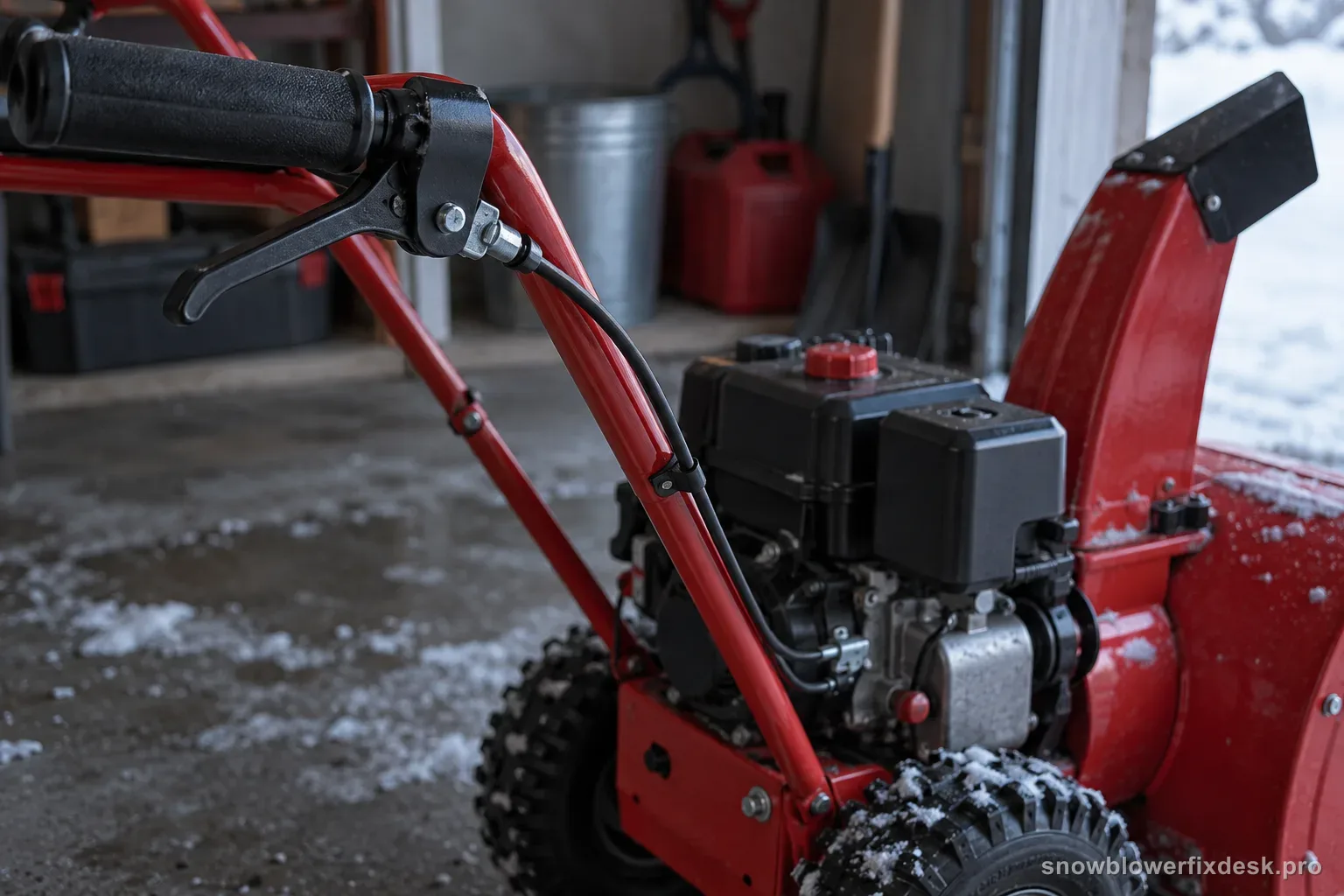
Applies to Power Clear 721 E (38753)
Identifiers: 38753 · 721 E
Engine ID: Toro 212cc
Guide scope: This guide is scoped to Toro Power Clear 721 E model 38753 serial 406836564+ under operator manual 3439-829 Rev B. Earlier serial 400000000–406836563 uses operator manual 3429-269; resolve the serial before applying this adjustment.
Model 38753 spans multiple serial ranges. Use the serial resolver below before assuming a manual or parts catalog.
This model has serial-range boundaries — resolve the serial before using a manual →
721 E 38753 is not the QZE 38756
This diagnosis is scoped to model 38753. The sibling 38756 is the 721 QZE and adds the Quick Shoot chute-control context, so confirm the model/serial label before using a parallel-looking QZE procedure.
Manual 3439-829 checks 2–3 mm (1/16–1/8 in) between the bar and handle after cable slack is just taken up. With the bar released, the cable still must not be taut; if the rotor remains driven, shut the machine down rather than adding tension.
An unreliable rotor release is a stop-use condition. Turn the engine off, remove the key, wait for all motion to end and keep clear of the housing and discharge opening until disengagement is corrected.
Diagnostic sequence
Work in order. The early checks are intentionally low-disassembly and model-specific; stop once the symptom changes or the fault is confirmed.
Confirm model and serial range
Why this check: Toro splits model 38753 manuals at serial 406836564.
What to do: Use this 2–3 mm control-cable procedure only for 38753 serial 406836564 and up under manual 3439-829. Earlier machines must stay on their matched manual.
Separate normal coast-down from continued drive
Why this check: The control bar is the rotor engagement control; releasing it is the documented disengagement action.
What to do: From the normal operator position, release the bar and observe only long enough to confirm whether the rotor actually continues to be driven. If it does, shut the engine off and end the powered test.
Measure the control-bar gap with the engine off
Why this check: Toro specifies 2–3 mm (1/16–1/8 in) between the control bar and handle when the bar is moved back only enough to remove cable slack.
What to do: Do not tighten by feel. Check the documented gap with the machine fully stopped and cool.
Make sure the cable is not taut at release
Why this check: The later manual ties residual cable looseness in the disengaged position to proper rotor stopping.
What to do: If an earlier adjustment pulled the cable tight with the bar released, return it to the documented condition instead of tightening farther.
Use the Z-fitting direction correctly
Why this check: On the adjuster link, a higher Z-fitting position closes the bar gap and a lower position opens it.
What to do: Change only enough to restore the specified clearance, then reconnect the spring and repeat the engine-off check before starting the machine.
Stop after the owner-level cable branch
Why this check: A rotor that still stays driven with the correct gap and disengaged slack has moved beyond a simple adjustment check.
What to do: Keep the machine out of service and take the model, serial and measured cable condition to an Authorized Toro Service Dealer rather than repeating live tests.
How to read this symptom on this model
Treat continued rotor movement after control-bar release as a control-and-stopping fault before you think about snow-throwing performance. On Toro manual 3439-829 Rev B, model 38753 serial 406836564+ uses the control bar to engage the rotor and release of that bar to disengage it. The same manual then makes cable slack part of the stopping system: when the bar is disengaged, the cable must still contain some slack so the rotor blades can stop properly.
Resolve the serial number before touching the cable. Toro splits model 38753 at serial 406836564: earlier production uses operator manual 3429-269, while the later generation uses 3439-829. The 2–3 mm gap and Z-fitting directions in this page belong to that later manual. A familiar-looking Power Clear handle is not enough reason to copy an adjustment across the serial boundary.
With the engine off, move the control bar back toward the handle only far enough to remove cable slack for the check. Toro specifies a 2–3 mm (1/16–1/8 in) gap between the control bar and handle at that point. That dimension is a setup measurement; it is not permission to tension the cable until the bar nearly touches the handle and it is not a rotor stopping-time specification.
The released condition matters just as much as the measured gap. Toro explicitly warns that some cable slack must remain when the control bar is disengaged. If the symptom appeared after someone tightened the control for a stronger bite or to cure belt squeal, that history is especially important because an over-tightened setup can trade engagement force for poor disengagement.
If adjustment is actually required, use the Z-fitting direction from the current manual rather than trial-and-error. A higher Z-fitting position closes the measured gap, while a lower position opens it. Reconnect the spring, slide the cover back into place and repeat the engine-off measurement before any powered test. One deliberate correction is safer than repeated live tuning.
Keep the separate belt-squeal branch separate. The same manual provides a spring-position change for a drive belt that continuously squeals under heavy load after extended use, but that instruction is followed by another control-cable adjustment. It does not cancel the released-bar slack requirement. If a belt-tension change created a rotor-stop problem, safe disengagement takes priority over throwing force.
Freeze-up can also make the control feel wrong, but Toro tells owners not to use excessive force on frozen controls. Thaw and recheck the mechanism before changing a permanent cable setting. A control that returns normally after thawing should not be shortened merely because ice temporarily made it stiff.
If the 2–3 mm gap is correct, released-bar slack is present and the rotor still remains driven after release, stop the diagnosis there. Do not keep making powered experiments around a rotor that cannot be relied on to disengage. Preserve the exact model, serial, gap measurement and adjustment history for an Authorized Toro Service Dealer.
Before you order parts
Before ordering a belt, cable, spring or rotor part, document model 38753, the serial range and the measured control-bar gap. A rotor-stop complaint with an incorrect cable setup can be created by adjustment alone, and replacing parts without correcting the geometry can reproduce the same unsafe condition.
If a recent belt-squeal or control-cable adjustment preceded the symptom, restore the complete later-manual cable condition first. Do not interpret a stronger-feeling control bar as proof that more tension is better; the released state must still contain slack.
Do not use a drive-belt replacement as a first response to a stop fault. The current manual separates belt wear/tension guidance from the requirement that the rotor stop after the bar is released. Safe disengagement is the deciding gate before parts escalation.
Back to the exact model hub →Retest without creating a second problem
After an engine-off cable correction, reinstall the spring cover and stand only at the operator position. Start outdoors with the discharge area clear, engage the rotor briefly, then release the control bar. Observe from behind the handle; if the rotor remains driven, shut the engine off immediately and end the test.
Do not make a snow-load pass until the no-load engage-and-release test is safe and repeatable. One successful stop is useful, but an intermittent stop still means the control system is not trustworthy enough for normal clearing.
If disengagement is restored, make a short light-snow pass and release the control again before returning to ordinary use. Throwing performance does not override stopping behavior; if a performance adjustment causes delayed or unreliable stopping, reverse course and service the machine.
Make sure this is the right symptom
The same search phrase can lead to a different branch on another machine. Compare the nearest model-specific examples: Ariens Deluxe 24 (921069): belt squeals continuously · Toro Power Clear 721 QZE (38756): rotor keeps spinning after control bar release.
Model-specific notes
- Do not copy the belt-squeal spring-position adjustment into this stop fault. More drive tension is not a safe substitute for proper disengagement.
- Manual 3439-829 covers model 38753 serial 406836564+ and also model 38756 from its own later serial boundary; the shared cable design does not remove the need to resolve the exact model and serial.
Questions people get wrong on this model
Should I tighten the control cable if the rotor keeps spinning after I let go?
No. Toro requires some cable slack with the control bar disengaged so the rotor can stop properly. Start with the 2–3 mm gap and released-bar slack, not extra tension. A rotor that still stays driven with the correct gap and disengaged slack has moved beyond a simple adjustment check.
Is 2–3 mm the rotor stopping time?
No. It is the specified control-bar-to-handle gap during the cable check. The safety result is that releasing the bar allows the rotor to stop normally. The later manual ties residual cable looseness in the disengaged position to proper rotor stopping. Before ordering a belt, cable, spring or rotor part, document model 38753, the serial range and the measured control-bar gap.
Can I keep using it if the rotor eventually stops?
Do not keep clearing snow with an unreliable disengagement control. Correct the cable condition and verify safe stopping before returning the machine to service. The control bar is the rotor engagement control; releasing it is the documented disengagement action. The later manual ties residual cable looseness in the disengaged position to proper rotor stopping.
Primary-source trail
Manufacturer material used for this diagnosis. Verify the model/serial range before ordering parts or applying an adjustment.
Toro Power Clear 721 Operator Manual 3439-829 Rev BOfficial current operator manual covers model 38753 serial 406836564 and up; includes the 2–3 mm control-cable gap, disengaged-cable slack requirement, rotor-blade wear indicator and blades-plus-scraper replacement boundary.www.toro.com →Toro Power Clear 721 Interactive Operator ManualOfficial interactive manual for the same later 38753 generation, with control-cable, rotor-stop, wear, fuel, starting and freeze-up guidance.manuals.toro.com →Toro 38753 Parts & Manuals — current serial rangeOfficial current-range model page confirms 38753 serial 416153644+ still uses operator manual 3439-829 / 3439-830.www.toro.com →Toro 38753 product page — serial-range resolverOfficial product page exposes the model 38753 serial-range selector so later manual coverage can be resolved before applying an adjustment or replacement decision.www.toro.com →