Husqvarna ST224 970528602 Auger Keeps Spinning After Release: 5-Second Stop Test
A safety-first current-SKU ST 224 guide for an auger or impeller that does not stop promptly after the auger-control lever is released, using Husqvarna’s less-than-5-second stop test, cable-tension procedure and belt service boundary.
Applies to Current ST 224 NA — 970528602
Matched SKU identifiers: 970528602 · 970 52 86-02
Engine ID: Husqvarna engine — generation dependent
Generation engine: Husqvarna 212cc / 12.9 cu.inch current engine family
Guide scope: Use this procedure only for current North American Husqvarna ST 224 SKU 970528602 / 970 52 86-02 under operator manual 2069-003. The ST 224 name spans other SKUs, including legacy 961930096; do not transfer the current cable or belt procedure to those machines without their exact manual revision.
Husqvarna support requires choosing the SKU before manuals and parts. Troubleshooting coverage here is explicitly scoped to current North American SKU 970528602; support-listed SKUs 970468501 and 961930096 remain identity-only until their exact manual revisions are selected.
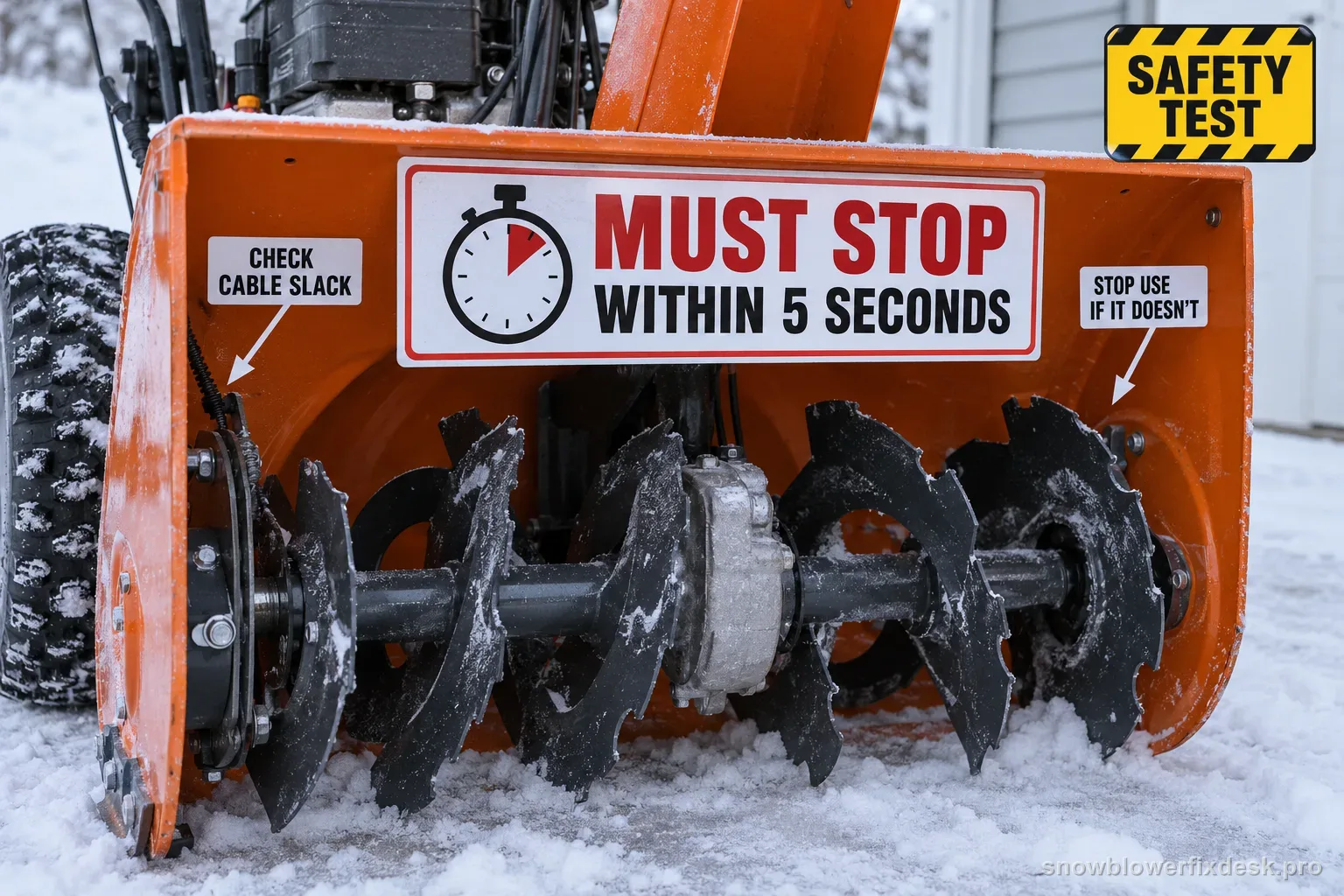
Treat continued auger rotation after lever release as a control-safety fault, not as a throwing-performance issue. Husqvarna’s current-family procedure has an observer measure stop time from a safe position and expects the auger to stop in less than 5 seconds. If it does not, the manual gives a specific auger-control-cable adjustment sequence and says to replace the auger belt if adjustment does not resolve the problem.
Do not keep clearing snow while the auger continues to rotate after the control is released. Shut the engine off, remove the ignition key, wait for all movement to stop and disconnect the spark-plug cable before adjustment. Keep observers at least 10 ft / 3 m in front of the machine and on the side opposite the discharge chute for the documented stop-time test; nobody should stand in the discharge path.
Diagnostic sequence
Work in order. The early checks are intentionally low-disassembly and model-specific; stop once the symptom changes or the fault is confirmed.
Confirm current SKU 970528602 and the exact symptom
Why this check: Husqvarna sells ST 224 under multiple SKUs and a machine that will not engage is a different fault from one that keeps rotating after release.
What to do: Read the product label and confirm 970528602 / 970 52 86-02. Then verify that the complaint is continued auger/impeller rotation after the auger-control lever is released, not weak engagement or poor snow discharge.
Do a visual release check before touching the cable
Why this check: The control should release cleanly and return normally; a lever that is physically held, iced or obstructed can change the evidence before any adjustment.
What to do: With the engine off, clear external snow/ice around the control and confirm the lever can return freely. Do not change cable length yet.
Measure the stop time using the manual’s observer position
Why this check: Husqvarna gives an objective stop-time check instead of asking the owner to judge whether the auger “seems slow to stop.”
What to do: For the controlled powered test, keep an assistant 10 ft / 3 m in front of the machine on the side opposite the chute. Release the auger lever and measure the time until auger rotation stops. The target is less than 5 seconds.
Adjust only the auger-control cable
Why this check: The current manual gives a turnbuckle/jam-nut procedure and says only a small amount of cable tension should remain when the lever is disengaged.
What to do: Shut down and disable the machine. Loosen the jam nuts at the auger-control-cable turnbuckle, rotate the specified adjuster section one full 360-degree turn at a time, and retest instead of making a large unmeasured change.
Preserve slight slack / low tension at release
Why this check: Over-tightening can make engagement feel stronger while defeating the release function that this repair is supposed to restore.
What to do: After each adjustment, make sure the lever is disengaged and only a small amount of tension remains in the cable. Lock the setting with the jam nut only after the release behavior is correct.
Use the belt boundary if cable adjustment does not fix it
Why this check: Husqvarna explicitly says that if the adjustment does not resolve the problem, the auger belt is the next service branch.
What to do: Stop repeated cable tightening. Inspect/service the auger belt using the matched manual or an authorized service center rather than continuing to shorten the cable until the auger can no longer release safely.
How to read this symptom on this model
A snowblower attachment that keeps rotating after the control is released deserves a different response from one that throws weakly. Throw distance is a performance question; release time is a control-safety question. On the current ST 224 family, Husqvarna gives the release behavior its own test and adjustment path, so do not keep clearing snow while waiting to see whether the symptom gets worse.
Identity comes first because ST 224 is a family name rather than a single immutable machine. This guide is tied to current North American SKU 970528602 / 970 52 86-02 and operator manual 2069-003. Husqvarna support also exposes other ST 224 SKUs, and a turnbuckle direction, belt route or control geometry from an older machine should not be assumed to be repair-equivalent.
Before changing cable tension, preserve the symptom. With the engine off, verify the auger-control lever is free to return and is not physically held by packed snow, ice or an external obstruction. If the lever itself cannot return, changing the cable can hide the original problem and create a second one. Restore free control movement before any powered timing test.
Husqvarna makes the retest measurable. The manual tells an assistant to stand 10 feet / 3 meters in front of the machine, on the side opposite the discharge chute, watch auger rotation and measure how long it takes to stop after the lever is released. The procedure treats less than five seconds as the acceptable stopping result. That is much more useful than saying the auger should stop “quickly.”
If stop time is too long, shut the machine down again before touching the adjustment. The current-family procedure uses jam nuts and a turnbuckle on the auger-control cable. It calls for one 360-degree change at a time followed by another engagement/release test. Small measured corrections matter here because an aggressive cable change can trade a slow-stop fault for a control that is over-tensioned or cannot disengage correctly.
The disengaged cable condition is part of the pass/fail decision. Husqvarna says to repeat the adjustment until only a small amount of tension remains in the cable when the lever is disengaged. This is why “tighten it until the auger bites harder” is the wrong repair logic. Strong engagement is not a successful fix if the attachment continues to rotate after the operator lets go.
If the cable setting cannot restore proper release, stop repeating the adjustment. Husqvarna’s note moves the diagnosis to the auger belt if adjustment does not solve the problem. At that point, belt alignment, wear and installation become service evidence. The site should not invent additional tension or generic belt substitutions beyond the matched current-SKU procedure.
Finish by testing both sides of the control behavior: the auger must engage normally when commanded and stop promptly when released. A repair that improves stopping but leaves the attachment sluggish to engage is not complete, and a repair that makes engagement strong but leaves the auger coasting too long is unsafe. Record both engagement and measured stop time before calling the issue resolved.
Before you order parts
Before buying a belt or cable, verify SKU 970528602, free lever return and the measured stop time. Those observations tell you whether the problem belongs to this exact current-SKU release path at all.
Do not order a traction-drive belt because both systems use belts. This symptom concerns the auger/impeller attachment and its auger-control cable/belt path, not loss of wheel drive.
Do not replace the cable solely because the auger stops slowly. First use the matched adjustment procedure; if adjustment cannot restore the stop-time requirement, the manual points to the auger-belt branch.
Back to the exact model hub →Retest without creating a second problem
After each small cable adjustment, reassemble/secure the adjustment area, start the machine in a safe open location and repeat the observer stop-time test from the documented 10 ft / 3 m position opposite the chute.
Confirm the auger stops in less than 5 seconds after release and also engages without hesitation when the lever is deliberately applied. Test both outcomes because excessive slack and excessive tension fail in different ways.
If the stop time remains too long after the matched cable procedure, stop operation and move to auger-belt service rather than continuing to shorten the cable or accepting the delayed stop.
Make sure this is the right symptom
The same search phrase can lead to a different branch on another machine. Compare the nearest model-specific examples: Ariens Deluxe 24 (921069): auger keeps spinning after release · Toro Power Clear 721 E (38753): rotor keeps spinning after control bar release.
Model-specific notes
- Keep “keeps spinning after release” separate from weak/no discharge and from an auger that will not engage. Those symptoms lead to different diagnostic branches even though they involve the same attachment.
- The current manual uses an observer and a stopwatch-style result because stop time is a safety outcome. A subjective “it slows down eventually” is not an adequate retest.
- The manual’s troubleshooting table also flags an auger-release fault separately from traction loss, discharge loss, lights and chute-rotation problems; that separation is why this long-tail query deserves its own exact-model page.
- Do not copy turnbuckle direction or belt routing from a legacy ST 224 video unless its SKU/manual matches the machine in front of you.
Questions people get wrong on this model
How fast should the Husqvarna ST224 auger stop after I release the lever?
For the current-family procedure used with SKU 970528602, Husqvarna has an observer measure the stop time and proceeds when the auger stops in less than 5 seconds. A longer stop time should be treated as a control-safety fault, not normal coast-down. Confirm the auger stops in less than 5 seconds after release and also engages without hesitation when the lever is deliberately applied.
Should I tighten the ST224 auger cable until there is no slack?
No. Husqvarna’s adjustment procedure says only a small amount of tension should remain when the lever is disengaged. The goal is reliable engagement plus prompt release, not maximum cable tension. Release the auger lever and measure the time until auger rotation stops. Inspect/service the auger belt using the matched manual or an authorized service center rather than continuing to shorten the cable until the auger can no longer release safely.
What if cable adjustment does not make the auger stop within 5 seconds?
Do not keep tightening the cable. The matched manual says that if the adjustment does not resolve the problem, move to the auger-belt branch. Use the exact current-SKU belt procedure or authorized service. Husqvarna gives an objective stop-time check instead of asking the owner to judge whether the auger “seems slow to stop.”
Primary-source trail
Manufacturer material used for this diagnosis. Verify the model/serial range before ordering parts or applying an adjustment.
Husqvarna ST 224 current product page — SKU 970528602Official current North American product identity: ST 224 NA 970 52 86-02, 24-inch width, friction-disc transmission and 12.9 cu.inch engine displacement.www.husqvarna.com →Husqvarna ST 224 / ST 227 / ST 230 Operator Manual 2069-003Official current-family manual with starting, rough-running, recoil, traction, discharge, vibration and chute troubleshooting tables.www-static-nw.husqvarna.com →Husqvarna ST 224 US support pageOfficial ST 224 support and SKU-selection path; use the machine SKU here before choosing manuals or parts.www.husqvarna.com →