Husqvarna ST224 970528602 Chute Rotator Hard to Move: Debris or Cable?
A current-SKU chute-control diagnosis built directly from Husqvarna’s two listed causes: debris inside the chute-rotator mechanism or kinked/damaged cables.
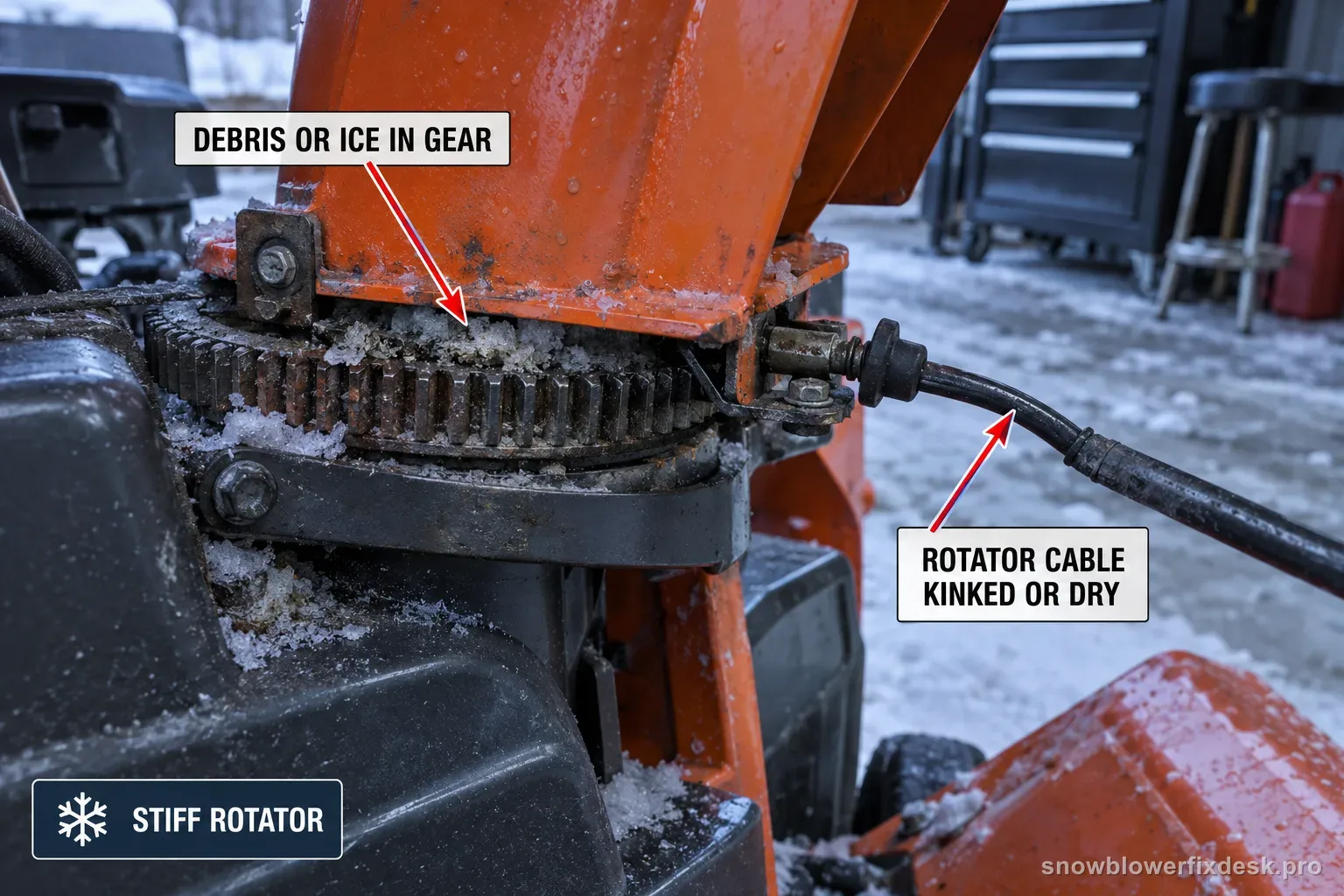
Applies to Current ST 224 NA — 970528602
Matched SKU identifiers: 970528602 · 970 52 86-02
Engine ID: Husqvarna engine — generation dependent
Generation engine: Husqvarna 212cc / 12.9 cu.inch current engine family
Guide scope: This guide is for current North American ST 224 SKU 970528602 / 970 52 86-02 with operator manual 2069-003. Legacy 961930096 remains a separate manual identity.
Husqvarna support requires choosing the SKU before manuals and parts. Troubleshooting coverage here is explicitly scoped to current North American SKU 970528602; support-listed SKUs 970468501 and 961930096 remain identity-only until their exact manual revisions are selected.
For current 970528602, Husqvarna tells you to clean the internal chute-rotator parts for debris and verify that control cables are not kinked or damaged before treating the stiffness as a deeper hardware failure.
Stop the engine and wait for all moving parts to stop before inspecting the chute base or control cables. Never reach into the discharge opening and do not force the control through a hard bind.
Diagnostic sequence
Work in order. The early checks are intentionally low-disassembly and model-specific; stop once the symptom changes or the fault is confirmed.
Confirm current 970528602
Why this check: The ST 224 name spans current and legacy Husqvarna SKUs.
What to do: Read the SKU label and continue with this exact troubleshooting path only for 970528602 / 970 52 86-02.
Separate freeze-up from a repeatable dry bind
Why this check: Snow/ice left after use can make controls stiff, while the troubleshooting table specifically identifies debris in the rotator mechanism and kinked/damaged cables.
What to do: With the machine off, let freeze-up thaw and clear external snow first. If the same hard point remains dry, preserve where in the rotation it occurs.
Clean the chute-rotator mechanism
Why this check: Husqvarna’s listed solution for debris in the chute rotator is to clean its internal parts.
What to do: Follow the matched manual’s access/cleaning procedure with the engine stopped. Remove debris rather than adding leverage to the control.
Inspect cable routing for kinks
Why this check: The current troubleshooting table lists kinked cables as the other cause.
What to do: Trace the visible control-cable path for a sharp bend, pinch or routing interference. Restore only the documented routing; do not invent a tighter path.
Replace visibly damaged cable rather than forcing it
Why this check: Husqvarna’s solution is to replace damaged cables, not to compensate with more control force.
What to do: If cable housing/wire damage is visible or the cable remains rough after correct routing, use the exact current-SKU service/parts path.
Retest through the full usable rotation
Why this check: A repair that fixes one position but still binds elsewhere is incomplete.
What to do: With the engine off first, move the chute smoothly through its usable range several times. Stop if a hard mechanical bind returns.
How to read this symptom on this model
The current manual makes this symptom narrower than many generic chute-repair articles. For a chute rotator that is difficult to move, Husqvarna lists two causes: debris in the chute-rotator mechanism and kinked or damaged cables. That gives the repair a strong “clean and inspect before replace” order rather than starting with a gearbox, control head or random adjustment.
Freeze history is still worth recording because snow and water left after use can refreeze around the chute base. A stiffness that disappears after thawing is different evidence from a hard point that repeats at the same angle when the machine is dry. The first is an after-use moisture/ice problem; the second is more consistent with debris, cable routing/damage or a mechanical bind.
Do not confuse cable routing with cable tension. The troubleshooting table says cables can be kinked or damaged. A housing pinched behind another control, bent sharply or routed across a moving part can create high effort even if the cable is not “loose.” Correct routing should preserve smooth curves and the documented attachment points.
Debris can be small enough that the chute still moves through part of its range. Grit or packed material in the rotator mechanism may create a repeatable rough zone rather than a total lock. Note where the bind occurs before cleaning; if the rough zone disappears afterward, that is much stronger evidence than simply saying the chute “feels better.”
A visibly damaged cable is a parts branch, but it is still model-gated. Current 970528602 has its own support identity. The shared ST 224 name on a legacy 961930096 machine is not enough to select the same cable or routing detail.
First decide whether the control is frozen temporarily or binds at the same position after the machine is dry. Snow and ice can make the rotator stiff after use, while the current troubleshooting table specifically calls out debris inside the mechanism and kinked or damaged control cables. Thaw and clear external accumulation with the engine off, then move the control slowly through its range. A repeatable dry hard spot is much more useful evidence than stiffness observed only while the assembly is iced.
The debris branch and the cable branch should not be corrected together. Clean the documented rotator area first, then retest before changing cable routing. If the hard point remains, trace the visible cable path for a pinch, sharp bend, or damaged housing and restore only the routing shown for current SKU 970528602. Forcing the handle harder can hide which branch was responsible and can turn a simple obstruction into cable damage.
Replacement belongs at the end of this sequence, not at the beginning. A cable that is visibly damaged or remains rough after correct routing is different from a healthy cable working against debris in the rotator. After cleaning or routing correction, move the chute across the full usable arc several times with the engine stopped. If a mechanical bind returns at one position, stop there and preserve the location of the bind for the current-SKU service path.
After cleaning, judge the control by repeatability rather than by one easy movement. Move the chute slowly through the usable arc with the engine off and note whether resistance returns at the same angle. A dry hard spot at one position supports a remaining routing or mechanical-bind problem; stiffness that appears only after wet snow freezes around the base supports an icing history instead. If a cable housing shows a kink, flattened section or frayed wire, stop forcing the control and use the current-SKU replacement path rather than masking the damage with lubricant or extra handle force.
Before you order parts
Before ordering a cable or rotator assembly, confirm 970528602, thaw any freeze-up and clean the rotator mechanism as the current manual directs. Those steps directly address the two manufacturer-listed causes and cost no speculative parts.
Before replacing a cable, trace the entire visible route for a pinch or kink and compare it with the matched manual. A cable that is merely misrouted can feel damaged under load even if the wire/housing itself is serviceable.
Do not use added leverage as a diagnostic tool. A pipe, clamp or hard twist can deform brackets or cable ends and turn a cleanable restriction into a genuine parts failure.
Back to the exact model hub →Retest without creating a second problem
With the engine off, rotate the chute through its full usable range several times. Effort should be reasonably smooth and no single angle should produce a hard stop.
Then repeat after the machine has been exposed to a small amount of normal vibration/use. If the bind immediately returns at the same point, preserve that position and recheck routing/rotator condition rather than forcing past it.
After wet-snow use, perform the manual’s snow/ice cleanup and exercise the chute before storage. If the complaint no longer returns after refreeze prevention, the successful retest points to moisture/ice rather than a failed control assembly.
Make sure this is the right symptom
The same search phrase can lead to a different branch on another machine. Compare the nearest model-specific examples: Ariens Deluxe 24 (921069): chute won't stay · Toro Power Clear 721 QZE (38756): Quick Shoot chute won't turn / stiff or unequal travel.
Model-specific notes
- Do not spray lubricant into random chute-control areas unless the matched manual explicitly calls for it; lubricant can hold grit and can hide the real source of a bind.
- If the symptom only appears after wet snow refreezes, focus on after-use snow/ice removal and drying rather than repeatedly changing cable geometry.
Questions people get wrong on this model
Does a hard-to-turn chute mean the chute gear is stripped?
Not from this symptom alone. The current Husqvarna troubleshooting table first lists debris in the rotator mechanism and kinked/damaged cables. Husqvarna’s listed solution for debris in the chute rotator is to clean its internal parts. Husqvarna’s solution is to replace damaged cables, not to compensate with more control force.
Can I use a pipe or extra leverage on the chute control?
No. Forcing the control can turn a cleanable bind into cable, bracket or rotator damage. A pipe, clamp or hard twist can deform brackets or cable ends and turn a cleanable restriction into a genuine parts failure. If the bind immediately returns at the same point, preserve that position and recheck routing/rotator condition rather than forcing past it.
What if the chute cable looks intact but the control still binds?
Clear snow/debris, inspect routing and note whether the bind occurs at one position or through the full travel. An intact cable does not rule out local mechanical binding, and forcing the control can create a new linkage or chute failure. If the bind immediately returns at the same point, preserve that position and recheck routing/rotator condition rather than forcing past it.
Primary-source trail
Manufacturer material used for this diagnosis. Verify the model/serial range before ordering parts or applying an adjustment.
Husqvarna ST 224 current product page — SKU 970528602Official current North American product identity: ST 224 NA 970 52 86-02, 24-inch width, friction-disc transmission and 12.9 cu.inch engine displacement.www.husqvarna.com →Husqvarna ST 224 / ST 227 / ST 230 Operator Manual 2069-003Official current-family manual with starting, rough-running, recoil, traction, discharge, vibration and chute troubleshooting tables.www-static-nw.husqvarna.com →Husqvarna ST 224 US support pageOfficial ST 224 support and SKU-selection path; use the machine SKU here before choosing manuals or parts.www.husqvarna.com →