Troy-Bilt Storm 2410 Chute Hard to Rotate or Won’t Reach 180°
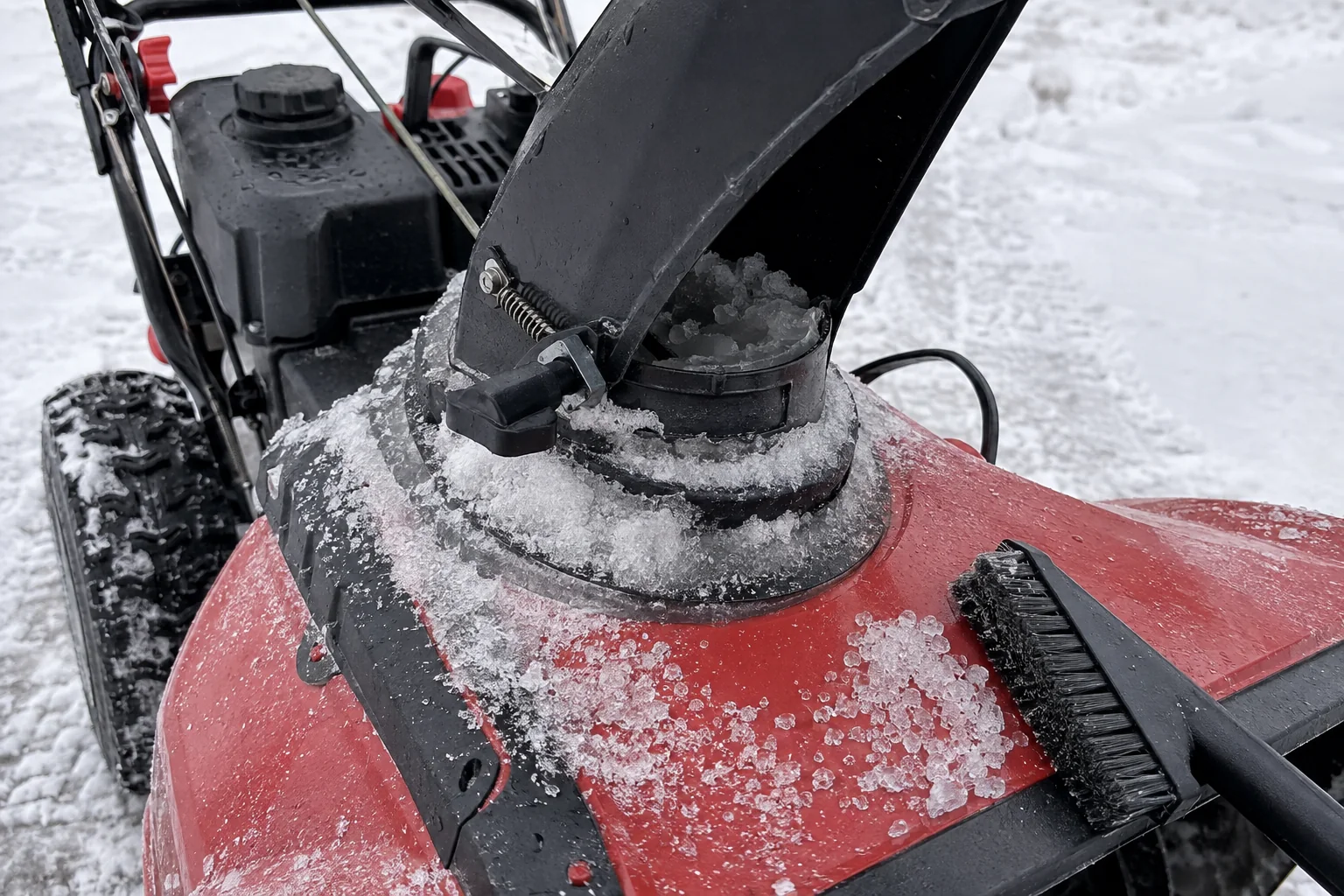
Separate incorrect chute assembly from bracket engagement and ice.
Applies to Storm 2410 family
Identifiers: Storm 2410 · 31BS6KN2766 · 31BS6BN2766 · 31AS6BN2723 · 31AS62N2766 · 31AS62N2711
Guide scope: Troy-Bilt sold Storm 2410 under multiple 11-character product IDs and manual revisions. The 180-degree remote side-crank description applies to verified variants such as 31BS6KN2766; use the exact Product Identification Label before applying bracket, gear or linkage service details.
Always match the 11-character product ID before ordering parts.
The troubleshooting guidance says a chute that will not easily rotate through its range may be assembled incorrectly; other Storm 2410 manuals also provide a chute-bracket engagement adjustment.
Shut the engine off and remove the key before adjusting chute brackets or gears.
Diagnostic sequence
Work in order. The early checks are intentionally low-disassembly and model-specific; stop once the symptom changes or the fault is confirmed.
Ice and packed snow
Why this check: Frozen chute bases can make correct hardware feel seized.
What to do: Clear and thaw before loosening adjustment hardware.
Assembly orientation
Why this check: The troubleshooting table calls incorrect assembly a cause of restricted rotation.
What to do: Compare the chute control to the assembly section for your exact model-year manual.
Chute bracket engagement
Why this check: The bottom spiral/gear must engage the chute ring correctly.
What to do: If your matched manual includes the bracket adjustment, loosen the two retaining nuts, reposition slightly and retighten.
Damaged gear or rod
Why this check: If alignment is correct but travel binds at the same point, parts may be bent or damaged.
What to do: Use the manufacturer parts diagram for your 11-character model.
How to read this symptom on this model
Storm 2410 chute systems span multiple 11-character model numbers and production revisions, so this symptom starts with identification rather than a universal adjustment dimension. On manufacturer support pages, Storm 2410 variants such as 31BS6BN2766 and 31BS6KN2766 are described with remote side-crank chute control and 180-degree rotation. The troubleshooting material for this family also gives a direct cause when the chute will not easily rotate through that range: incorrect chute assembly.
That official troubleshooting branch is important because a hard-to-turn chute is easy to misdiagnose as a stripped gear or bad cable. If the problem existed immediately after assembly, storage reassembly or prior chute service, assembly orientation and engagement deserve priority. If the same chute rotated normally until a wet freeze, ice is a different branch. The history of when it became difficult is more useful than simply applying more force to the crank. Also note whether the chute reaches less travel on one side than the other, because asymmetric travel is different evidence from uniformly heavy rotation.
With the engine off and key removed, clean snow and ice from the chute base and inspect the visible crank/rod/bracket relationship for the exact model. A chute that binds at the same dry point on every sweep suggests a mechanical alignment, assembly or damage issue. A chute that becomes free after thawing suggests freeze-up. A chute that has unusually large free play before movement may point to engagement or wear, but the exact repair should still follow the matched manual rather than a generic Storm 2410 video.
Avoid adding leverage. Pliers, pipe extensions or forcing the crank can convert a reversible assembly problem into stripped teeth or bent linkage. If the chute will not move through its intended travel with ordinary control effort after it is thawed and correctly assembled, stop at that observation and inspect the mechanism instead of forcing it to 180 degrees.
Older Storm 2410 troubleshooting tables give a direct remedy for a chute that will not easily rotate through 180 degrees: incorrect chute assembly should be corrected by disassembling the chute control and reassembling it according to the Assembly section. That matters because it puts assembly ahead of speculative lubrication, cable replacement or gear replacement. On a machine whose symptom began immediately after setup or prior service, return to the assembly relationship first rather than compensating with more force.
Some Storm 2410 revisions also show the lower chute-control bracket as an adjustable engagement point during assembly. That does not mean every year uses the same bracket position or hardware. Use the matched 11-character model manual to see whether that adjustment exists on your unit. If it does, make only the small alignment correction described there and then confirm full travel. If it does not, do not import the procedure from a visually similar 2410 generation.
Check whether the stiffness follows weather or chute angle. A control that becomes normal after thawing points toward ice around the chute base, while a hard spot that returns at the same angle when dry suggests debris, misalignment or control hardware. Move the chute through its intended range with the engine off after clearing ice. If it cannot approach the manual’s normal rotation without excessive force, stop forcing the crank and inspect the matched cable/gear/rod path instead of adding leverage.
A repeatable hard spot at one chute angle is more useful evidence than the general description “stiff.” After thawing the chute base completely, rotate the control slowly through its full range with the engine off and note whether effort is uniform or spikes at the same position. Uniform stiffness points toward the control/cable/rotation mechanism as a whole; one localized bind puts alignment, local hardware or damaged teeth higher on the list. Because Storm 2410 variants use different revisions and parts, carry the exact 11-character product ID into any parts diagram before ordering a crank, cable or gear that merely looks similar to the installed hardware.
Before you order parts
Read the 11-character product ID first and use the matching Troy-Bilt support/manual information. The Storm 2410 name covers multiple model IDs, which is why a part or adjustment borrowed from another 2410 may physically resemble yours yet still be the wrong reference. For a chute that was difficult from first assembly, compare the chute-control installation sequence before ordering gears, brackets or cables.
Thaw and clean the chute base before changing hardware. Then rotate it by hand control only, noting whether resistance is uniform or concentrated at one position. If a bracket is not correctly engaged, correct that relationship before parts replacement. If the control has normal engagement but the chute binds because a component is visibly bent or damaged, replacing the damaged component is more defensible than tightening the system further.
A dry, repeatable bind at exactly the same angle after the chute has been assembled to the matched manual is stronger parts evidence than a chute that is merely frozen or was assembled incorrectly. Record where the bind occurs and whether the crank has normal engagement before ordering a gear or rod. That observation helps prevent replacing the drive parts for an assembly problem the manufacturer troubleshooting table already names.
Back to the exact model hub →Retest without creating a second problem
With the engine still off, sweep the chute repeatedly through its usable left/right range. Movement should be reasonably smooth without a hard stop caused by misassembly, and the control should not require excessive force. Check that the deflector function remains separate and was not accidentally altered while working on chute rotation.
During the first snow test, reposition the chute only from the normal control position and watch whether vibration changes the behavior. If it rotates normally when dry but becomes difficult only after wet-snow accumulation, shift the prevention work toward clearing and thawing rather than continuing to alter the dry mechanism. If the same dry bind returns at one point, stop forcing the control and re-open the model-specific assembly/service branch.
After reassembly or bracket correction, test the full left/right sweep several times with the engine off before snow use. The chute should move through the intended range without the control rod climbing, disengaging or hitting a hard point. Only after the dry sweep is consistent should the machine be returned to a short operating test.
Make sure this is the right symptom
The same search phrase can lead to a different branch on another machine. Compare the nearest model-specific examples: Ariens Deluxe 24 (921069): chute won't stay · Toro Power Clear 721 QZE (38756): Quick Shoot chute won't turn / stiff or unequal travel.
Model-specific notes
- Do not assume every Storm 2410 uses identical chute hardware; production-year variants exist.
- A repair that increases force but reduces full travel is not a correct adjustment.
Questions people get wrong on this model
Why does the exact model number matter for a chute?
Troy-Bilt used multiple chute-control arrangements across Storm 2410 production years. The Storm 2410 name covers multiple model IDs, which is why a part or adjustment borrowed from another 2410 may physically resemble yours yet still be the wrong reference. Do not assume every Storm 2410 uses identical chute hardware; production-year variants exist.
Should I force the crank through an icy spot?
No. Clear/thaw ice first to avoid stripping the control or chute gear. During the first snow test, reposition the chute only from the normal control position and watch whether vibration changes the behavior. The chute should move through the intended range without the control rod climbing, disengaging or hitting a hard point.
Can freeze-up mimic a chute-control adjustment problem?
Yes. Packed snow or ice can create a hard spot or reduced travel even when the linkage is assembled correctly. Thaw and clear the chute base before changing cable or crank geometry, then retest full travel without forcing the control. The chute should move through the intended range without the control rod climbing, disengaging or hitting a hard point.
Primary-source trail
Manufacturer material used for this diagnosis. Verify the model/serial range before ordering parts or applying an adjustment.
Troy-Bilt Storm 2410 model support pageManufacturer model page with operator manuals, diagrams and model-number guidance.www.troybilt.com →Troy-Bilt Storm 2410 alternate model supportConfirms Storm 2410 family spans multiple 11-character model numbers.www.troybilt.com →Troy-Bilt Storm 2410 model 31BS6BN2766 supportManufacturer page confirms another Storm 2410 11-character model and exposes matched manuals.www.troybilt.com →