Troy-Bilt Storm 2410 Auger Not Turning: Check Shear Pins Before the Belt
A Storm 2410 family diagnostic order built around model identification, shear hardware, obstruction, auger-control engagement and the auger belt.
Applies to Storm 2410 family
Identifiers: Storm 2410 · 31BS6KN2766 · 31BS6BN2766 · 31AS6BN2723 · 31AS62N2766 · 31AS62N2711
Guide scope: Storm 2410 is a family name, not one chassis ID. Match the full 11-character product ID (for example 31AS6BN2723, 31BS6KN2766, 31BS6BN2766 or another supported variant) and its manual revision before using a cable adjustment or part number.
Always match the 11-character product ID before ordering parts.
For a Storm 2410 whose auger will not turn, the manufacturer troubleshooting path puts sheared pins and physical obstruction ahead of the control-cable and auger-belt branches.
Stop the engine, remove the ignition key, disconnect the spark-plug wire where the matched manual calls for it and use the clean-out tool—not your hands.
Diagnostic sequence
Work in order. The early checks are intentionally low-disassembly and model-specific; stop once the symptom changes or the fault is confirmed.
Read the exact 11-character product ID
Why this check: Troy-Bilt sold Storm 2410 machines under multiple product IDs and manual revisions.
What to do: Use the Product Identification Label before buying shear hardware, belts or applying a revision-specific adjustment.
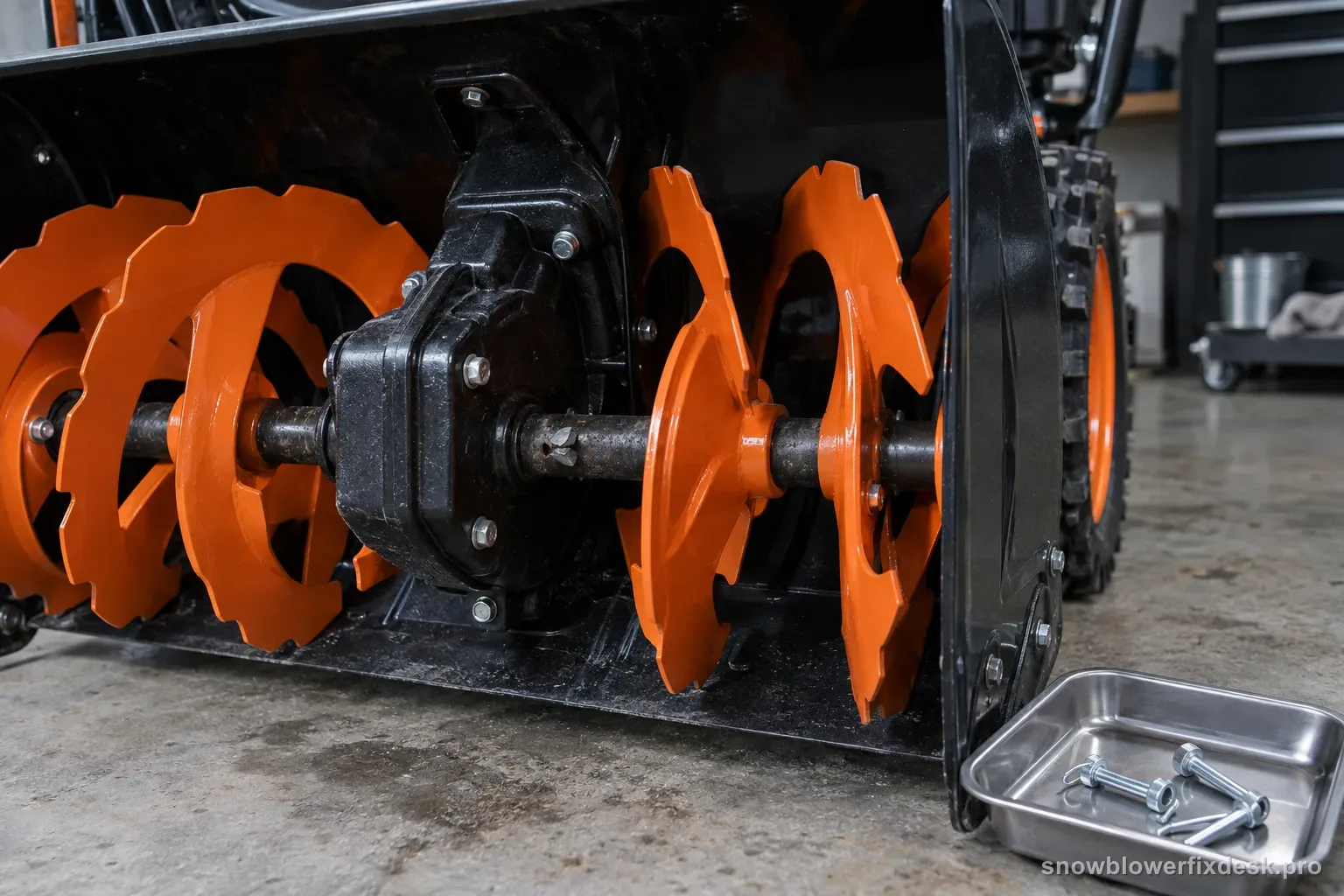
Compare one auger side with the other
Why this check: A single inactive auger section after an impact is stronger evidence for a sheared pin than a whole attachment that never engages.
What to do: With the machine fully disabled, inspect both shear-pin positions and note whether only one side lost torque.
Remove ice or a foreign object
Why this check: An obstruction can stop rotation and may be the reason a shear pin failed.
What to do: Use the clean-out tool after full shutdown. Do not install another pin until the auger/impeller path is free enough to avoid immediately repeating the overload.
Verify auger-control cable behavior
Why this check: The manual family includes an auger-control check: the released cable should not be pulled tight, and the auger must stop when the control is released.
What to do: Use the cable-bracket adjustment only if the matched manual/control test fails. Do not tighten past safe disengagement just to force more belt grip.
Inspect the auger belt
Why this check: A loose, damaged or displaced auger belt can remove drive after the external shear/obstruction checks are clear.
What to do: Open the belt area only after safe shutdown and use the service section for the exact model year. Inspect belt condition and routing before ordering.
Retest engagement and stop
Why this check: Restored rotation is only half the repair; the attachment must disengage normally too.
What to do: Reinstall guards, test briefly with no snow load, release the auger control and verify a full stop before making a short light-snow pass.
How to read this symptom on this model
Storm 2410 is a family label, so the first diagnostic step is reading the 11-character product ID. Troy-Bilt support surfaces multiple Storm 2410 IDs and corresponding manual records. That matters most when the diagnosis reaches cable adjustment or belt parts; a family-level troubleshooting idea can be correct while a dimension or part number from the wrong production revision is not.
Use the left-versus-right auger behavior as evidence. If one auger section stopped after striking ice or an object while the other side can still transfer torque, a sheared pin is a much stronger first branch than a total belt failure. If both augers and the impeller are locked, look for a common obstruction or freeze-up before opening the belt cover.
The shear fastener is protective by design. Installing a solid or harder bolt may make the immediate symptom disappear but can send the next impact into a shaft or gearcase. If the correct replacement shears again immediately, do not “upgrade” the bolt—find the continuing overload or bind.
The auger-control cable is a separate branch after the snow path and shear hardware are clear. The manual-family control check expects the released system not to be pulled tight and requires the auger to stop after release. That means more cable tension is not a universal fix; a machine that turns only because the cable is over-tightened has traded no-auger for unsafe disengagement.
The auger belt becomes more credible when both sides are physically free, shear hardware is intact and the control still does not transmit drive. Inspect route and condition under the matched manual. A belt failure can coexist with normal engine operation and normal traction because the attachment drive is separate.
Start with the shear-pin pattern because it can localize the failure quickly. If one auger section can rotate independently of the shaft after an impact while the other remains driven, protective hardware is more likely than a complete belt failure. If both sections are locked, clear ice or a foreign object before replacing anything. The correct shear pin is meant to fail under overload, so installing a stronger substitute can move the damage into the auger shaft or gearbox instead of fixing the cause.
Cable and belt checks come after the snow path is free and the shear positions are intact. Watch the auger-control travel with the engine off and compare it with the matched Storm 2410 manual; obvious slack or a damaged housing can prevent full engagement. If control travel is credible but the attachment still loses motion under load, belt condition becomes stronger evidence. Do not tighten the cable and replace the belt at the same time, because that erases which correction actually restored drive.
On the Storm 2410 family, use the exact 11-character product ID before turning the symptom into a parts order. Troy-Bilt lists different manual revisions under the same family name; for example, 31BS6KN2766 is paired with the 31X 5X/6X/8X operator manual and has model-specific auger belt, auger cable and shear-pin listings. The physical pattern still comes first: one auger spiral that stopped after an impact points more strongly to its sacrificial shear hardware, while both augers failing to drive with the housing clear keeps cable and belt transfer open. Record which side failed and whether the impeller is also affected before removing covers.
After a broken shear pin is found, the repair is not complete when a new pin fits the hole. Clear the original obstruction or ice, use the specified shear hardware and make a brief no-load engagement only after guards are restored. If the correct pin fails again immediately, stop powered testing; a bind, alignment problem or deeper attachment load is still present. If the shear hardware is intact, inspect the auger-control adjustment and belt using the matched manual. A cable adjustment must restore engagement without defeating disengagement—the auger still has to stop when the control is released, so extra cable tension is not a substitute for a slipping or damaged belt.
Before you order parts
Before ordering a belt, identify the full product ID, clear the chute/auger housing and inspect both shear-pin locations. These external checks are faster, safer and specifically relevant after an impact.
Before ordering a set of shear pins, verify the auger/impeller are free enough to avoid immediately breaking the replacement. Repeated pin failure is evidence of continued overload, not proof that the pins are “too weak.”
Before adjusting the control cable, establish the released-control behavior and use the exact manual revision for the product ID. If the auger already fails to stop normally, treat that as a stop-use safety condition rather than increasing engagement.
Back to the exact model hub →Retest without creating a second problem
Reinstall all guards and make the first powered attachment test with no snow and nobody in the discharge path. Engage briefly, release the control and confirm the auger/impeller stop normally.
Then use a short light-snow pass. If one side immediately stops again, shut down and recheck that side’s shear hardware and binding instead of continuing to feed snow.
If the attachment turns unloaded but slips only under modest snow load, preserve that difference for the belt/control branch. A no-load pass and an under-load failure are not the same diagnosis.
Make sure this is the right symptom
If your machine is showing an adjacent symptom instead, switch paths before changing parts: excessive vibration · shear pin keeps breaking.
The same search phrase can lead to a different branch on another machine. Compare the nearest model-specific examples: Ariens Deluxe 24 (921069): auger not turning · Ariens Deluxe 24 legacy (921024 / 921045): shear bolt keeps breaking.
Model-specific notes
- Use only manufacturer-specified shear hardware for the exact Storm 2410 variant; a stronger solid bolt defeats the intended sacrificial protection.
- If a correct replacement pin breaks immediately with no snow load, stop repeating the repair and inspect for binding or deeper driveline damage.
Questions people get wrong on this model
Why inspect shear pins before removing the belt cover?
They are external sacrificial failure points, and the manufacturer troubleshooting sequence explicitly lists sheared pins/obstruction as causes when the auger or discharge stops. A loose, damaged or displaced auger belt can remove drive after the external shear/obstruction checks are clear. Before ordering a belt, identify the full product ID, clear the chute/auger housing and inspect both shear-pin locations.
Can the auger cable be too tight?
Yes. The released control must still allow proper disengagement. A repair that makes the auger turn but prevents it from stopping is unsafe. Restored rotation is only half the repair; the attachment must disengage normally too. Before adjusting the control cable, establish the released-control behavior and use the exact manual revision for the product ID.
What does it mean if only one auger side stops after an impact?
That pattern makes a sheared pin on the affected section more plausible than a total attachment-belt failure. With the machine fully disabled, inspect both shear positions and clear the overload before installing the correct replacement hardware. A single inactive auger section after an impact is stronger evidence for a sheared pin than a whole attachment that never engages.
Primary-source trail
Manufacturer material used for this diagnosis. Verify the model/serial range before ordering parts or applying an adjustment.
Troy-Bilt Storm 2410 model support pageManufacturer model page with operator manuals, diagrams and model-number guidance.www.troybilt.com →Troy-Bilt Storm 2410 alternate model supportConfirms Storm 2410 family spans multiple 11-character model numbers.www.troybilt.com →Troy-Bilt Storm 2410 model 31BS6BN2766 supportManufacturer page confirms another Storm 2410 11-character model and exposes matched manuals.www.troybilt.com →