Troy-Bilt Storm 2410 Not Discharging Snow: 5 Causes the Manual Lists
A safe diagnostic sequence based on the Storm 2410 troubleshooting logic, with model identification kept ahead of parts or adjustment decisions.
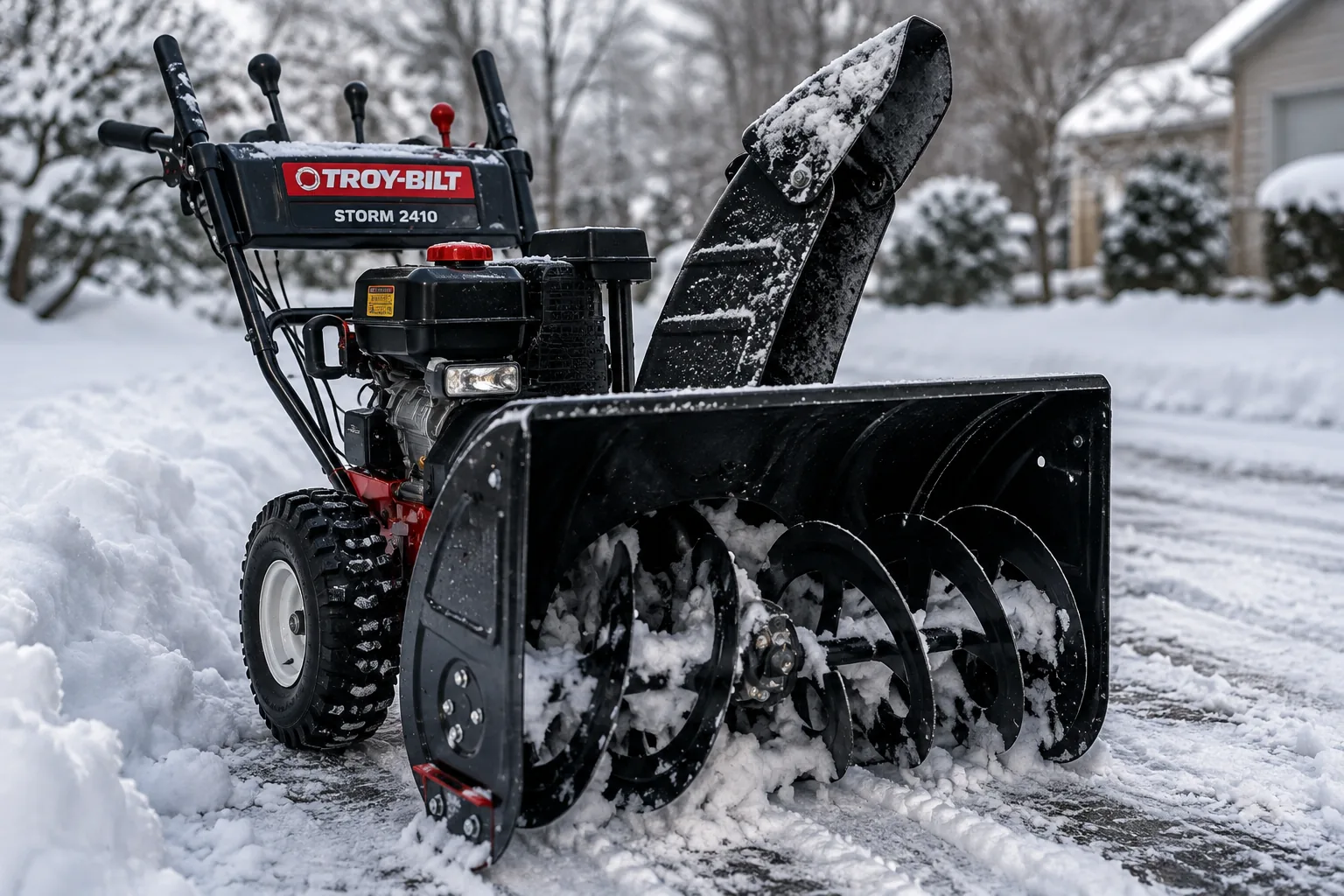
Applies to Storm 2410 family
Identifiers: Storm 2410 · 31BS6KN2766 · 31BS6BN2766 · 31AS6BN2723 · 31AS62N2766 · 31AS62N2711
Guide scope: Storm 2410 is a family name used across multiple 11-character Troy-Bilt product IDs. This guide uses troubleshooting logic shared by the matched family manuals, but belts, cables, shear hardware and revision-specific adjustments must be resolved from the exact Product Identification Label.
Always match the 11-character product ID before ordering parts.
The manual lists a clogged chute, foreign object in the auger, auger-control cable adjustment, loose/damaged auger belt and sheared pin(s).
Stop the engine immediately for chute/auger obstruction. Use the clean-out tool or a stick only after all motion stops.
Diagnostic sequence
Work in order. The early checks are intentionally low-disassembly and model-specific; stop once the symptom changes or the fault is confirmed.
Chute clog
Why this check: It is the first listed cause for failure to discharge.
What to do: Clear the chute assembly and auger housing using the clean-out tool after shutdown.
Foreign object
Why this check: An object can jam the auger while the engine keeps running.
What to do: Remove it with the clean-out tool; inspect shear pins afterward.
Auger control cable
Why this check: Insufficient engagement can reduce or stop auger drive.
What to do: Run the auger control test and adjust only if needed.
Auger belt
Why this check: A loose/damaged belt can slip under load.
What to do: Inspect/replace according to the service section for the exact model.
Shear pins
Why this check: Pins may shear under impact and disconnect the auger from the shaft.
What to do: Install the correct replacement pin/cotter hardware.
How to read this symptom on this model
A Storm 2410 that runs but does not discharge snow should be diagnosed as a snow-flow chain, not as one generic “auger problem.” Troy-Bilt support material points first to cable adjustment and belts for auger or drive loss, then to broken shear bolts when the engine and belts are functioning but one or both auger sections lose operation. Before any of those branches, a physically packed chute or housing can stop discharge even while the drive system is still intact. Work from the outlet backward: chute, housing/impeller obstruction, auger engagement, belt path, then shear hardware.
The exact 11-character model number matters because Storm 2410 spans multiple production variants. Troy-Bilt lists models such as 31BS6KN2766 and 31BS6BN2766 as 208 cc, 24-inch, self-propelled Storm 2410 machines, but their matched manuals and parts are resolved by the full Product Identification Label. Do not order a belt or shear pin using only “Storm 2410” from a marketplace listing. Confirm the label on the left side first and use that model’s support page.
Failure timing narrows the chain quickly. If discharge stopped the instant the machine struck buried debris, shut down and inspect for an obstruction and broken shear hardware before assuming ordinary belt wear. If discharge faded gradually while the control still felt normal, a belt that is loose, worn or slipping becomes more plausible. If the control lever suddenly has excess travel or never fully engages, cable stretch or adjustment deserves priority. These are diagnostic observations, not reasons to keep feeding snow into a machine that is no longer ejecting it.
Clearing a blockage has its own safety sequence. Stop the engine, release controls, remove the ignition key and wait for moving parts to stop; then use the clean-out tool rather than a hand. After the path is open, manually visible auger sections should be checked only with the machine disabled. A new shear pin that immediately breaks again is evidence of an unresolved jam, seized section or wrong hardware—not evidence that a stronger ordinary bolt should be substituted.
The manufacturer troubleshooting table is unusually explicit for this symptom: it lists five branches rather than one vague 'auger failure.' Chute blockage and a foreign object are shutdown-and-clear branches; cable adjustment and belt condition are drive-transfer branches; sheared pins are sacrificial-hardware branches. Keep those categories separate while testing. For example, a control cable that needs adjustment does not justify replacing shear pins, while a single auger section that lost drive immediately after an impact does not justify tightening the cable until the attachment can no longer disengage.
The official Troy-Bilt clogging guidance adds an important sequence after the obstruction is removed: refasten the clean-out tool, return to the operator position, restart, and engage the auger briefly to clear remaining snow and ice. That controlled retest is different from reaching into the housing or repeatedly cycling the control while the chute is still packed. If the chute immediately plugs again under a narrow, ordinary pass, record snow condition and auger behavior before moving to the belt/cable branch; repeated blockage can be a load symptom or evidence that the snow path still is not clear.
Use what stopped moving to choose the branch. A packed chute with normal auger motion is different from one auger section losing drive after a shear pin fails, and both differ from the whole attachment slowing under load because the cable or belt is not transferring power. Clear the snow path first, then observe the auger/impeller from a safe position. That sequence keeps a simple clog or protective fastener failure from turning into an unnecessary engine or gearbox diagnosis.
Once the chute is physically clear, look at whether the whole attachment is weak or only one auger section has stopped. A single side that lost drive after an impact makes the shear-pin branch much stronger than a cable adjustment. Both augers turning while discharge fades only under snow load keeps belt transfer and feed rate in play. The entire attachment failing to engage with an intact, free auger path points back toward control/cable or belt drive. Those three patterns should be recorded separately before cover removal. They turn Troy-Bilt’s five-cause troubleshooting list into an actual decision tree instead of a reason to replace five parts in sequence.
Before you order parts
Match the full 11-character Troy-Bilt model before ordering an auger belt, cable or shear pin. The family name alone is not a fitment check.
Do not keep operating while the housing fills and nothing leaves the chute. Shut down, remove the key and clear with the clean-out tool. Repeated engagement against a blockage can create the belt or shear-pin failure you were trying to diagnose.
If one auger side stopped immediately after an impact while the other still turns, inspect the correct shear hardware before buying a belt. If both sides lose drive and the cable has abnormal slack, work through cable and belt checks before assuming the gearbox is damaged.
Treat the Auger Control Test as a gate before cable or belt replacement. The attachment must both engage strongly enough to drive the auger and release safely when the lever is let go. Do not 'fix' weak discharge by adding cable tension until the auger drags at release. A safe disengagement check after any adjustment is part of the repair, not an optional final detail.
Back to the exact model hub →Retest without creating a second problem
After the obstruction or documented drive issue is corrected, reinstall all guards and run the auger/impeller briefly without snow. Confirm smooth engagement and that the rotating system stops normally when the control is released.
Then make one narrow pass in light snow. If discharge is restored, widen the pass gradually. If a fresh shear pin fails immediately, the chute re-packs in ordinary snow, or the belt slips again, stop and find the recurring overload instead of repeating the same replacement.
Use a two-stage retest: first verify a clean, unloaded engagement with all guards installed; then make a narrow pass in ordinary snow and watch whether both auger sections feed evenly and the chute remains open. If only one side stops feeding, return to shear hardware/obstruction. If both feed but discharge fades under load, belt or cable transfer becomes the stronger branch.
Make sure this is the right symptom
If your machine is showing an adjacent symptom instead, switch paths before changing parts: low engine power while clearing snow.
The same search phrase can lead to a different branch on another machine. Compare the nearest model-specific examples: Ariens Deluxe 24 (921069): not throwing snow · Toro Power Clear 721 E (38753): not throwing snow.
Model-specific notes
- This sequence avoids guessing at engine problems when the actual failure is downstream in the snow-handling system.
- If a new shear pin fails immediately, do not keep feeding pins—find the jam or mechanical overload.
Questions people get wrong on this model
Can packed snow alone stop discharge?
Yes. The manual’s first no-discharge cause is a clogged chute assembly. It is the first listed cause for failure to discharge. If a fresh shear pin fails immediately, the chute re-packs in ordinary snow, or the belt slips again, stop and find the recurring overload instead of repeating the same replacement.
If both pins look intact, what next?
Move to obstruction, auger-control adjustment and belt condition rather than replacing unrelated engine parts. If both sides lose drive and the cable has abnormal slack, work through cable and belt checks before assuming the gearbox is damaged. If both feed but discharge fades under load, belt or cable transfer becomes the stronger branch.
Can a healthy-sounding engine still have a no-discharge problem?
Yes. Discharge depends on the chute, auger/impeller path, shear hardware, control cable and auger belt separately from whether the engine sounds normal. A good-running engine does not rule out an attachment-side failure. If one auger side stopped immediately after an impact while the other still turns, inspect the correct shear hardware before buying a belt.
Primary-source trail
Manufacturer material used for this diagnosis. Verify the model/serial range before ordering parts or applying an adjustment.
Troy-Bilt Storm 2410 model support pageManufacturer model page with operator manuals, diagrams and model-number guidance.www.troybilt.com →Troy-Bilt Storm 2410 alternate model supportConfirms Storm 2410 family spans multiple 11-character model numbers.www.troybilt.com →Troy-Bilt Storm 2410 model 31BS6BN2766 supportManufacturer page confirms another Storm 2410 11-character model and exposes matched manuals.www.troybilt.com →